Our top picks at a glance
Picture the first evening on site: the kids are tired, the light is going, and the family next to you is already zipped inside while your tent is still a pile of poles on the grass. Or picture the second night, when it rains at 2 a.m. and a cheap seam gives up over somebody's sleeping bag. A budget tent that leaks, or that sleeps two fewer people than the box claims, ruins the whole trip, which is why every tent here had to be a real family tent first and a bargain second. If you only read one line, make it this one: the Coleman Sundome 4-Person Tent is the pick for most families, a proven dome with a 9 by 7 foot floor, a proper rainfly and weather protection the maker spells out in detail. The other nine each win on something specific, from a blackout lining for lie-ins to pop-up frames that are standing before the kettle boils.
 Coleman Sundome 4-Person TentBest overallCheck price on Amazon
 CAMPROS CP 4 Person Dome TentBest value domeCheck price on Amazon
 Amazon Basics 4-Person Dome TentBest for walk-in campsitesCheck price on Amazon
 Amazon Basics 4-Person Instant Cabin TentBest instant cabinCheck price on Amazon
 MOON LENCE Instant Pop Up Tent 4-5 PersonBest pop-up for spaceCheck price on Amazon
 HUI LINGYANG 4 Person Easy Pop Up TentBest two-door pop-upCheck price on Amazon
 CAMEL CROWN 4 Person Dome TentBest headroom on a budgetCheck price on Amazon
 MOON LENCE Pop Up Tent 3-4 PersonBest for festival weekendsCheck price on Amazon
 LOYEAHCAMP 4 Person Blackout Camping TentBest for sleeping inCheck price on Amazon
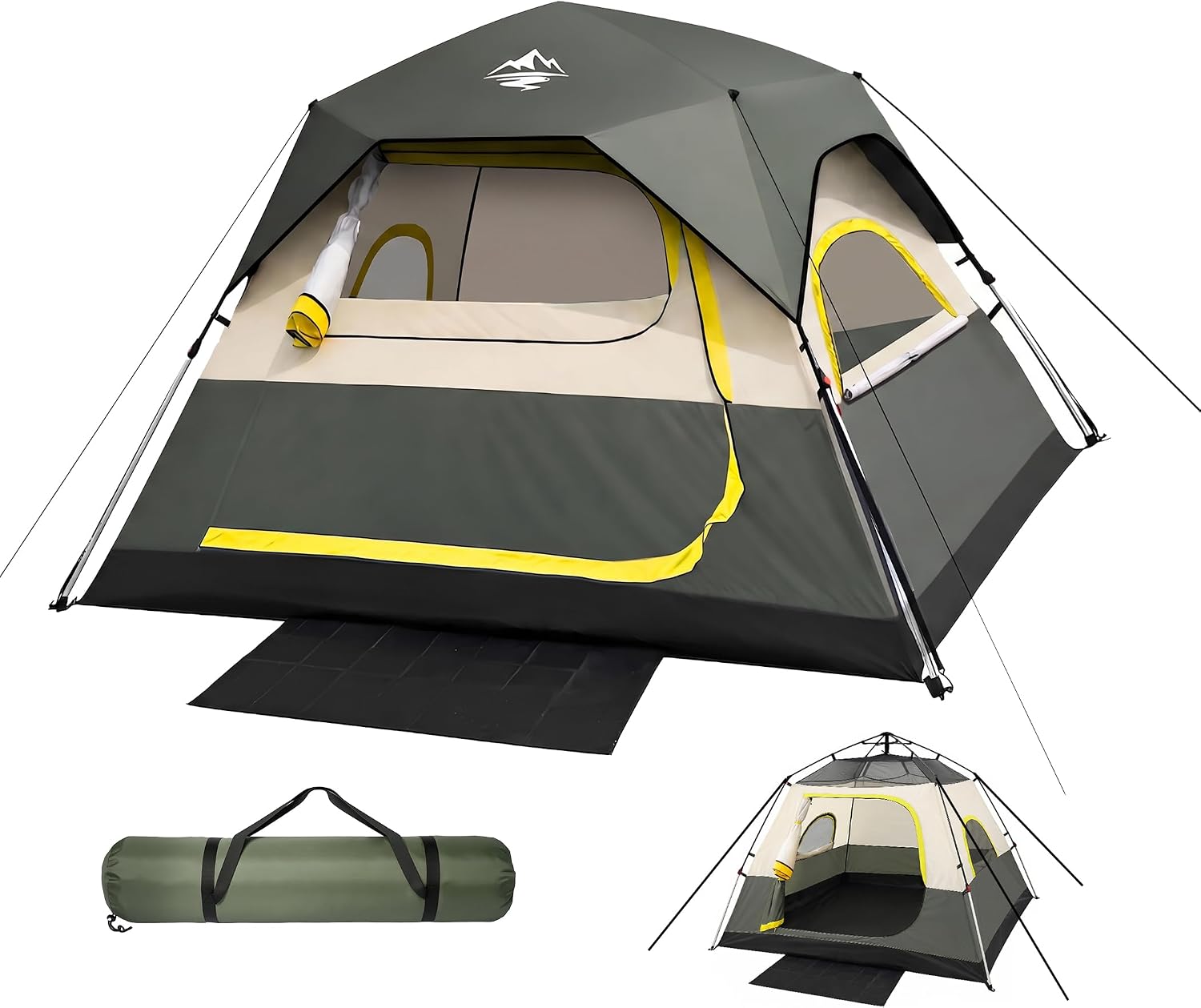 Purebox 4 Person Instant Cabin TentBest square floor planCheck price on Amazon
Amazon prices shift constantly, so no price is printed here to go stale. The price check button on each pick shows today's figure.
The Best Camping Tents Under $100
Coleman Sundome 4-Person Tent
The Sundome is the tent most families should start with. A queen air bed fits on the 9 by 7 foot floor with space left at the sides. The fly is a full separate sheet, not a small cap, and the floor seams are welded while the other seams turn inward to keep water out. Large windows and a ground vent keep air moving on warm nights. Buy it if you want the proven, no-drama option for campsite weekends. Skip it if you need to stand up to change, or if a second door matters for night-time trips out with small children.
Pros
- 9 x 7 ft floor fits a queen air bed with space at the sides
- WeatherTec system: welded floors and inverted seams
- 10-minute setup with snag-free continuous pole sleeves
- Ground vent and large windows for airflow on warm nights
Cons
- One door and no vestibule, so wet boots live inside or under the fly edge
- 59 in peak height means crouching to change clothes
- Fiberglass poles, standard at this budget but not the longest-lived
CAMPROS CP 4 Person Dome Tent
This is the cheapest proper two-wall dome here with its waterproofing given as a number. The PU 1500mm coating matches the Sundome's figure, the seams are sealed, and the wider door makes a real difference when you are wrestling an air bed in and out. The fly extends over the door to form a small vestibule, just enough for shoes and a rucksack. Buy it if the budget is the whole point and you still want a tent that reads like a tent, not a toy. Skip it if your family is tall, because 50 inches of peak height is sit-up room only.
Pros
- PU 1500mm coating, with sealed seams and a waterproof strip
- Wider door makes loading air beds and gear easier
- Small vestibule under the fly awning for shoes and bags
- Lightest of the conventional domes here at 8.2 lb
Cons
- 50 in peak height is the joint lowest among the domes
- One door only, so night exits mean climbing past sleepers
- Vestibule is small, more a doorstep than a storage room
Amazon Basics 4-Person Dome Tent
Amazon's dome has the same 63 sq ft floor as the Sundome but weighs less packed, which helps on walk-in pitches where you leave the car in the car park. The tub-style floor is welded polyethylene, the kind of groundsheet that shrugs off wet grass, and there is a back window and a cool-air port for ventilation as well as the mesh panels. Buy it if you carry your kit any distance to the pitch and want a big floor when you get there. Skip it if headroom matters, because at 48 inches this is the lowest roof in the guide.
Pros
- Full 9 x 7 ft floor at a light 8.4 lb packed weight
- Welded polyethylene tub floor for wet ground
- Back window and cool-air port alongside the mesh panels
- 6-minute assembly with snag-free pole sleeves
Cons
- 48 in peak height, the lowest in this guide
- One door and no vestibule for wet gear
- Coating figures are less detailed than some rivals here
Amazon Basics 4-Person Instant Cabin Tent
Here the poles are already joined to the tent. You unfold it, pull the legs out, and the cabin stands up. Cabin walls fall more steeply than a dome's, so the 56 sq ft floor stays usable closer to the edges, and the box includes a gear loft as well as the rainfly, stakes and carry bag. Buy it if pitching a conventional tent puts you off camping altogether. Skip it if you walk far to your pitch, because at 14.1 lb it is the joint heaviest here, and the frame makes a long carry bag.
Pros
- Pre-attached frame removes pole threading entirely
- Cabin walls keep the floor usable nearer the edges
- Gear loft, rainfly, stakes and carry bag all in the box
- 54 in peak height beats the conventional domes here
Cons
- Heaviest pick in the guide at 14.1 lb
- No hydrostatic head figure is given
- Door count is not given, so check the photos before ordering
MOON LENCE Instant Pop Up Tent 4-5 Person
No other floor here is close. At about 96 sq ft this Moon Lence is half as big again as the 4-person domes, so two adults and two children can sleep with gaps between their mats, and it pops up seconds after it leaves the bag. Four mesh windows keep it airy, and its 2000mm water resistance matches the best figures here. Buy it if space per person is your first priority and the car does the carrying. Skip it if you want doors on two sides, because one door serves this whole floor.
Pros
- Biggest floor in the guide at about 96 sq ft
- Pop-up frame pitches in seconds
- 2000mm water resistance with a 210D Oxford groundsheet
- Four mesh windows for cross-breeze on still nights
Cons
- One door for the largest tent here
- 52.4 in peak height despite the huge floor
- Pop-up frames pack into a long bag that needs boot space
HUI LINGYANG 4 Person Easy Pop Up Tent
You rarely get two doors on a pop-up at this price. It changes nights inside: children can get out on their own side, and air can move straight through when it is hot. It is also the lightest tent in the guide and carries the highest water resistance figure, 3000mm. One honest caution: the maker rates it 4 season, but a lightweight pop-up frame is a fair-weather design whatever the label says, so treat it as a spring-to-autumn tent. Buy it for festivals and summer sites where speed and airflow matter most. Skip it for exposed or cold-weather camping.
Pros
- Two doors, almost unheard of on a budget pop-up
- Lightest pick in the guide at 7.7 lb
- 3000mm water resistance, the highest figure here
- Storage pockets and a lantern hook inside
Cons
- The maker's 4-season rating is optimistic for a pop-up frame
- 6.6 ft width is the narrowest floor here
- Pop-up design packs flat and wide rather than into a small roll
CAMEL CROWN 4 Person Dome Tent
At 61 inches, this dome stands taller than anything else in the guide, and that extra headroom is what you feel every time you sit up, dress, or sort children into sleeping bags. The floor is a sensible size, the coating is 2000mm, and the fabric details are unusually specific. Treat the 4-season label the same way as the other generous ratings here: the shape and poles are fair-weather camping kit. Buy it if you are tall or simply hate crouching. Skip it if you want every detail confirmed before ordering, because no door count is given for it.
Pros
- Tallest peak in the guide at 61 in
- 2000mm PU coating, with fabric weights given
- Floor length of 98.4 in suits taller sleepers
- Conventional dome pitch that most campers already know
Cons
- You are not told how many doors it has
- 4-season rating is the maker's; the design is a fair-weather dome
- Packed weight varies, so check it before you order
MOON LENCE Pop Up Tent 3-4 Person
Festival camping rewards a tent that pitches itself and ventilates well, and this smaller Moon Lence does both. The fly is pre-attached to the pop-up frame, so the inner stays dry even if you pitch in a shower, and two ground vents pull air through when the doors are shut. The maker's 4-season label should be read as marketing; this is a warm-weather tent. It sits at the top of this guide's budget, so check the price before you commit. Buy it for festivals and one-night stops. Skip it as a main family tent, because the floor is the smallest here.
Pros
- Fly pre-attached to the frame, so pitching in rain keeps the inner dry
- Two doors and two ground vents for airflow
- Seam sealing and a 2000mm coating
- Freestanding frame you can lift and reposition
Cons
- Smallest floor in the guide at about 54 sq ft
- 49.2 in peak height, sit-up room only
- Maker's 4-season rating overstates a lightweight pop-up
LOYEAHCAMP 4 Person Blackout Camping Tent
Blackout tents exist for one reason: campsites get light early, and children wake with the sun. The dark coating on this dome keeps the inside dim well past dawn, its water resistance is a strong 3000, and at 59 inches the peak height matches the Sundome. The trade-offs are a floor at the smaller end and no packed weight given, which is worth knowing before you order. Buy it if lie-ins are the difference between a restful trip and a 5 a.m. one. Skip it if floor space for four adults is the priority.
Pros
- Blackout coating for sleeping past sunrise
- Water resistance of 3000
- 59 in peak height, joint best among the conventional domes
- Full kit in the box, including 11 stakes and 7 guylines
Cons
- Packed weight is not given anywhere
- Floor of about 54.3 sq ft is snug for four adults
- One door, and the awning is a doorstep rather than storage
Purebox 4 Person Instant Cabin Tent
Square floors are underrated. An 8 by 8 foot plan takes a queen air bed either way round and leaves a clean strip for bags, and the near-vertical cabin walls mean that space stays usable to the edges. Five feet of centre height is the best standing room in this guide alongside the tallest dome, and the frame uses aluminium in its construction, unusual at this budget. No season rating is given for it, so treat it as fair-weather kit. Buy it if you want cabin space without pole threading. Skip it if you carry your tent far from the car.
Pros
- Square 64 sq ft floor, the largest among the cabins and domes
- 5 ft centre height with near-vertical walls
- Aluminium in the pre-attached frame, rare at this budget
- Taped seams and a reinforced polyethylene floor
Cons
- 13.4 lb, and instant frames pack long
- No season rating is given
- No vestibule for wet boots and bags
What This Budget Does and Does Not Buy
This budget buys a real tent: a double-wall shelter with a separate rainfly, a waterproof coating, sealed or welded seams on the better models, and a floor your family can genuinely sleep on. What it does not buy is margin. Fabrics are thinner, poles are fiberglass rather than aluminium, zips are standard rather than heavy duty, and the waterproof figures sit at the sensible minimum for campsite rain rather than mountain weather. Two design choices decide most of what you feel on site, so it is worth understanding both before you pick.
| Point of difference | Option A | Option B |
|---|---|---|
| Wall shape | Cabin tents: near-vertical walls and 54 to 60 in of peak height, so the floor stays usable to the edges and adults can almost stand | Dome tents: sloping walls and lower peaks, but the shape sheds wind better and usually costs less |
| Pitching | Instant and pop-up frames: pre-attached poles, standing in seconds or a few minutes, kind to beginners | Traditional pole pitching: sleeves or clips and a separate fly, slower but lighter, smaller packed, and easier to repair |
| Doors | Two doors: children get their own exit and air flows straight through | One door: simpler and cheaper, but night exits mean climbing past sleepers |
| Gear storage | A vestibule: covered space for boots and bags outside the sleeping area | No vestibule: everything lives inside, or under the fly edge in the rain |
Weight deserves a plain word. The tents here run from 7.7 lb to just over 14 lb packed, which is nothing to a car boot and far too much for a rucksack carried over distance. Every pick in this guide is a car camping tent. If you are weighing a tent for walking trips against one for drive-up sites, Camping Tent vs Backpacking Tent works through the differences in weight, packed size and floor space.
Also considered
UNP 4-Person Cabin Tent: a tall cabin with a 3-minute setup for two people, but the freshest price we could verify had moved over this guide's budget.
Coleman Skydome 4-Person: a strong design with pre-attached poles, but the prices we could verify for it conflicted between variants, and the clearest reads sat over budget.
Coleman Sundome 6-Person: the bigger Sundome would suit larger families, but Amazon copies showed no available featured offer at research time and other retailers priced it over budget.
AYAMAYA 6 Person Easy Pop Up Tent: a genuinely spacious pop-up with a vestibule and porch, but its Amazon listing showed no featured offers available when we checked.
Eureka! Tetragon NX 4: a well-specified dome from a long-standing maker, but we could not verify an Amazon price for it, so it cannot anchor a budget guide.
Who this guide is for
Family camping
If your trips are two adults and children on a booked pitch, start with floor area and doors, not the person number on the box. The Coleman Sundome 4 and the Amazon Basics dome give you 63 sq ft to spread mats and bags across, and the big MOON LENCE pop-up nearly doubles the elbow room if the car is doing the carrying. Everything here assumes a car nearby, a kettle on a stove, and no need to carry the tent further than the length of the car park.
Beginners
First-time campers give up on tents that fight back at pitching time, so the instant and pop-up models earn their place here. The Amazon Basics instant cabin and the Purebox remove pole threading altogether, and both Moon Lence models pitch from a pre-attached frame. Traditional domes such as the Sundome and the CAMPROS are still simple, two poles and a fly, and they teach you how tents work, which pays off when something needs re-pegging at midnight.
Festival camping
Festival fields reward speed, airflow and a tent you can find in the dark. The MOON LENCE 3-4 person and the HUI LINGYANG both pitch in seconds, open on two sides for air, and pack flat behind the seats. The blackout LOYEAHCAMP is the wildcard: on a field where the music ends late and the sun rises early, a dark interior is worth more than extra floor.
What to look for when buying a camping tent
Floor dimensions first. The person rating is a maximum, not a comfort figure. Look at the length and width in feet, multiply them for floor area, and compare that against the mats or air beds you actually own. A queen air bed needs roughly 60 by 80 inches of clear floor, which several tents here only just provide.
Peak height. Anything under 50 inches is crawl-and-sit space. Heights of 54 inches and above let you dress sitting up comfortably, and the tallest models here, at 60 and 61 inches, let shorter adults nearly stand. Cabin walls keep height usable nearer the edges; dome height exists only at the centre line.
Waterproofing. Look for a coating figure in millimetres, and for seam sealing, taped seams or welded floors. A number with no seam treatment behind it is half a claim.
Doors and ventilation. Two doors transform night-time exits and hot nights, but they are rare at this budget. Otherwise, check for mesh panels, windows that open, and ground vents, because a sealed budget tent in summer sun becomes a greenhouse by breakfast.
Poles and pitching. Fiberglass poles are the budget standard: adequate, heavier than aluminium, and the first thing to budget a repair for. Sleeves are snag-free and forgiving; clips are faster. Instant frames remove the work but add weight, packed length, and a mechanism you cannot easily mend in a field.
For the complete walk-through of sizes, seasons and materials, read How to Choose a Camping Tent.
Camping Tent Sizes and Capacity
Here is the honest arithmetic behind every tent box. A maker's capacity rating assumes sleeping pads laid shoulder to shoulder, edge to edge, with nothing else in the tent: no bags, no rucksacks, no elbow room, no child who sleeps like a starfish. A standard pad is about 20 inches wide and a wide one about 25 inches, so four adults on pads need 80 to 100 inches of clear width before anyone stores so much as a water bottle.
Read the floor instead. The tents in this guide offer between about 54 and 96 sq ft, which works out at roughly 13 to 24 sq ft per person at full rated capacity. As a working rule, a 4-person tent sleeps two adults in real comfort, two adults and one or two small children happily, and four adults only if everyone travels light and likes each other. If your family is four full-size people plus kit, you will be happier in a 6-person model outside this budget, and the sizes section of the hub explains the step up.
Length matters as much as width. Sleepers over six feet should look for a floor at least 96 inches long, which rules out the shortest floors here once a pillow takes its share. Peak height is the last number to check: it is measured at the single highest point, and dome walls fall away quickly, so the usable standing or sitting zone is always smaller than the figure suggests.
How much does a good camping tent cost
Tent prices climb in steps, and each step buys something specific rather than something vague. At this guide's level you get honest campsite shelter: polyester fabrics, fiberglass poles, coatings in the 1500mm to 3000mm range, and floors big enough for a family. The next step up buys aluminium poles, tougher floor fabrics, better zips, two doors as standard and vestibules you can actually cook under. Beyond that you are paying for lighter materials, stronger wind performance, brand warranties with real stock behind them, and details like colour-coded clips that only matter on your fiftieth pitch.
The running costs are modest but real. Budget for a footprint or groundsheet tarp to protect the floor, a mallet and better pegs than the wire ones in most bags, seam sealer for the day the coating ages, and replacement pole sections eventually. None of it is expensive individually, and together it decides whether a budget tent lasts two summers or six.
If your family camps often enough that durability and space move up the list, the step-up models are gathered in Best Camping Tent for Family Camping, which covers the wider family range beyond this budget.
Common mistakes when buying a camping tent
Trusting the person number. The single most common budget tent mistake. A 4-person rating means four pads fit, not that four people sleep well. Buy on floor dimensions, as the sizes section above explains, and let the number on the box be a ceiling rather than a plan.
Ignoring packed weight and bag size. Instant and pop-up frames are wonderful on site and awkward in a small boot. Check the packed length against your car before you fall for a 50-second pitch.
Leaving the fly off on a clear evening. Dew soaks an unprotected inner as surely as rain, and mesh ceilings under open sky collect it all night. Pitch the fly even when the forecast smiles.
Packing the tent away damp. This is the fastest way to ruin any tent at any price: mildew blooms in days, coatings turn sticky, and the smell never quite leaves. Always dry a tent fully at home after a wet trip, and if yours is already musty, How to Clean Camping Tent explains how to rescue it safely.
Skipping the garden pitch. Every tent here is easier the second time. A practice pitch at home finds the missing peg bag, the confusing sleeve, and the pole that needs two people, while the stakes are low and the kettle is near.
Buying for the one exceptional trip. A tent bought for a single festival in a heatwave then used for autumn weekends will disappoint in one direction or the other. Buy for your typical trip, and hire or borrow for the extremes.
Budget Camping Tent Pros and Cons
Pros
- A family of four can be under a real roof for the cost of one or two nights in a budget hotel room
- Waterproof coatings, sealed seams and full rainflies are now normal at this level, not upgrades
- Instant and pop-up frames have removed the worst beginner friction from pitching
- Floors of 54 to 96 sq ft cover everything from festival pairs to families with young children
- Replacement parts, groundsheets and repair kits are cheap and widely available
Cons
- Fiberglass poles and standard zips are wear items; expect repairs or replacement within a few seasons of regular use
- Capacity ratings flatter every tent here, so the usable size is always smaller than the box suggests
- One door and no vestibule is the norm, which family campers feel on every wet night
- Waterproof ratings suit campsite rain, not prolonged storms or exposed sites
- Season labels are optimistic on several models, and none of these is a winter tent
Who should not buy a camping tent
Some campers should walk past this whole category. Backpackers and wild campers need shelters a fraction of these weights and packed sizes, and should look at backpacking tents instead. Anyone camping in winter, at altitude, or on exposed coasts needs a tent built and rated for those conditions, with stronger poles and fabrics than this budget allows. Families of five or six full-size people will find even the largest floor here a squeeze at full stretch, and should size up beyond this guide. And if you camp once a year at most, honestly consider borrowing or hiring: a budget tent that lives damp in a garage between rare trips may not survive to its third outing.
Best Camping Tent Under $100: Frequently Asked Questions
Is a cheap camping tent worth it under $100?
For campsite camping in spring, summer and early autumn, yes. The better tents in this guide pair a waterproof coating with sealed or welded seams and a proper rainfly, which is the combination that actually keeps a family dry. What you are not buying is longevity insurance or storm performance. If your trips are a handful of weekends a year on booked sites, a budget tent is a rational purchase rather than a compromise, provided you choose on floor size and waterproofing rather than on the person rating.
Which camping tent features do you still get under $100?
More than you might expect: full rainflies, mesh windows and vents, storage pockets and lantern hooks, gear lofts on some models, blackout coatings, and pop-up or instant frames that pitch in seconds. Two models here have a 3000mm water resistance figure, and the largest floor in the guide is about 96 sq ft. The features that mostly disappear at this level are second doors, roomy vestibules, aluminium poles and brand-name zips.
What do you give up with a budget camping tent?
Mainly durability and refinement. Fiberglass poles flex more and age faster than aluminium, fabrics are thinner, zips are standard grade, and waterproof coatings start at the sensible minimum for campsite rain. You also give up space per person, because budget ranges top out at smaller floor plans, and you give up warranty depth: support exists, but it is not the decades-long backing the premium makers advertise. None of that matters on a calm weekend; all of it matters across five hard seasons.
How can you spot a bad cheap camping tent?
Start with the listing itself. No stated waterproof figure, or a figure with no mention of seam sealing, is a warning. So is a capacity claim with no floor dimensions, a single-wall design sold as rain-ready, and a rainfly that is clearly a small cap rather than full coverage. Photographs that never show the tent pitched from the side, and specifications that change between the title and the details table, are the other classic tells. Every tent in this guide clears those checks.
How long does a budget camping tent last?
Used a few weekends a year and stored bone dry, a budget tent should give you several seasons of family trips. The usual failure order is zips first, then fiberglass pole sections, then the waterproof coating as it ages and turns tacky. You can stretch the lifespan a lot with unglamorous habits: dry it fully after every trip, keep it out of damp garages, re-proof the fly when water stops beading, and never force a stiff zip. Stored damp, the same tent can be ruined in a single winter.
Keep researching this camping tent
The wider family camping range in one place, including larger tents and step-up models beyond this budget.
ComparisonCamping Tent vs Backpacking TentWeight, packed size and floor space compared, so you can see which style of tent your trips actually need.
How to ChooseHow to Choose a Camping TentSizes, seasons, materials and pole types explained in order, with the checks to run before you order any tent.
Use & CareHow to Clean Camping TentHow to wash, dry and store a tent so the coating, seams and zips survive from one season to the next.
More in Outdoors & Camping
Outdoors & CampingAll Pick Hearth guides in this categoryHow we check camping tents like these
Read the full Pick Hearth methodology- We check every pick against its own Amazon listing, and we only include tents whose own listing rates them at four people or more, or sells them as family tents with the floor space to match.
- We take every specification from the maker's published figures: capacity, floor dimensions, peak height, packed weight, season rating and waterproof wording, and where a listing leaves a figure unstated, the card says so rather than guessing.
- We quote waterproof performance only in the maker's own terms, whether that is a coating figure in millimetres, seam sealing, or a named system, and we flag maker ratings that read optimistically against the design.
First published · Updated in place as products and specs change