Our top picks at a glance
Start with the honest part, because it decides everything else in this guide. Nine of the ten machines below are 120V AC appliances. In an RV they run on shore power, on a generator, or on an inverter big enough for their wattage, and an inverter also drains the battery bank while it works. Exactly one pick, the Silonn 4-Power, can also run directly from a 12V or 24V socket. If a listing for any other machine hints at car or battery use, treat that as marketing for carrying it along, not as a power option.
Within that limit, the field splits cleanly. The bullet ice machines are light, mostly 13 to 17 lb, draw between about 100 and 200 watts, and make their first batch in 6 to 8 minutes. They do not keep ice frozen: the basket is insulated, not refrigerated, so ice melts slowly and the meltwater runs back into the tank to be made into ice again. The one nugget machine, the GE Profile Opal 2.0, makes soft chewable ice people cross a site for, but it weighs 38 lb, stands 16.5 in tall and draws around 300 watts, which is a shore power appliance in all but name. Our first choice for most RVs is the Igloo ICEB26HN, because its 105 watt draw is the gentlest here on an inverter, its 2 quart tank is among the largest in the bullet group, and a carry handle makes the travel day move simple.
The working rule: size the machine to your power first, your counter second and your ice habit third. A machine you can only run at hookups is still useful, but buy it knowing that is the deal.
 Igloo ICEB26HNBest overall for most RVsCheck price on Amazon
 Silonn 4-Power Ice MakerBest for off-grid powerCheck price on Amazon
 Frigidaire EFIC189Best for fewer refillsCheck price on Amazon
 Euhomy Countertop Ice MakerBest low heightCheck price on Amazon
 Silonn SLIM21BBest compact footprintCheck price on Amazon
 NewAir NIM026Best for fuss-free controlsCheck price on Amazon
 Costway Countertop Ice MakerBest low power drawCheck price on Amazon
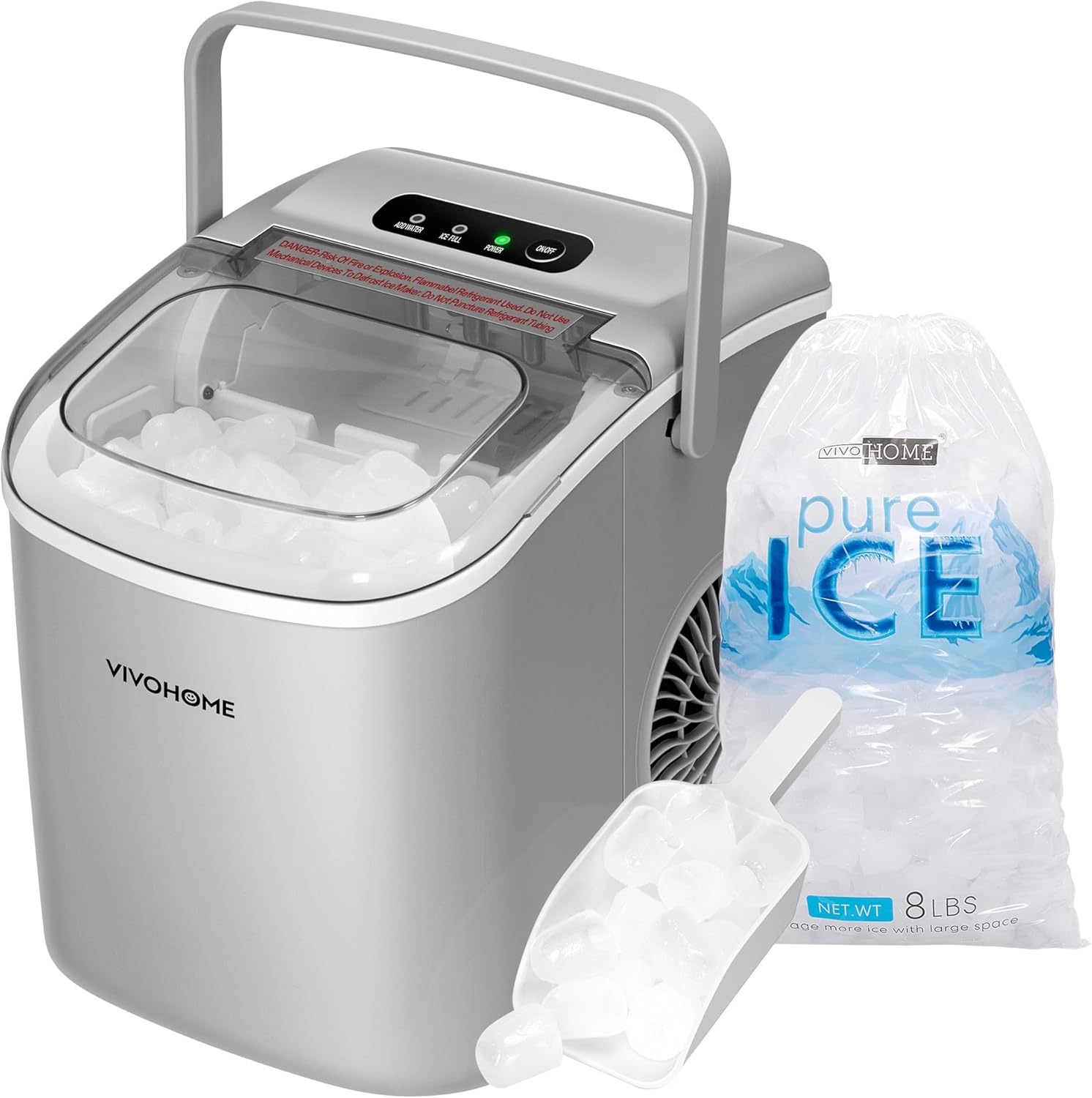 VIVOHOME Countertop Ice MakerBest for batching aheadCheck price on Amazon
 Iceman Dual-Size Ice MakerBest for one or two peopleCheck price on Amazon
 GE Profile Opal 2.0Best high endCheck price on Amazon
Prices move up and down on Amazon, so we never print a price here that could be stale by the time you read it. Use the price check button to see the current price.
The Best Countertop Ice Makers for RV
Igloo ICEB26HN
The Igloo earns the top spot on power manners. It runs on 120V AC at 105 watts and 1.7 amps, the lightest draw in this guide alongside the Costway, so a modest inverter handles it without drama and a battery bank feels it less per batch. The water tank holds 2 quarts, the basket holds 1.25 lb of ice, and the rated output is 26 lb of bullet ice per day, with 9 cubes ready in about 7 minutes in a choice of small or large. It measures 12.2 in deep, 9.06 in wide and 12.8 in tall, weighs about 16.5 lb, and the carry handle plus a five cycle self-cleaning routine suit a machine that gets moved and stored often. Buy it if you want one machine that works at hookups and, within your inverter limits, away from them too. Skip it if you want ice kept frozen in the machine, because the basket only insulates and meltwater recycles into the tank.
Pros
- 105 watt draw is gentle on inverters and battery banks
- 2 quart tank, the joint largest among the compact bullet picks
- Carry handle and self-cleaning routine suit a machine that travels
- Two bullet sizes, with the first 9 cubes ready in about 7 minutes
Cons
- 120V AC only, so off-grid use always means an inverter or generator
- Basket holds 1.25 lb, so a group empties it faster than the machine refills it
- At 12.8 in tall plus lid room, low RV cabinets still need measuring
Silonn 4-Power Ice Maker
This is the one machine in the guide built around the way RVs actually store power. It accepts four power inputs: 12V and 24V vehicle power as well as 100 to 240V AC, so it can make ice from the vehicle system on a driving day or from a campsite hookup without an inverter in between. Output is rated at 22 lb of bullet ice per day, the lowest rating here, with 9 cubes ready in about 6 minutes, and a self-cleaning cycle is built in. That trade is the whole point: you give up some daily output and gain the only genuine off-grid route in this list. Buy it if you boondock, drive long days between stops, or simply refuse to size an inverter around an ice maker. Skip it if your ice habit is a crowd habit, because 22 lb a day and a small basket run out fast at a group site.
Pros
- Runs on 12V and 24V vehicle power as well as household AC
- First batch of 9 cubes in about 6 minutes
- Self-cleaning cycle helps on trips with limited fresh water for scrubbing
- No inverter needed on vehicle power, which saves battery conversion losses
Cons
- Rated output of 22 lb per day is the lowest in this guide
- Vehicle power still drains the battery it draws from, so parked use needs a plan
- Newer model with a shorter track record than the long-running bullet machines
Frigidaire EFIC189
The Frigidaire case is water storage. Its reservoir holds 2.3 quarts and the bin holds 1.5 lb of finished ice, both at the generous end for a compact bullet machine, so it needs less topping up across an afternoon than the 1.2 litre machines below. It makes 9 bullet cubes per cycle in a choice of two sizes, is rated at 26 lb per day, and a large viewing window lets you check the basket without lifting the lid and letting the cold out. Published figures for this model family vary between sources, including the power rating and the outer dimensions, so measure your counter and confirm the figures on the product page before ordering. Buy it if your RV counter has the room and your habit is steady drinks for two to four people at a serviced site. Skip it if every inch and every pound matters, because smaller and lighter picks below do the same job in less space.
Pros
- 2.3 quart reservoir and 1.5 lb bin mean fewer refills and fewer emptying trips
- Two bullet sizes from a simple control panel
- Large viewing window for checking ice without opening the lid
- Rated at 26 lb per day, in line with the strongest bullet picks
Cons
- One of the larger footprints among the bullet machines here
- No self-cleaning cycle, so the reservoir is a hand wash job
- Published dimensions and power figures vary, so verify them before ordering
Euhomy Countertop Ice Maker
Height is the quiet killer in RV kitchens, where the counter often sits under a shallow cabinet or a bunk. This Euhomy stands 11.57 in tall, the lowest profile in the guide alongside its near twins, on a body 11.42 in deep and 8.74 in wide that weighs 12.9 lb. It draws 170 watts on 115V, holds 1.2 litres of water, keeps 1.3 lb of ice in the basket, and is rated at 26 lb of bullet ice per day with the first 9 cubes in about 6 minutes. A carry handle and a self-cleaning cycle round out a machine that is easy to lift down, run, clean and stow. Buy it if your counter clearance is tight and you want a light machine one person can move without thinking. Skip it if you hate refilling, because the 1.2 litre tank is the small end of this guide.
Pros
- 11.57 in tall, a fit where taller machines foul the cabinet above
- Light at 12.9 lb, with a handle for moving and stowing
- First 9 bullet cubes in about 6 minutes, two sizes
- Self-cleaning cycle for low-effort upkeep between trips
Cons
- 1.2 litre tank needs regular refills on a busy day
- 170 watt draw is mid-pack, not the gentlest on an inverter
- Basket holds 1.3 lb, so batch into the fridge freezer for a group
Silonn SLIM21B
The SLIM21B is the smallest full-strength bullet machine here. It measures 8.7 in by 11.4 in with a height of 11.6 in, weighs 13.7 lb, and still carries a working power rating of up to 160 watts on 115V, a 1.2 litre reservoir and a 1.32 lb basket. Output is rated at 26 lb per day, the first 9 cubes land in about 6 minutes in two sizes, and a self-cleaning cycle and carry handle are both fitted. In a camper van or a small trailer where the counter is also the prep area, that footprint is the difference between a machine that lives out and one that lives in a locker. Buy it if counter area, not output, is your binding limit. Skip it if you run it all day on a small battery bank, because 160 watts for hours is a real draw.
Pros
- Smallest footprint in this guide at 8.7 in by 11.4 in
- Full 26 lb per day rating despite the compact body
- Carry handle and self-cleaning cycle fitted as standard
- 13.7 lb, easy to secure or stow for travel days
Cons
- 1.2 litre reservoir means frequent refills at full output
- Up to 160 watts, so inverter sizing still matters
- Small basket at 1.32 lb needs emptying into the freezer as you go
NewAir NIM026
The NewAir keeps operation down to two buttons: power and ice size. It measures 12.32 in deep, 8.74 in wide and 12.6 in tall, weighs 15.62 lb, runs on 115V with an ice-making current of 1.7 amps, and holds 0.6 gallons of water with a 1.5 lb storage basket. Output is rated at 26 lb of bullet ice per day with a fresh batch in about 7 minutes, the parts that touch ice and water are BPA free, and the official NIM026 product page and manual set out the ETL certification and the full specification. There is no self-cleaning cycle, which is the honest cost of the simple design. Buy it if you want the least to learn and a maker with a real support desk behind it. Skip it if you want the machine to flush itself clean, because this one is rinsed by hand.
Pros
- Two-button control, the simplest routine in this guide
- 0.6 gallon reservoir and 1.5 lb basket, generous for its size
- BPA free parts and ETL certification
- Batch of bullet ice in about 7 minutes, two sizes
Cons
- No self-cleaning function, so upkeep is manual
- 15.62 lb, mid-weight for a compact bullet machine
- 120V class power only, so off-grid use needs an inverter
Costway Countertop Ice Maker
Power is the Costway headline. Its rated power is 100.3 watts on 115V, the lowest figure in this guide, which makes it the easiest bullet machine to feed from a small inverter for short runs. The body is compact at 8.7 in wide, 11.4 in deep and 11.6 in tall, weighs 13.4 lb, stores 1.3 lb of ice, and is rated at 26.5 lb per day, with 9 cubes taking 6 to 13 minutes depending on the size chosen. A handle, a self-cleaning cycle that runs for 30 minutes, and ice full and add water indicators complete a travel-friendly package. Buy it if your inverter is small and your ice sessions are short and deliberate. Skip it if you want the fastest first batch, because the larger cube setting is the slow end of this guide.
Pros
- 100.3 watt rated power, the lowest draw here
- Compact 8.7 in wide body at 13.4 lb, with a carry handle
- Rated at 26.5 lb per day, the highest bullet rating in the guide
- Self-cleaning cycle and clear ice full and add water indicators
Cons
- Cycle time stretches to 13 minutes on the large setting
- Storage holds 1.3 lb, so plan freezer transfers for groups
- 120V class power only, despite the gentle wattage
VIVOHOME Countertop Ice Maker
The VIVOHOME is built for the make-ahead habit: run it at a hookup, bag the ice, and fill the RV freezer before a dry stretch. It ships with 10 ice bags and a scoop alongside the basket, measures 11.6 in deep, 8.7 in wide and 11.4 in tall, and weighs 13.7 lb with a carry handle. Output is rated at 26 lb of bullet ice per day, with 9 cubes in 6 to 13 minutes, a transparent window for checking progress, and a self-cleaning cycle started by holding the power button. Buy it if your pattern is batch at the serviced site, then coast on freezer ice. Skip it if you want ice on demand all day from the machine alone, because like every pick here it does not freeze what it stores.
Pros
- 10 ice bags included for moving batches into the RV freezer
- Low 11.4 in height suits shallow RV cabinets
- Self-cleaning cycle and a window for checking the basket
- Light at 13.7 lb with a carry handle
Cons
- Cycle time runs to 13 minutes on slower settings
- Bagging and freezing is a routine you have to keep
- 120V class power only, so batching needs hookups, a generator or an inverter
Iceman Dual-Size Ice Maker
Solo travellers and couples do not need 26 lb of ice a day, and this Iceman by Chefman machine is sized to that truth. It runs on 120V at 120 watts, holds 1.2 litres of water, stores 0.88 lb of ice, and is rated at 22 lb per day, with each cycle making 9 round bullet pieces in 7 to 15 minutes in a choice of large or small. A self-cleaning cycle, a viewing window and a bottom drain plug make the weekly clean simple, and Chefman covers the machine with a 1-year assurance. Buy it if your crew is one or two and your counter is small, and you would rather have a gentle power draw than a big daily rating. Skip it for family sites, because the small basket and the slower cycle will not keep up.
Pros
- 120 watt draw suits short inverter runs
- Smallest storage and tank here, matched to one or two drinkers
- Bottom drain plug makes emptying and winterising simpler
- Self-cleaning cycle and a 1-year assurance from Chefman
Cons
- Rated at 22 lb per day, with cycles up to 15 minutes
- Basket holds only 0.88 lb of ice at a time
- Needs 6 in of clearance on all sides, which eats into its small size advantage
GE Profile Opal 2.0
The Opal 2.0 is a different species from the nine bullet machines above. It makes nugget ice, the soft chewable pellets formed from compacted flakes, at a rated 38 lb per day and about 1.6 lb per hour, with the first nuggets ready in around 10 minutes and a bin that holds 3 lb. The version here carries a 0.75 gallon side tank, WiFi control through the SmartHQ app, and a scale inhibiting filter, and the official Opal 2.0 specifications confirm the 3 lb bin and the daily rating. The RV cost is real: 17.5 in deep, 13.43 in wide with the side tank and 16.5 in tall, 38 lb on the counter, and a draw of about 2.5 amps on 120V, roughly 300 watts. Buy it if nugget ice is the point, your rig is large, and your stops are serviced. Skip it for small campers, small inverters and any counter under low cabinets.
Pros
- Nugget ice, soft and chewable, unlike any bullet pick here
- Rated at 38 lb per day with a 3 lb bin, the largest storage in the guide
- 0.75 gallon side tank cuts refills on long stays
- WiFi scheduling and a scale inhibiting filter for hard water sites
Cons
- 38 lb and 16.5 in tall, a permanent installation in most RVs
- Around 300 watts, so it is a shore power machine in practice
- Needs securing for travel, and its size leaves little counter for prep
Power first: where these machines split for RV use
Two decisions explain nearly every difference above. The first is where the power comes from. Shore power and generators feed all ten machines happily. An inverter changes the maths: it must cover the running wattage with headroom for the compressor start, and every hour of ice making comes out of the battery bank. At 105 to 120 watts, the Igloo, the Costway and the Iceman sip by appliance standards. At 160 to 200 watts, the Silonn SLIM21B, the Euhomy and the Frigidaire are still reasonable for planned sessions. At roughly 300 watts, the Opal 2.0 belongs on shore power. The Silonn 4-Power steps outside this table entirely by running on 12V or 24V vehicle power, which is why it sits second in this guide despite the lowest output rating.
| Point of difference | Gentle on RV power | Shore power first |
|---|---|---|
| Running draw | About 100 to 120 watts | Around 300 watts |
| Inverter need | A small inverter covers short sessions | A large inverter and a large battery bank |
| Ice type | Bullet ice in two sizes | Nugget ice, soft and chewable |
| Typical picks here | Igloo ICEB26HN, Costway Countertop Ice Maker, Iceman Dual-Size Ice Maker | GE Profile Opal 2.0 |
The second decision is what happens to the ice after it is made, and it is the same fork covered by countertop ice maker vs fridge ice maker: a fridge ice maker stores ice in a freezer, while every countertop machine here stores it in an insulated basket where it melts slowly and the water is recycled into new ice. In an RV that means the countertop machine is a producer, not a store. The winning habit is to run it while power is plentiful, then move finished ice into the RV freezer in bags, which is exactly the routine the VIVOHOME bundle is built around.
Bullet or nugget is the third split, and it is simpler than it looks. Bullet ice is fast, cheap to make and fine in any drink, and nine of the ten picks make it. Nugget ice is the one people seek out for its soft chew, and only the Opal makes it here, at a heavy cost in weight, height and watts. Choose nugget only if the ice itself is the treat.
Also considered
- Antarctic Star Nugget Ice Maker: a countertop nugget machine rated at 35 lb per day with a first batch in 6 to 8 minutes and a handle for moving it. It missed the ten because the Opal 2.0 covers the nugget intent with a larger bin and a side tank, and a second nugget machine would have pushed out a lighter bullet pick that suits more RVs.
- Costway Countertop Nugget Ice Maker: a nugget machine rated at 44 lb per day with a pull-out 1.8 litre tank, at 24.2 lb and 14.8 in tall. It missed the ten because that weight and height are a poor trade in a moving vehicle, and its bullet sibling above draws far less power.
- Frigidaire EFIC206: the same compact Frigidaire family as the EFIC189, rated at 26 lb per day with a see-through lid. It missed the ten because it shares its listing family and specification with pick 3, so it cannot stand as a separate verified pick, and the EFIC189 above carries the larger documented reservoir.
- NewAir AI-100: the long-running NewAir bullet machine, rated at 28 lb per day with three ice sizes. It missed the ten because it weighs 24.3 lb, has no self-cleaning function, and the NIM026 above covers the NewAir intent at two thirds of the weight.
- hOmeLabs Countertop Nugget Ice Maker: a stainless nugget machine rated at 44 lb per day with a touch screen. It missed the ten because that output class belongs on a fixed home counter, and between it and the Opal, the Opal is the nugget machine with the side tank and filter that long stays reward.
Who this guide is for
Full-time RVers and long-stay travellers
You live with your power budget, not around it. Favour a gentle draw and a big tank: the Igloo at 105 watts with a 2 quart tank, the Frigidaire for fewer refills, and the Opal only if your stays are serviced and nugget ice is a genuine daily pleasure rather than a novelty.
Weekenders and hookup campers
Your trips run on shore power, so wattage matters less than speed and convenience. Any bullet pick here will serve you, and the self-cleaning models, the Euhomy, the Silonn SLIM21B and the Costway, keep the Sunday pack-up simple.
Small campers, vans and tight counters
Your counter is also your prep space and your storage is spoken for. The Silonn SLIM21B and the Costway have the smallest footprints, the Euhomy and the VIVOHOME the lowest heights, and the Silonn 4-Power removes the inverter question entirely for van power systems.
Small counters beyond the RV
The same small-counter logic serves dorm rooms and small apartments, the other settings these compact machines are sold for. If your limit is a strip of counter beside a sink and a shared socket, the compact bullet picks apply unchanged, with no travel securing to think about.
What to look for when buying a countertop ice maker for an RV
The full framework sits in how to choose a countertop ice maker. For an RV buyer, these five points do most of the work.
- Power source, answered honestly: check the voltage before anything else. A 120V machine needs shore power, a generator or an inverter sized above its running wattage, and only a machine with a genuine 12V input runs from the vehicle system directly.
- Running wattage against your battery bank: 100 watts for an hour is a snack for a large bank and a meal for a small one. Add up your planned ice sessions alongside the fridge, lights and fans the bank already feeds.
- Height under your cabinets, with the lid open: most bullet picks stand 11.4 to 12.9 in tall, and the lid needs room above that to open and to fill the tank. The Opal at 16.5 in tall fails many RV counters on this point alone.
- Weight you can secure: a 13 lb machine can be strapped, boxed or stowed for a travel day. A 38 lb machine is furniture, and it needs a permanent, secured home.
- Tank size against your water discipline: tanks here run from 1.2 litres to 0.75 gallons. A bigger tank means fewer refills and more carried weight, and every litre in the tank is a litre of your fresh water supply.
Countertop ice maker sizes and capacity for RV counters
Capacity on these machines means three different numbers, and only one of them is the size of a drink session. The daily rating is output across a full day of continuous running under mild conditions, so treat it as a ceiling, not a promise. The basket size is what you can actually serve at once, between 0.88 lb and 3 lb here. The tank size decides how often you refill.
- Compact bullet machines (about 8.7 in wide, 11.4 to 12.9 in tall, 13 to 17 lb): nine of the ten picks live here. Tanks of 1.2 litres to 2.3 quarts, baskets of about 1.3 to 1.5 lb, rated output of 22 to 26.5 lb per day. Honest for two to four drinkers who transfer ice to the freezer as it is made.
- The nugget machine (17.5 in deep, 13.43 in wide with its side tank, 16.5 in tall, 38 lb): the Opal 2.0. A 3 lb bin and a rated 38 lb per day, earned at the cost of a permanent counter home and shore power habits.
Depth is the dimension RV buyers misjudge. Counters in campers are shallower than kitchen counters, and several picks here are 12 in or more deep before you leave room for the lid and the power cord. Measure the counter front to back, then measure again with the machine's ventilation clearance in mind, because these machines breathe through side and rear vents that should not sit flush against a wall.
How much does a good countertop ice maker cost?
Printed prices would be stale within the month, so this section covers the features that set them instead. Ice type is the first: bullet machines are simple mould-and-release designs and sit at the accessible end, while a nugget machine forms ice by scraping and compacting flakes, and that mechanism is what the high end of this guide charges for. Power flexibility is the second: the one machine here that runs on vehicle power as well as mains carries a premium over its bullet output alone.
The hidden third driver is the power system behind the machine. A 120V ice maker bought for off-grid use may also need an inverter, or a larger one than the rig already carries, and that cost belongs in the comparison from the start. Self-cleaning cycles, side tanks and filters add smaller amounts. Readers shopping at the tight end should read best countertop ice maker under 50 alongside this guide, and expect the machines there to be small-tanked bullet models with the same insulated basket behaviour.
Common mistakes when buying a countertop ice maker for an RV
- Assuming it runs on 12V because it is sold for RVs: almost none do. Portable in this category means light enough to carry, and the power is 120V AC unless a 12V input is a headline feature, as it is on exactly one pick here.
- Expecting the basket to keep ice frozen: the basket is insulated, not refrigerated. Ice left in it melts and recycles, which is fine across an afternoon and useless across a weekend. Bag finished ice into the freezer instead, and work through countertop ice maker problems and how to fix them when output drops or the machine stops mid-cycle.
- Buying on the daily rating alone: a rating of 26 lb assumes a full day of running in mild conditions with the basket emptied as it fills. Heat, a small basket and a small tank all cut what you actually get.
- Travelling with water in the tank: a full tank sloshes, adds moving weight and can leak into the machine. Drain it before a travel day, secure the machine itself, and let it stand upright for a while after a rough road before switching it on.
- Skipping the clean cycle until the ice tastes stale: RV water sits in tanks and lines, and scale and biofilm build in a warm machine. Run the self-cleaning cycle or a hand clean regularly, drain the machine fully before storage, and dry it with the lid open so it does not sit damp between trips.
Countertop ice maker pros and cons for RV use
Pros
- Fresh ice in 6 to 10 minutes beats a fridge tray overnight and a camp store run in the heat
- No plumbing and no water line: fill the tank and the machine does the rest
- Small bullet models draw little enough power for planned inverter sessions
- Ice on demand frees the small RV freezer for food
Cons
- Nearly all models are 120V AC, so off-grid ice costs inverter capacity and battery charge
- No countertop machine keeps ice frozen; it produces, it does not store
- Counter space, height clearance and travel securing are real costs in a small rig
- Tanks and lines need regular cleaning and full draining before storage
Who should not buy a countertop ice maker
If your trips are mostly dry camping on a small battery bank with no inverter, a countertop ice maker will sit unused or drain the power your fridge needs, and bagged ice plus a good cooler is the honest answer. If your RV freezer already keeps up with your drinks, the machine is counter space spent on a problem you do not have. And if nobody will drain it, clean it and secure it on travel days, skip it: a neglected machine in a hot, closed-up RV grows stale fast, and a loose 15 lb appliance on a moving counter helps nobody.
Countertop Ice Maker for RV: Frequently Asked Questions
What should I look for first when buying a countertop ice maker for an RV?
Power, before ice. Confirm whether the machine runs on 120V AC only or also accepts 12V vehicle power, then match its running wattage to your shore power, generator or inverter setup. Height under your cabinets and the weight you can secure come next, because a machine that fails either test never gets used.
What size countertop ice maker suits an RV?
For most rigs, a compact bullet machine around 9 in wide and under 13 in tall, with a basket of about 1.3 lb and a rated output near 26 lb per day. That size serves two to four drinkers if you move finished ice into the freezer as it is made. Larger machines suit large rigs on serviced sites, not small campers.
How much does a good countertop ice maker cost?
Cost follows ice type, power flexibility and build rather than output alone. Bullet machines cluster at the accessible end, the dual-power machine charges for its vehicle power inputs, and a nugget machine sits at the top because its ice-forming mechanism is more complex. An inverter bought to run one belongs in the total too. The cost section above works through the same drivers in detail.
What is the most common mistake when buying a countertop ice maker for an RV?
Assuming it will run from the 12V system because it is marketed for camping and RVs. Nearly every machine in this category is a 120V AC appliance, and the second mistake follows from the first: expecting its insulated basket to keep ice frozen like a freezer. It produces ice; your freezer stores it.
Is a high end countertop ice maker worth it in an RV?
Only in the right rig. A high end nugget machine earns its place in a large RV on serviced sites, where its weight, height and roughly 300 watt draw stop mattering and the chewable ice is a daily pleasure. In a small camper or an off-grid setup, the same money buys a gentle bullet machine and the inverter headroom to run it.
Who should not buy a countertop ice maker at all?
Dry campers on small battery banks without an inverter, travellers whose RV freezer already covers their ice habit, and anyone who will not drain, clean and secure the machine between trips. For those readers, bagged ice and a well packed cooler remain the better system.
Keep researching this countertop ice maker
the same RV test applied at the tight end of the market, where small bullet machines are the pattern.
ComparisonCountertop Ice Maker vs Fridge Ice Makerthe split between a machine that produces ice and a freezer that stores it, and which habit suits which rig.
How to ChooseHow to Choose a Countertop Ice Makerthe full framework for power, ice types, tank sizes and footprints, in one place.
Use & CareCountertop Ice Maker Problems and How to Fix Themslow output, stopped cycles, stale tasting ice and the fixes that solve most of them.
More in Kitchen & Cookware
Kitchen & CookwareAll Pick Hearth guides in this categoryHow we check countertop ice makers like these
Read the full Pick Hearth methodology- Premise and power checked against the manufacturer's stated specifications: every pick here is a real countertop ice maker, and its voltage is stated plainly, including the one machine that genuinely runs on 12V vehicle power.
- Limits, capacities and claims taken from manufacturer documents: wattages, tank sizes, dimensions, weights and cycle times come from maker and listing documents, and daily output figures are carried as ratings, not as measured results.
- Recall status checked before any pick is listed: the category was searched against CPSC records, including the CPSC recall notice for Gevi countertop nugget ice makers, and no model in this guide is a recalled model.
- No brand can pay for a place, and affiliate earnings never change the order: the ranking follows power draw, footprint, tank size and ice type, in that order.
First published · Updated in place as products and specs change