Our top picks at a glance
The failure this guide exists to prevent is a familiar one: a machine bought in a weekend mood, used twice, then parked because every drink meant grinding guesswork, a wand that spat, and a tank the size of a mug. Under this budget the machines that survive in real kitchens are the ones that forgive. Pressurised baskets forgive uneven grinding. A pressure gauge forgives nothing but teaches fast, which is why the CASABREWS CM5418 leads this list: it shows you the shot while it happens, in a body under six inches wide. The De'Longhi Stilosa is the calmer alternative, a dial and a wand from a maker with a service network. From there the list divides by how much of the milk work you want to hand over: the Chefman froths from its own reservoir at a touch, the ECP3420 and the Wirsh ask for a jug and some wrist, and the Essenza Mini removes coffee preparation from the morning altogether.
The decision rule is about your second purchase, not your first. No pick here grinds beans, so every portafilter machine in this guide needs an espresso-capable grinder beside it or a bag of pre-ground coffee in the cupboard. If that second cost breaks the plan, the capsule pick at the end is the honest route. Readers weighing the whole market rather than this band should start with Best Espresso Machine for Home and come back here once the budget is fixed.
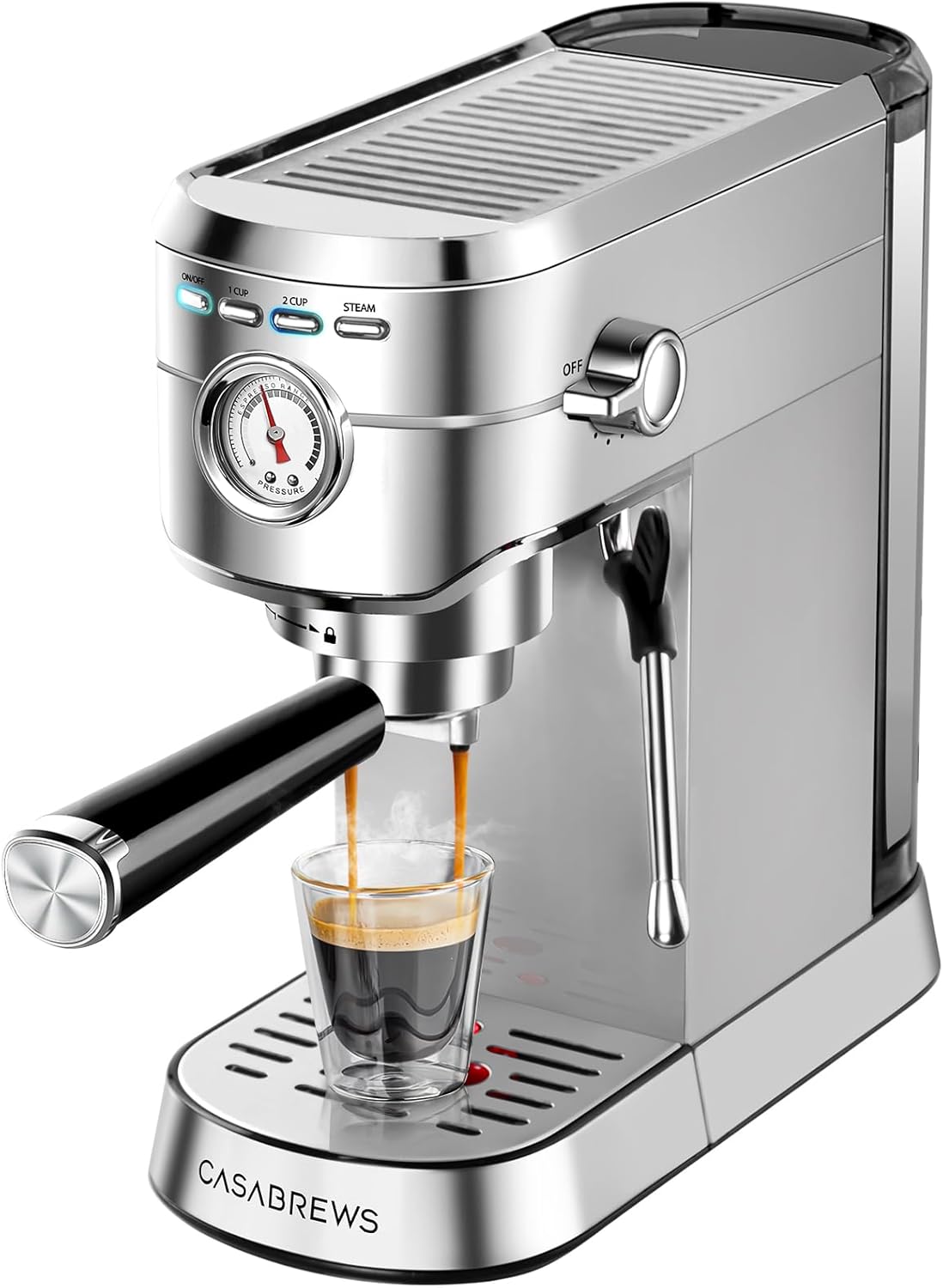 CASABREWS CM5418Best overallCheck price on Amazon
 De'Longhi StilosaBest simple start from a big brandCheck price on Amazon
 De'Longhi ECP3420Best for milk drinksCheck price on Amazon
 Chefman 6-in-1 Espresso MachineBest one-touch machine with a milk reservoirCheck price on Amazon
 CASABREWS 3700 EssentialBest narrow machine for the least moneyCheck price on Amazon
 Gevi Espresso Machine GECME022-UBest for adjustable shot volumeCheck price on Amazon
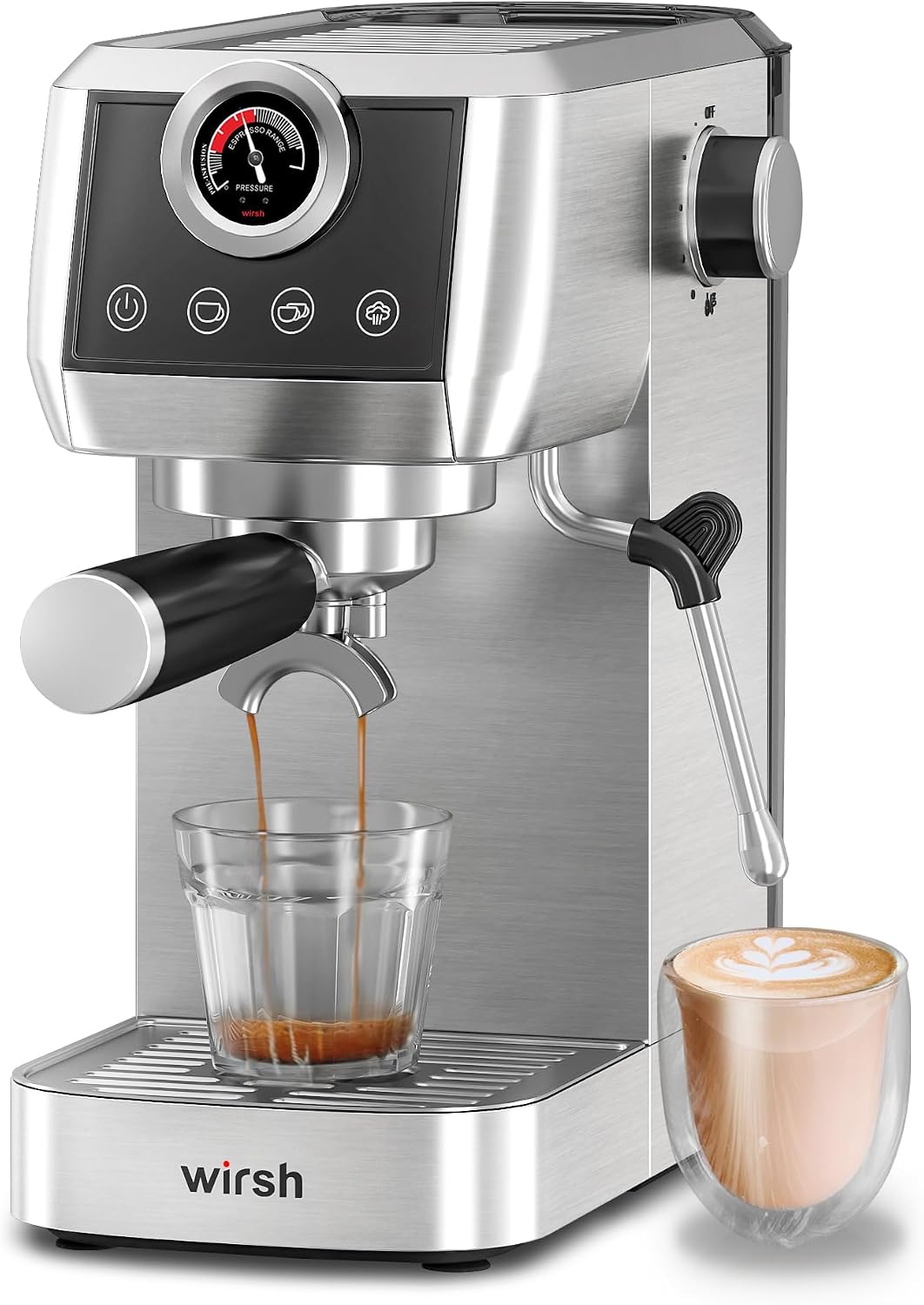 Wirsh Home BaristaBest steam wand in this guideCheck price on Amazon
 Hamilton Beach 40792Best for pods or ground coffeeCheck price on Amazon
 Capresso EC100Best for a cup warmer and two frothing positionsCheck price on Amazon
 Nespresso Essenza MiniBest capsule machine for tiny countersCheck price on Amazon
Prices move up and down on Amazon, so we never print a price here that could be stale by the time you read it. Use the price check button to see the current price.
The Best Espresso Machines Under 200
Every card below uses the same spec order, type, pump pressure, heating system, water tank capacity, grinder, milk frothing, dimensions and wattage, so the ten can be compared line by line.
CASABREWS CM5418
Most machines at this level hide the shot from you. This one puts a pressure gauge on the front, and that single dial changes what a first machine can do: you can watch a choked shot climb and a fast shot fall short, then change the grind or the tamp and watch the needle answer. The body is stainless, the portafilter is 51 mm, and single and double filters are in the box alongside a tamper spoon. The costs of the design are size related. The 34 oz tank is the joint smallest among the portafilter picks here, and milk work means waiting for the machine to cool before the next shot. Buy it if you want to learn espresso with feedback on every cup. Skip it if your household drinks in rounds of three or more.
Pros
- Built-in pressure gauge, rare at this level and genuinely useful while learning
- Stainless steel body in a footprint under 6 in wide
- 51 mm portafilter with single and double filters included
- Steam wand textures milk rather than only foaming it
Cons
- 34 oz tank needs refilling in a two-latte household
- No brewing straight after frothing, the machine has to cool first
- 51 mm accessories are a smaller ecosystem than 58 mm
De'Longhi Stilosa
The Stilosa is the pick for anyone who distrusts the no-name end of this market, and the distrust is reasonable: parts, seals and service exist for this machine in a way they do not for most of this list. What you get is deliberately plain. A dial selects coffee or steam, the boiler is stainless steel, the portafilter takes ground coffee or ESE pods, and a tamper is in the box. There is no gauge, no programme and no shot timer, so your tongue does the measuring. The 1 L tank is small, and extraction and steaming share one boiler, so drinks happen in sequence. Buy it if you want the simplest possible route into portafilter espresso with a known name behind it. Skip it if you want any feedback or automation while you learn.
Pros
- Stainless steel boiler and a 15 bar pump from an established maker
- Takes ground coffee and ESE pods
- Dial control with nothing to configure or update
- Tamper included, and the tank and drip tray both remove for cleaning
Cons
- 1 L tank is small for more than two regular drinkers
- No pressure gauge and no temperature control
- Brewing and steaming run one after the other on a single boiler
De'Longhi ECP3420
Where the Stilosa treats milk as an extra, the ECP3420 is built around it. Its frother mixes steam and air in a way that produces forgiving foam without much technique, which is the difference between a cappuccino on a Tuesday and a practise session. The machine self-primes, so there is no priming ritual after the tank runs dry, and the double drip tray adjusts for taller cups. Three filter options cover single shots, double shots and ESE pods, and the 37 oz tank is a step up from its sibling above. Temperature control is basic and there is still no gauge, so espresso purists will feel the ceiling quickly. Buy it if milk drinks are the household order and nobody wants to apprentice as a barista. Skip it if straight espresso is the point.
Pros
- Frother designed to make cappuccino foam with little technique
- Self-priming system, no manual priming after a refill
- Single, double and pod filters included
- Adjustable tray height for mugs as well as espresso cups
Cons
- Basic temperature control, with no gauge to learn from
- Plastic-heavy body compared with the steel picks in this guide
- Single boiler path means milk and espresso take turns
Chefman 6-in-1 Espresso Machine
This is the only portafilter machine in the guide that handles milk the way a fully automatic does. A separate milk reservoir froths and pours for cappuccino and latte at a touch, so the wand skills and the jug washing disappear from the routine, and the water tank is the largest here at 1.8 L. A digital display runs single and double shots, and detachable parts go in the dishwasher. The trade is control: the froth texture is the machine's decision, not yours, and the milk reservoir needs washing and fridge space between uses. No heating system figure is published for this model. Buy it for a household that wants lattes without a learning curve. Skip it if you enjoy the manual ritual or hate washing milk parts.
Pros
- Milk reservoir froths automatically for cappuccino and latte
- 1.8 L water tank, the largest in this guide
- One-touch single and double shots on a digital display
- Detachable parts are dishwasher safe
Cons
- Milk reservoir needs washing after use and storage in the fridge
- Froth texture is automatic, with no manual wand to learn on
- Reservoir system adds parts that a plain wand machine does not have
CASABREWS 3700 Essential
The 3700 Essential answers a specific question: how little can a real portafilter machine cost before something important goes missing? On the evidence here, less than you would expect. It keeps a 20 bar pump, a thermoblock, programmable shot volumes and a steam wand, and its 43.9 oz tank is bigger than the tank on the dearer CM5418 above. What goes missing is feedback and finish. There is no pressure gauge, the baskets are pressurised only, which produces crema at the basket rather than in the coffee, and the four-button control panel is as basic as controls get. At 5.7 in wide it fits counters that rule out most of this guide. Buy it if the budget is firm and the counter is narrow. Skip it if you plan to chase shot quality with fresh beans and a good grinder, because the baskets will hide your progress.
Pros
- 43.9 oz tank, larger than several dearer picks here
- Programmable shot volumes on a very simple control panel
- 5.7 in wide, among the narrowest machines in this guide
- Portafilter, both filters and a tamper spoon included
Cons
- Pressurised baskets only, which cap how much grind changes can improve the shot
- No pressure gauge or temperature display
- Steam wand needs purging between milk and the next shot
Gevi Espresso Machine GECME022-U
The Gevi earns its place on a control most budget machines skip: shot volume you can set yourself, with one-cup, two-cup and manual modes, so a ristretto habit and a long-shot habit can share one machine. Temperature is regulated electronically rather than left to a thermostat's mood, heat-up is fast, and the transparent 1.2 L tank shows the water level at a glance. The honest limits are the brand and the build. Gevi has nothing like the service footprint of the De'Longhi picks above, and the body uses more plastic than its stainless styling suggests. Buy it if programmable volume matters and you accept a newer name. Skip it if long-term parts availability is your first concern.
Pros
- Adjustable shot volume with a manual mode, unusual at this level
- Electronic temperature control for more even extraction
- Transparent tank makes the water level obvious
- Ready to brew in well under a minute
Cons
- Newer brand with a thinner service and parts network
- More plastic in the body than the finish implies
- 51 mm portafilter format, so accessories stay in a small ecosystem
Wirsh Home Barista
Milk is where budget machines usually cheat, fitting a frothing sleeve that makes foam whether you want it or not. The Home Barista fits a proper stainless steam wand on an articulated arm, driven by a thermoblock that reaches steam temperature quickly, and that makes it the one pick here where latte art is a realistic ambition rather than a slogan. Brew temperature and volume are adjustable, the pump is an Italian ULKA unit, and the 42 oz tank is sensibly sized. The compromises are polish and provenance: the brand is small, the finish is tidy rather than premium, and there is no pressure gauge to coach your shots. Buy it if milk texture is the skill you want to build. Skip it if brand support matters more than the wand.
Pros
- Proper stainless steam wand, the most capable milk tool in this guide
- Italian ULKA pump and fast thermoblock heating
- Adjustable brew temperature and shot volume
- 42 oz tank and a narrow 5.5 in wide body
Cons
- Small brand, with support that cannot match the big makers here
- No pressure gauge
- Water and coffee contact parts are well specified, but the outer finish is plain
Hamilton Beach 40792
Every other portafilter in this guide locks in with a twist that beginners routinely fumble, cross-thread or under-seat. This machine replaces the twist with a Slide and Lock holder that slides in from the front and closes with a lever, and that one mechanism is the reason it belongs here. It brews ground coffee or ESE pods, so a household can mix weekend shots with weekday pods, and the steam wand swivels for cappuccino and latte work. The costs are capacity and build: the 30 oz reservoir is the smallest in the guide, plastic does much of the structural work, and the proprietary holder means replacements come from one maker. No wattage figure is published for this model. Buy it if the portafilter ritual itself is your barrier. Skip it for a multi-drinker household.
Pros
- Slide and Lock holder removes the twist-in portafilter struggle
- Brews ground coffee or ESE pods
- Swivelling steam wand and a cup warmer on top
- Single and double filters, scoop and tamper included
Cons
- 30 oz reservoir, the smallest in this guide
- Plastic-heavy build
- Proprietary filter holder keeps accessories brand specific
Capresso EC100
The EC100 is the quiet traditionalist of the ten: a thermoblock lined in stainless steel so water never sits against aluminium, a 46 oz tank that is the largest fitted to a wand machine here, and a heavy cup warming platform on top that most rivals in this guide simply omit. Its frother has two positions, one for steaming milk and one for frothing it, which gives a beginner a fighting chance at both latte and cappuccino textures. Two sieves cover one or two espressos, and the second sieve takes pods. Nothing here is programmable and there is no gauge, so the machine's ceiling is set by its simplicity. Buy it if you value water path materials and tank size over electronics. Skip it if you want shot programming or volume presets.
Pros
- Stainless-steel lined thermoblock keeps water off aluminium
- 46 oz tank, the largest on a steam wand pick in this guide
- Frother with separate positions for steamed and frothed milk
- Stainless steel cup warming platform
Cons
- No programming, no gauge and no shot timer
- Self-locking filter holder takes a little practice
- Design and controls are dated next to the touchscreen era
Nespresso Essenza Mini
The Essenza Mini is the control group in this guide: the machine you buy when the honest answer is that nobody in the house will grind, tamp or steam. At 3.3 in wide it is less than half the width of the narrowest portafilter pick here, it is ready in about 25 seconds, and two programmable buttons cover espresso at 40 ml and lungo at 110 ml, with the full figures on the official Essenza Mini page. The used capsule container holds six capsules and the tank holds 20.3 oz, so it suits one or two drinkers, not a family queue. There is no milk system on this version, so lattes need a separate frother. Buy it for speed, size and zero routine. Skip it if per-cup cost or fresh beans matter to you.
Pros
- 3.3 in wide, the smallest footprint in this guide by a wide margin
- Ready in about 25 seconds with two programmable cup sizes
- No grinder, no tamping and almost nothing to clean
- Automatic shut-off after 9 minutes
Cons
- No milk frothing on this version, a separate frother is a second purchase
- Capsules cost more per drink than ground coffee, every drink, forever
- 20.3 oz tank and a six-capsule used container suit light use only
What This Budget Does and Does Not Buy
This budget buys the core of espresso: a pump with headroom to spare, a thermoblock or small boiler that heats in under a minute on most picks, a real portafilter on nine of the ten, and milk in some form on nine of the ten. It does not buy the things that make espresso repeatable at cafe level. No pick grinds beans. None offers the temperature stability, portafilter size or build weight of the machines in the next tier up, and the pressurised baskets fitted to several picks exist precisely to hide grind problems rather than solve them. The real difference between a cheap and an expensive machine is not the first month's drinks, which can be genuinely close. It is shot ten thousand, the spare parts shelf, and how much of your technique the machine can even register.
| Point of difference | Option A | Option B |
|---|---|---|
| Milk handling | Automatic help: the Chefman froths from a reservoir at a touch, and the ECP3420 frother foams with little technique | Manual wands: the Wirsh, CM5418, Gevi and Capresso hand you texture control and a jug to wash |
| Learning feedback | A pressure gauge: the CM5418 shows extraction live, so grind and tamp changes have visible results | No gauge: the Stilosa, ECP3420 and 3700 Essential leave judgement to taste and timing |
| Coffee input | Ground coffee and ESE pods: the Stilosa, ECP3420 and Hamilton Beach accept both, softening the grinder problem | Capsules only: the Essenza Mini removes grinding entirely and replaces it with a per-cup cost |
| Tank and refills | Larger tanks: the Chefman at 1.8 L and the Capresso at 46 oz suit households making drinks in rounds | Small tanks: the Hamilton Beach at 30 oz and the Essenza Mini at 20.3 oz suit one or two drinkers and frequent refills |
One boundary is worth drawing before you order, because it decides the running cost of everything above. A portafilter machine and a drip machine ask completely different things of your kitchen: the drip machine wants filter paper and coarse grounds, while every portafilter pick here wants fine grinding, tamping and a cleaning routine. Espresso Machine vs Coffee Maker lays out that split in full, including which household habits suit which side.
Also considered
- De'Longhi Dedica Arte: the slim machine many readers will look for first, but every price we could verify for it sat outside this band, so it cannot anchor a guide built on the band.
- CASABREWS Ultra: the CM5418's bigger sibling with a display and custom settings, ruled out because its verified Amazon price sat just over this budget when we checked.
- Cuisinart EM-100: a long-running stainless design with a generous tank, but its current Amazon-fulfilled price read over the band, so it stays on the bench.
- Galanz Retro Espresso Machine: a charming 15 bar machine with a 1.5 L tank, beaten on verification: its colours sell as separate variants and the prices we found could not be pinned to one variant cleanly.
- Mr. Coffee Café Barista: a one-touch machine with an automatic milk frother that many households would enjoy, but its price reads straddled this band in both directions, so no clean inside-the-band offer could be verified.
Who this guide is for
Busy weeknights
Your window for coffee is measured in minutes and patience is spent. Favour heat-up speed and milk that handles itself: the Chefman froths from a reservoir, the Essenza Mini is ready in about 25 seconds with nothing to prepare, and the Gevi and CM5418 reach temperature in under a minute. The manual De'Longhi picks reward a slower evening more than a rushed one.
Families with kids
Drinks get made in rounds, mornings are crowded, and anything with a complicated cleaning routine will quietly stop being used. Tank size and sturdiness decide your shortlist: the Chefman's 1.8 L tank, the Capresso's 46 oz and the ECP3420's forgiving frother cover a family queue, and every machine here keeps its hot water behind a portafilter, a closed front or a capsule slot rather than in an open boiler.
Small counters and shared kitchens
The third audience for this guide is not about who drinks the coffee but where the machine has to live: a narrow strip beside the sink, a shared house kitchen, a counter that also holds the microwave and the post. Width is your first filter. The Essenza Mini at 3.3 in, the Wirsh at 5.5 in, the 3700 Essential at 5.7 in and the CM5418 at 5.47 in are the four that fit a strip; everything else in this guide needs a proper home of nine inches or more.
What to look for when buying a cheap espresso machine
The full framework is in How to Choose an Espresso Machine. Inside this budget, five checks do most of the work.
Ignore the pump number contest. Picks here carry 15, 19 and 20 bar pumps, and the spread means almost nothing: espresso extracts at far lower pressure than any of those ceilings, and the figure describes the pump's maximum, not what reaches the coffee. Treat a bigger number as marketing headroom, never as a quality ranking.
Decide how milk happens. This is the split that decides daily satisfaction. A reservoir frother removes skill and adds washing. A pannarello style frother forgives technique. A plain steam wand gives real texture and a real learning curve. Pick the one matching your patience, not your ambition.
Read the basket type. Pressurised baskets make crema at the basket and forgive pre-ground coffee and uneven grinding, which suits beginners honestly. They also cap improvement: once you own a good grinder, a pressurised basket hides the differences you paid to create. Several picks here are pressurised only.
Count the second purchase. No machine in this guide grinds. Budget for an espresso-capable burr grinder in the same breath, or plan on pre-ground coffee and pressurised baskets, or choose the capsule pick and accept its per-cup cost instead.
Check the tank against your round. A 30 oz tank is a two-drink tank once steaming and rinsing are counted. Households making three or more drinks at a sitting should start at the 42 to 46 oz picks and treat the Chefman's 1.8 L as the comfort option.
Espresso machine sizes and tank capacity
Capacity at this level comes in three honest sizes, and the cards above sort cleanly into them.
- Capsule and single-drinker size (about 3 to 6 in wide, tanks of 20 to 34 oz): the Essenza Mini, the CM5418 and the Stilosa. Built for one or two people, with refills treated as part of the ritual.
- Standard budget size (about 5.5 to 10 in wide, tanks of 37 to 46 oz): the ECP3420, the 3700 Essential, the Gevi, the Wirsh and the Capresso EC100. Two to four drinkers, refilling every day or two.
- Household size (tank of 1.8 L): the Chefman alone in this guide, because its milk reservoir system was designed for rounds of drinks rather than a single careful shot.
Height is the quiet trap. Most picks stand between 11.6 and 13.5 in tall, which fits under standard wall cabinets, but tanks lift out upward on several models, so the working clearance is the cabinet height plus your hand. Depth matters on the wider machines: the Hamilton Beach and Capresso need their full footprint plus room to swing a jug under the wand.
How much does a good espresso machine cost?
Cost in this category climbs for identifiable reasons rather than magic. The first driver is the milk system: a plain wand costs little, a pannarello frother a little more, and an automatic reservoir system carries its own pump and plumbing. The second is feedback and control, gauges, programmable volumes and electronic temperature regulation, each adding parts a dial machine does not need. The third is materials, where stainless bodies and lined thermoblocks cost more than plastic shells around the same pump.
Above this band, money buys a different category of thing: built-in grinders, 58 mm portafilters, dual heating so brewing and steaming run together, and the weight and parts support of machines built to be repaired. The cheap versus expensive difference, stated plainly, is consistency and lifespan rather than the existence of crema. A well-fed budget machine with fresh coffee makes a drink most households are happy with. An expensive machine makes the same drink on a grey Tuesday in year six, with less coaxing.
Timing is the one lever fully in your hands. Espresso machines are discount regulars around the big sale events, and last-season colours of the same model often carry the cut while the hardware stays identical. A machine bought in a sale at this level can free up exactly the money the grinder needs.
Espresso machine running costs and accessories to budget for
The machine is the down payment. The recurring costs are coffee itself, which dwarfs everything else within a year for a daily drinker, and the small consumables that keep a budget machine alive: descaler, replacement portafilter baskets and group seals over time, and milk, which nobody counts until the fridge bill arrives. Capsule drinkers swap the grinder cost for a per-cup cost that never ends, and that trade should be made with open eyes: it is the most convenient line in this guide and the most expensive per drink.
Accessories worth budgeting for from day one are few and specific. A milk jug if your pick has a wand and none in the box, a tamper that actually fits your basket size if only a scoop tamper is included, and a knock box or a sturdy sink routine for spent pucks. Scale is the slow enemy behind most budget machine deaths: mineral build-up narrows water paths and shows up first as weak flow and descaling problems that a proper descale cycle, run on time, would have prevented.
Common mistakes when buying a cheap espresso machine
Judging by the bar number. A 20 bar badge is not a better machine than a 15 bar one. Extraction happens well below both figures, and the extra headroom mostly exists for the box copy.
Forgetting the grinder until the machine arrives. Pre-ground coffee in a pressurised basket is a workable start, but a first week of stale, coarse grounds in an unpressurised basket is how budget machines earn unfair reputations.
Buying the wand you aspire to, not the one you will use. A plain steam wand in tired hands at 7 am produces hot, bubbly milk and resentment. The forgiving frothers exist for exactly that hour of the day.
Skipping descaling until the flow slows. By the time a budget machine slows, scale is already restricting the water path. Use the descaler specified for your machine, at the interval your water hardness demands: the De'Longhi descaler guidance for its pump espresso machines covers dose and product choice for the De'Longhi picks here, and the full routine for every type is in How to Maintain an Espresso Machine.
Measuring width and forgetting the jug. A machine that fits its strip can still be unusable if there is no room to angle a milk jug under the wand or lift the tank out upward. Measure the working space, not just the footprint.
Chasing a built-in grinder at this money. Machines that promise grinding inside this band pay for it somewhere, usually in the pump, the basket or the build. At this level a separate grinder, or honestly no grinder and pressurised baskets, beats a token one built in.
Budget Espresso Machine Pros and Cons
Pros
- Real pump espresso, with crema and steam, is fully available inside this budget
- Thermoblock machines heat in under a minute, which suits weekday mornings better than slow boilers
- Pressurised baskets make the first month forgiving for pre-ground coffee and new hands
- One pick froths milk automatically from a reservoir, and one removes preparation entirely with capsules
- Footprints are small: half this guide fits a counter strip under 6 in wide
Cons
- No built-in grinder anywhere in the band, so the true starting cost is the machine plus grinding
- Temperature stability and shot consistency sit a clear tier below dearer machines
- Pressurised baskets cap how far a good grinder can improve the drink
- Small tanks on the cheapest picks mean refills become part of the routine
- Parts and service networks thin out fast away from the established makers
Who should not buy a cheap espresso machine
Walk past this band if espresso is already a settled hobby. You will feel the pressurised baskets, the 51 mm portafilters and the single heating systems within a month, and the money is better held for a machine with a 58 mm group and room to grow. Anyone who wants bean-to-cup convenience, grinding included, should also skip it: nothing here does that job at any setting. Households that drink long filter coffees in mugs gain little from any pick in this guide, and anyone unwilling to descale, rinse milk parts or empty a drip tray will watch a budget machine decline faster than a dearer one, because the margins for neglect are thinner. A pod machine or a simple drip setup serves all of those readers more honestly.
Best Espresso Machine Under 200: Frequently Asked Questions
Is a cheap espresso machine worth it under 200?
Yes, for the right definition of worth it. The machines here make real espresso with proper crema and steam milk credibly, and for a household currently buying cafe drinks several times a week the arithmetic settles quickly. What the money does not buy is longevity insurance or cafe consistency: expect a learning curve, a separate grinder cost, and a machine that rewards descaling and punishes neglect.
What do you give up with a budget espresso machine?
Four things, in order of how soon you notice them. A built-in grinder, which becomes a second purchase. Feedback and control, since most picks have no gauge, no PID and no shot timer. Temperature stability across back-to-back drinks, because one small heating system does every job in turn. And build margin: more plastic, smaller tanks, and thinner parts support than the tier above.
Which espresso machine features do you still get under 200?
More than the price suggests. Every pick has a pump of 15 bar or more, nine of the ten steam or froth milk, and thermoblock heating on most means a drink in under a minute. A pressure gauge, programmable shot volumes, an automatic milk reservoir, ESE pod compatibility and a stainless-steel lined thermoblock all appear somewhere in this guide. The features that vanish are built-in grinders, dual heating, 58 mm portafilters and automatic cleaning programmes.
How can you spot a bad cheap espresso machine?
Look for what is missing rather than what is promised. No basket type declared, no tank capacity, a single giant pressure number with no other engineering detail, and photographs that never show the portafilter or the wand up close are all tells. So is a grinder promised at a price where the pump alone should cost the whole budget. Every pick in this guide has its pump, heating system, tank size and dimensions published, and that willingness to be measured is itself a quality signal.
When is the best time to buy an espresso machine on sale?
Around the major sale events, when kitchen appliances are discounted as a category, and in the weeks after new model announcements, when the outgoing version of the same machine takes the cut. Colour variants are the quiet opportunity at this level: an unpopular finish of a machine in this guide is the same hardware with a lower price. Set the shortlist first, from guides like this one, then let the sale choose the timing rather than the product.
Keep researching this espresso machine
The full home espresso range in one place, including the step-up machines with built-in grinders and dual heating that sit above this budget.
ComparisonEspresso Machine vs Coffee MakerPressure-brewed espresso against drip coffee, compared on routine, running cost and counter space, so you can check you are buying the right category.
How to ChooseHow to Choose an Espresso MachineMachine types, heating systems, basket formats and grinder provision explained in order, with the checks to run before ordering at any budget.
Use & CareHow to Maintain an Espresso MachineDescaling, wand care and the daily habits that decide whether a budget machine lasts two years or six.
More in Kitchen & Cookware
Kitchen & CookwareAll Pick Hearth guides in this categoryHow we check espresso machines like these
Read the full Pick Hearth methodology- We check every pick against the manufacturer's own specifications: each machine here is a genuine pump or capsule espresso machine for a home counter, with its type, pressure and milk system confirmed before it earns a place.
- Every pick had to be selling inside this guide's budget on Amazon when we checked, with no coupon, checkout trick or different variant needed to get under the line. Limits, capacities and claims on each card come from manufacturer documents and listings, and prices are never printed because they move.
- No brand can pay for a place, and affiliate earnings never change the order: the ranking follows milk handling, learning feedback, tank size and footprint, in that order.
First published · Updated in place as products and specs change