Our top picks at a glance
The honest headline at this budget is that glass survives the cut better than most buyers expect. Six of the ten sets here are glass, including latching glass with silicone seals, because the simple end of the glass market is priced for exactly this band. What the band trims is not the material but the engineering around it: fewer vented lids, fewer system lids that fit across ranges, and plastic sets that cover food well at home while asking you not to carry soup in a bag.
Start with the Pyrex Simply Store if one set has to do everything at home: it is the fullest size ladder here that still fits the cap. The Amazon Basics Glass Locking set is the latching glass answer for buyers who carry lunch. The HOMBERKING and FineDine sets trade brand depth for container counts no big name matches at this level. The Prep Naturals and Snapware sets are uniform-size glass for people who portion the same lunch all week. On the plastic side, the TakeAlongs and GladWare Matchware packs are the share-and-store end of the market, the Bentgo Prep trays divide a meal into sections, and the Easy Find Lids set closes the guide with the largest container count of all.
Read piece counts the way this guide does: a lid is half of every pair, so a 24-piece set is twelve containers and a 42-piece set is twenty-one. The cards give container counts and sizes, because those are what your fridge feels.
 Pyrex Simply StoreBest overall under the capCheck price on Amazon
 Amazon Basics Glass LockingBest budget latching glassCheck price on Amazon
 HOMBERKING 24-Piece Glass SetMost glass containers for the moneyCheck price on Amazon
 FineDine 24-Piece Glass SetBest hinged-lid glass valueCheck price on Amazon
 Prep Naturals Glass Meal Prep ContainersBest uniform glass meal prepCheck price on Amazon
 Snapware Total Solution 5-PackBest single-size glass stackCheck price on Amazon
 Rubbermaid TakeAlongsBest cheap plastic for sharing foodCheck price on Amazon
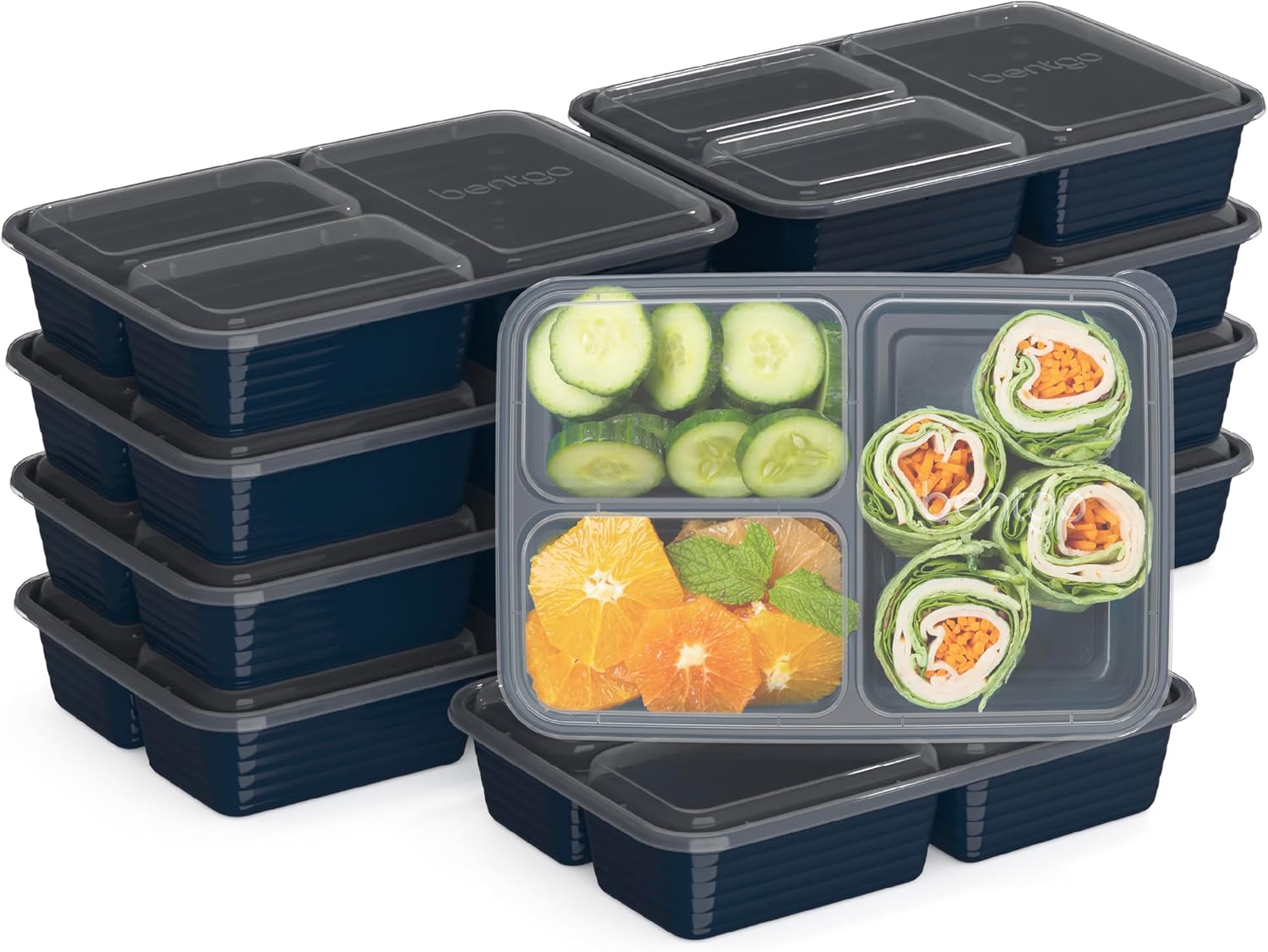 Bentgo Prep 3-CompartmentBest divided meal prep traysCheck price on Amazon
 GladWare MatchwareBest colour-matched family plasticCheck price on Amazon
 Rubbermaid Easy Find LidsBest big plastic setCheck price on Amazon
Prices move up and down on Amazon, so we never print a price here that could be stale by the time you read it. Use the price check button to see the current price.
The Best Food Storage Container Sets Under 50, Reviewed in Full
Pyrex Simply Store
At this ceiling, most glass sets make you choose between a real size ladder and a price that fits. This is the one that keeps both. The nine tempered glass containers form a ladder with no missing rung: rounds at 1 cup, two at 2 cups, two at 4 cups and one at 7 cups, plus rectangles at 3 cups and 6 cups for foods that store flat, so a sauce pot, a packed lunch and the remains of a family meal each have a home. The glass moves between freezer, microwave, dishwasher and a preheated oven, and it comes out of strong-smelling meals without keeping the smell. The compromise sits entirely in the lids: plain press-on plastic that covers food properly in a fridge, vents or lifts for microwaving, never enters an oven and never pretends to be a travel seal. Pyrex covers the set with a 2-year limited warranty. Buy it if your containers live at home and one set has to cover every size. Skip it if lunch travels in a bag each day, where a latching set below is the safer spend.
Pros
- Rounds and rectangles together span 1 cup to 7 cups across nine containers
- Glass covers freezer, microwave, dishwasher and preheated oven
- Full working ladder with no missing middle sizes
- 2-year limited warranty
Cons
- Press-on lids cover food but do not seal it for travel
- Glass weight adds up across a full fridge shelf
- One container per large size, so big leftovers queue
Amazon Basics Glass Locking
This set answers the usual budget question, whether latching glass exists at this level, with seven borosilicate containers and lids that lock down over a blue silicone ring. Two 3.6-cup and two 1.6-cup rectangles pair with a 2.8-cup round and two 1.5-cup rounds, a compact ladder weighted toward lunches and sides rather than family dishes. With the lids removed, the glass bases tolerate a 450 degree F oven, and the freezer, microwave and dishwasher are all covered too, so the least expensive latching glass set in this guide still offers the complete journey from cold storage to a hot oven. The trade is scale: seven containers is a starter set, not a household system, and there is no large container for a whole dish of leftovers. Buy it if you want a sealed glass lunch set without leaving the budget. Skip it if you store family quantities, where the twelve-container sets below fit better.
Pros
- Borosilicate glass with locking lids and a silicone ring
- Glass bases oven safe to 450 degrees F, lids off
- Seven containers across rectangles and rounds
- Freezer, microwave and dishwasher routes covered
Cons
- Seven containers is a starter count, not a household set
- Largest container is 3.6 cups, no family size
- Rectangles and rounds nest separately, not as one stack
HOMBERKING 24-Piece Glass Set
Twelve borosilicate containers is a count no established brand reaches inside this budget, and the size spread is planned rather than padded: rectangles at 1.6, 2.7 and 4.5 cups, squares at 1.4, 2.3 and 3.4 cups, and rounds at 1.7, 2.7 and 4.1 cups, with doubles of the three smallest sizes that portioning uses up first. Snap locking lids close over seals for fridge storage and carrying, and the glass handles the oven, freezer and dishwasher as a daily routine. Two habits protect the set: stack the glass with a layer between pieces, because glass resting on glass is how rims chip, and expect a young label behind the product rather than a deep support network, so the retailer returns window does real work here. Buy it if container count per purchase is your first measure. Skip it if a long track record and spare lids on demand matter more than the count.
Pros
- Twelve borosilicate containers, the most glass here
- Nine sizes across rectangles, squares and rounds
- Doubles of the three smallest portioning sizes
- Snap locking lids for storage and carrying
Cons
- Largest container is 4.5 cups, no family dish size
- Glass needs a layer between pieces when stacked
- Young brand, so support runs through the retailer
FineDine 24-Piece Glass Set
FineDine builds its twelve borosilicate containers around a hinged locking lid, the closure that stays attached to the lid instead of snapping off as a separate tab. Sizes run from 11 oz sauce pots through the working middle sizes to a 35 oz largest container, in a mix of rounds, squares and rectangles that covers lunches, sides and single portions of a main. The glass is built for the freezer-to-oven direction with the lids off, and for the microwave and dishwasher with everyday care. What the budget trims here is headroom and history: nothing in the set takes a whole family dish, and the label is a marketplace brand, so judge the purchase inside the returns window. Buy it if you like hinged lids and want twelve real containers at this level. Pass on it if your kitchen revolves around a couple of big sharing dishes.
Pros
- Twelve borosilicate containers in three shapes
- Hinged locking lids that stay in one piece
- Sizes from 11 oz up to 35 oz for portions and lunches
- Glass covers oven, freezer, microwave and dishwasher
Cons
- Largest container is 35 oz, no family size
- Marketplace brand with a thin support record
- Small sizes outnumber the working lunch sizes
Prep Naturals Glass Meal Prep Containers
Uniformity is the whole design here: five identical 36 oz borosilicate containers, one for each weekday, each closing with a snap-lock lid over a seal. A cook who portions the same lunch five times gets a stack that fills evenly, reheats evenly and washes as one repeated shape, and the glass takes the oven, microwave, freezer and dishwasher without the food ever sitting in hot plastic. The limits are the mirror of the strength. One size has to fit every meal, so a small side and a large salad both land in a 36 oz box, and five containers leave no spares when two are in the dishwasher and one is still in a work bag. Buy it if your week runs on identical packed lunches. Skip it if your leftovers arrive in unpredictable sizes, where a ladder set serves you better.
Pros
- Five identical 36 oz borosilicate containers
- Snap-lock lids with a seal for carrying meals
- One repeated shape stacks and reheats evenly
- Glass covers oven, microwave, freezer and dishwasher
Cons
- One size only, so small and large meals share a box
- Five containers leave no spares midweek
- No small sizes for sauces or chopped ingredients
Snapware Total Solution 5-Pack
Five 4-cup square glass containers, all the same, is a narrower idea than the Prep Naturals set above and a stronger one for fridge order: squares tile a shelf with no dead corners, the stack stands as one column, and every lid fits every base. The bases are Pyrex glass, the lids lock on four tabs over a seal and carry a write and erase area for dating what is inside, a small feature that earns its keep by the third week. Snapware covers the glass with a 2-year limited warranty and the lids with a limited lifetime warranty. The honest cost is range: 4 cups is a meal size, so sauces, sides and family leftovers all need a second system beside this one. Buy it if five matching meal squares solve your actual problem. Skip it if you need a ladder of sizes from one purchase.
Pros
- Five matching 4-cup square Pyrex glass containers
- Four-tab locking lids with a write and erase area
- Squares tile a fridge shelf without wasted corners
- Limited lifetime warranty on the lids
Cons
- One size only, and it is a meal size
- No small or large containers for sides or family dishes
- Glass stack is heavy once all five are full
Rubbermaid TakeAlongs
TakeAlongs occupy the end of the market where a container is cheap enough to send home with a guest and not chase afterwards. The pack spans seven sizes from 0.5-cup smalls up to 8-cup containers, the lids carry ridges that stack cleanly in a fridge, and the press closure clicks shut so you can hear that it has seated. The plastic is BPA-free, the set is freezer safe and top-rack dishwasher safe, and the bases reheat in the microwave with the lids off. Read the closure for what it is: a firm press seal for home storage and short trips upright, not a latching system for soup rolling around in a bag, and plastic never sees an oven. Buy it if your containers regularly leave the house with other people. Skip it if sealed transport is the main job, where the latching sets above are the honest answer.
Pros
- Seven sizes from 0.5 cups to 8 cups in one pack
- Ridged lids stack cleanly in the fridge
- Light, drop-tolerant and cheap to replace or give away
- Freezer safe, with microwave-safe bases
Cons
- Press closure is not a latching travel seal
- Plastic only, so no oven use
- Thin walls flex under a heavy stack
Bentgo Prep 3-Compartment
Ten identical trays, each holding 4 cups across three compartments, turn portioning into a single repeated motion: a main in the large section, two sides in the small ones, a lid on top, and the week stacks in the fridge. The trays are PFAS-free and BPA-free plastic, and they cycle through the microwave, freezer and dishwasher, which suits a set that will be used hard and replaced eventually rather than kept for a decade. The lid is a custom-fit press-on lid, good at keeping a tray covered and stackable, and it is not a leak seal, so saucy meals travel upright or not at all. There is also no oven route and no size variety of any kind. Buy it if divided lunches are your whole routine. Skip it if your food is liquid, baked or differently sized every day.
Pros
- Ten identical 4-cup trays with three compartments
- PFAS-free and BPA-free plastic
- Trays stack into one tidy fridge column
- Microwave, freezer and dishwasher safe
Cons
- Press-on lids are not a leak seal for saucy meals
- One size and one layout, no variety at all
- Plastic only, never for the oven
GladWare Matchware
Matchware attacks the lid hunt with colour instead of hardware: each lid carries a colour and pattern that matches its base, so the right pairing is visible across a crowded drawer. Twenty pieces make ten containers across square, rectangular and round shapes, the lids close with the Glad Lock seal, and the plastic is BPA-free and built for the fridge, freezer, microwave and dishwasher routine of a family kitchen. This is everyday plastic in the plain sense: light and forgiving when dropped, fine for reheating, finished at the oven door, and sealed well enough for home storage and careful carrying rather than for liquids in motion. Buy it if a household keeps losing the lid battle and wants a visual system instead. Skip it if you carry soup daily, where latching lids earn their extra parts.
Pros
- Colour-matched lids pair with bases at a glance
- Ten containers across square, rectangular and round shapes
- Glad Lock seal for everyday home storage
- Light plastic that shrugs off drops
Cons
- Seal suits home storage, not liquids in a moving bag
- Plastic only, so no oven use
- Printed patterns will not suit every kitchen
Rubbermaid Easy Find Lids
No other set in this guide reaches twenty-one containers, and the reason to choose this one sits in the lid system rather than the tubs themselves. Each lid clicks onto the bottom of the container it belongs to and onto neighbouring lids, which means a stack stored in the cupboard keeps its closures attached instead of scattering them through a drawer. The ladder leans small on purpose, with five 0.5-cup minis, six each at 1.25 and 2 cups, two 3-cup containers and single 5-cup and 7-cup containers on top, and the three largest sizes carry vented lids for reheating. The plastic is BPA-free and safe across the microwave, dishwasher and freezer. The seal is a press-on seal, honest at home and wrong for a bag of soup, and sixteen of the containers hold 2 cups or less, so check that the small-size weighting matches your fridge before the count persuades you. Buy it if many small portions and an end to lid hunting are the brief. Skip it if most of your storage is family-size leftovers.
Pros
- Twenty-one containers, the most in this guide
- Lids snap to bases and to each other for storage
- Ladder weighted to portions, sides and snacks
- Vented lids on the 3, 5 and 7 cup sizes
Cons
- Press-on lids are not a leakproof travel seal
- Sixteen containers hold 2 cups or less
- Plastic only, so no oven use
What This Budget Does and Does Not Buy
Under this cap you keep more than the price suggests, and what you give up is specific rather than general. The premium end is worked through in the full Budget Food Storage Container Set vs Premium Food Storage Container Set comparison; the table below stays inside this band.
| Point of difference | What this budget buys | What it does not buy |
|---|---|---|
| Materials | Tempered and borosilicate glass, plus everyday BPA-free plastic | Thick premium glass systems and crystal-clear Tritan as the norm |
| Lids | Press-on lids, snap locks and four-tab locking lids with seals | Vented system lids that fit across glass and plastic ranges |
| Container counts | Five to twenty-one containers, with twelve-container glass sets | Twelve containers plus a deep range of spare lids and add-on sizes |
| Largest sizes | Family sizes in the two press-on sets, at 7 and 8 cups | Large latching glass containers above 5 cups |
| Support | Established names on half the list, retailer windows on the rest | Decades-deep spare parts and lid replacement programmes |
The pattern to remember is that the lid, not the container, is where this budget is spent or saved. A press-on lid is one moulded part. A locking lid adds tabs or hinges and a silicone seal, and a vented system lid adds more again. Every set above chose where to stand on that ladder, and your own choice should follow the journey your food makes: press-on for a fridge at home, locking for a bag.
Also considered
- Snapware Total Solution 24-Piece Glass Set: twelve Pyrex glass containers with four-tab lids, the natural big sibling of our sixth pick. It missed the ten on price, which current records place above this budget, so the five-container version carries the Snapware place here.
- OXO Good Grips Smart Seal Glass: borosilicate glass with four locking tabs and the strongest freezer-to-oven route in the wider market. It missed the ten on price, which sits above the cap.
- Glasslock 18-Piece Set: nine latching tempered glass containers. It missed the ten on price at the time of checking, and the two twelve-container glass sets above cover more containers inside the band.
- Rubbermaid Brilliance Glass: nine glass containers with vented latching lids. It missed the ten because two sets is this guide's overlap limit with the wider field, and the Pyrex and Easy Find Lids sets hold those places; its price also sits at the very edge of the cap.
- Joseph Joseph Nest Lock: five nesting plastic containers with clip-together lids, the cleverest empty-storage design in the category. It missed the ten because no genuine image of the exact set could be retrieved for this guide, and an unimaged pick helps nobody compare.
- Ello Duraglass Mixed Meal Prep Set: five sleeved glass containers built for packed lunches. It missed the ten because a household set has to span more than five containers, all of them sized for lunch, can reach, whatever the budget.
Who this guide is for
Meal preppers working to a fixed budget
You portion a week of lunches on a Sunday and the set has to survive that rhythm. The uniform glass sets, Prep Naturals and Snapware, portion evenly and reheat in the dish; the Bentgo trays divide each meal as you pack it; and the twelve-container glass sets give you spares when the first five are still in use. How to Use a Food Storage Container Set walks through cooling and labelling in the order a safe prep session needs.
First kitchens and renters
You are buying a whole storage system in one purchase, probably for the first time. The Pyrex ladder covers the widest range of real leftovers, the TakeAlongs pack forgives the drops and moves that rental kitchens involve, and every set here stores as one stack or system rather than a loose pile.
Households that send food home with people
Leftovers leave with guests, grandparents and grown children, and the containers rarely come back. TakeAlongs and Matchware are priced and built for that traffic: light, sealed well enough for the trip, and painless to replace in part rather than as a set.
Small cupboards on a small budget
Your empty storage competes with your pans. The Easy Find Lids stack carries its lids with it, the Snapware squares stand as one column, and the Amazon Basics seven nest in two short stacks. Measure the cupboard for the set as it will actually live there, lids included.
What to look for when buying a food storage container set on a budget
The full framework sits in How to Choose a Food Storage Container Set. Five checks carry most of the weight at this level.
- Container count, not piece count. Halve the headline number before you compare anything. A household portioning ten lunches needs ten containers, whatever the box claims.
- The lid matched to the journey. Locking lids with a seal are for carrying food and for long fridge storage. A press-on lid suits food that never leaves the house. At this budget both are honest tools; buying the wrong one is the common failure.
- Glass type where it matters. Borosilicate handles sudden temperature change and the freezer-to-oven direction. With tempered glass, the oven must be preheated and temperature changes kept gradual, and a dish with a chip comes out of rotation immediately.
- The largest size, checked against your leftovers. Several sets here top out near 4 cups. If a whole dish of leftovers is your regular load, only the Pyrex 7-cup, the TakeAlongs 8-cup and the Easy Find Lids 7-cup reach it.
- A support route you can name. On the established names it is the maker. On the younger labels it is the retailer returns window, so buy, fill the set with your heaviest regular week, and decide inside that window.
Food storage container set sizes and capacity at this budget
Capacity at this level falls into three bands, and the bands explain most of the price differences in the guide.
- Small sizes, up to 2 cups. This is sauce, dressing and chopped-ingredient territory, along with one helping of yoghurt or a handful of berries. The HOMBERKING, FineDine and Easy Find Lids sets carry these in doubles and sixes, which suits portioning work.
- Working sizes, 3 to 5 cups. A single person's meal fits here, and so does a side dish meant for the whole table. Every set here lives in this band: the Snapware and Bentgo sets are built entirely from it, and the Pyrex 4-cup rounds do daily work in most kitchens.
- Large sizes, 6 cups and up. The remains of an entire cooked dish land here, as does a salad made to be shared. Only three sets reach this band, all of them press-on sets, which is the budget trade in one line: at this level, big and latching do not arrive in the same box.
One habit prevents most regret at any budget: decide where the empty set will live before it arrives. A set that only fits when perfectly nested will spend its life on the counter, and a fridge shelf fills with full containers sooner than a piece count suggests.
How much does a good food storage container set cost?
Inside this band, price follows the lid first and the material second. A press-on plastic pack costs the least to make, a press-on glass set costs more, and latching glass costs the most because each lid carries tabs or hinges and a seal. Uniform meal prep sets sit in the middle: one size repeated is cheaper to tool than a nine-size ladder, which is why five identical glass containers can undercut a mixed set with fewer total pieces.
Timing helps at this level more than at most. Promotions for kitchen storage concentrate in the January organisation season and around Amazon's big sale events, and the younger labels undercut each other through the year. Treat a lower price on a set you have already verified as a bonus, and never let a countdown talk you into a set whose sizes you have not checked.
Running costs and accessories to budget for
A storage set is close to free to run. No filters, bags or proprietary refills exist for a storage set; what you spend later goes on replacement parts and honest wear. Lids are the wear item: press-on lids warp if they meet high dishwasher heat cycle after cycle, seals pick up strong smells if they are stored closed on an empty container, and locking tabs fatigue after years of daily use.
The accessories worth budgeting for are modest. A second small set of your most-used size beats a second full set, because every kitchen runs out of one size first. A roll of freezer tape and a marker for dating leftovers costs very little and does more for food safety than any lid upgrade. Replacement lids are easy to find for the established names in this guide and patchy for the younger labels, which is worth knowing before a twelve-container set becomes an eleven-container set.
Common mistakes when buying a cheap food storage container set
- Counting pieces instead of containers. Half of every headline figure is lids, so an 18-piece box holds nine containers. Work out how many containers your week needs and shop against that number.
- Carrying soup under a press-on lid. Inside a fridge, a press-on lid is all a container needs to stay covered. Soup on the move is a different job, one for a locking lid with a seal, because the classic first spill lands across a bag lining or a car seat.
- Taking tempered glass directly from the freezer into a hot oven. For glass storage, an abrupt swing in temperature is the breakage risk that matters most. The Pyrex safety and usage guidance sets the rules out plainly: let the oven preheat fully first, keep a frozen dish out of it rather than transferring straight across, place hot glass only on dry surfaces at room temperature, and take any chipped or cracked dish out of use.
- Keeping leftovers past their days. A tight seal slows spoilage; it does not extend the calendar. According to the FoodSafety.gov cold food storage chart, cooked meat and poultry keep for three to four days in the fridge and soups and stews follow the same window, while anything kept longer belongs in a freezer held at 0 degrees F or below.
- Judging a young label outside its returns window. For the newer names in this guide, the first weeks are the real test period. Fill the set, run your heaviest regular week through it, and decide while returning it is still simple.
Food storage container set pros and cons at this budget
Pros
- Real glass, including latching borosilicate, exists at this level in six different sets
- Container counts run to twelve in glass and twenty-one in plastic
- Uniform meal prep sets portion a working week from one repeated shape
- Every set stores as a system, so the cupboard problem is solved in the same purchase
Cons
- Large latching glass sits above this band, so big and sealed do not combine here
- Vented lids and cross-system lid ranges are premium features that mostly stay premium
- Support depth is thin on the younger labels, where the returns window does the work
- Plastic picks stop at the microwave, and every lid in the guide stays out of the oven
Who should not buy a food storage container set
Skip this band if your food travels in liquid form every day and in family quantities: the sets that combine large sizes with latching glass seals sit above this ceiling, and compromising here means leaks now and a second purchase later. Skip the mixed ladder sets if you need one size in quantity, where a uniform set or a single-size multipack is the straighter buy. And skip the category for now if you seldom cook: ten to twenty containers storing air in a cupboard help nobody, and the money serves a kitchen better elsewhere until the cooking habit exists.
Food Storage Container Set: Frequently Asked Questions
Is a cheap food storage container set worth it under 50?
Yes, for the jobs most kitchens actually run. At this level you can buy tempered or borosilicate glass, locking lids with seals, container counts up to twelve in glass and twenty-one in plastic, and full freezer, microwave and dishwasher routes. What you are not buying is large latching glass and premium lid systems, so the set is worth it when your food is stored at home, portioned for lunches or carried carefully, and not worth it when family-size sealed transport is the daily job.
What do you give up with a budget food storage container set?
Size headroom at the sealed end, lid engineering and support depth. You give up latching glass containers above about 5 cups, vented lids that microwave while latched, lids that fit across a whole glass and plastic system, and the spare lid programmes of the premium ranges. You also give up margin: a budget set works near its design limits, where a premium set has capacity and parts in reserve.
What features do you still get under 50?
More than the price implies. Borosilicate glass that handles the freezer-to-oven direction, four-tab and hinged locking lids with silicone seals, write and erase lid labels for dating food, colour-matched lids, lids that snap to their own bases, vented lids on the largest sizes of the big plastic set, and warranties that include a limited lifetime term on one set of lids. The basics of the category are present; it is the system depth that is missing.
How do you spot a bad cheap food storage container set?
Judge a cheap set by what its listing avoids. Warning signs: piece counts with no container count separated out, sizes given only as a total volume, seal language for lids with no tabs, hinges or gasket visible, photographs recycled across several brand names, and no named maker or returns route. A good budget set publishes its sizes container by container, shows its lid mechanism plainly and tells you exactly how its glass should be treated.
How long does a budget food storage container set last?
Glass bases last for years when the temperature rules are followed, because glass does not wear in normal use; a chipped or cracked dish is retired at once, which is the real end of a glass container's life. Lids set the working lifespan of the whole set: press-on lids commonly warp or loosen after a year or two of daily dishwashing, and locking lids last longer when their seals are washed and dried rather than left closed on empty containers. Expect the plastic sets here to serve a few years of hard use, and the glass sets to outlast several sets of their own lids.
Keep researching this food storage container set
the full field ranked without a price ceiling, where latching glass and borosilicate systems take their places.
ComparisonBudget Food Storage Container Set vs Premium Food Storage Container Setwhat the premium actually adds, lid by lid and glass by glass, against the budget pattern.
How to ChooseHow to Choose a Food Storage Container Setthe full framework for materials, lids, glass types and size ladders, in one place.
Use & CareHow to Use a Food Storage Container Setcooling, portioning, sealing and storing, plus the glass care routine that keeps a set in service.
More in Kitchen & Cookware
Kitchen & CookwareAll Pick Hearth guides in this categoryHow we check food storage container sets like these
Read the full Pick Hearth methodology- Every set was checked against the ceiling on Amazon.com on 21 November 2026 before it was ranked; the dated price evidence sits in the research notes, since a figure printed here would go stale.
- Every pick is a genuine multi-container food storage set, verified set by set: container counts are kept apart from piece counts, and each size ladder was read container by container.
- Lid systems were read as decision facts: the sets that lock over a seal, the ones that press on, the lids that vent, and which closures can honestly carry liquids and which belong in the fridge only.
- Published heat limits were checked for every set: glass bases to 450 degrees F with lids off, the preheated oven rules for tempered glass, borosilicate's freezer-to-oven paths, and the oven ban that covers every plastic set and every lid.
- Before ranking, the whole pool was screened against current CPSC recalls: no pick appears in one, and the single glass food storage recall on record concerns a baby food cube set from an unrelated maker, nothing in this guide.
- No brand can buy its way in, and affiliate earnings do not move the order: container count first, then lid honesty, then how well each set serves a real kitchen at this budget.
First published · Updated in place as products and specs change