Our top picks at a glance
Under this ceiling the honest split is not steel against glass. It is complete against almost complete. Some sets below give you a full size ladder and nothing else. Some give you lids on every bowl and a shorter ladder. Two give you graters you may use monthly. One gives you a colander and a sifter instead of extra bowls. What none of them gives you is everything at once, and pretending otherwise is how budget guides waste your money.
Start with the FineDine stack if one purchase has to cover the most cooking: six steel bowls stepping up to a genuinely large top size, at the simple end of this band. Start with the Cuisinart trio if covered storage matters as much as mixing, because every bowl carries its own lid and the sizes are the classic ladder. The wider ranking in best mixing bowl set for baking shows what more money buys; this guide is about how little of it you actually have to give up.
The working rule at this band: count bowls, not pieces, and read the quart sizes before the photographs. A set that reaches 5 quart with a lid and a base that grips is a complete kitchen tool here. A set that stops at 3 quart is a prep kit, however many attachments fill the box.
 FineDine Stainless Steel Mixing BowlsBest overall under the ceilingCheck price on Amazon
 Cuisinart CTG-00-SMB Mixing Bowl SetBest lidded set from a kitchen brandCheck price on Amazon
 Priority Chef Stainless Steel Mixing BowlsBest with graters and gripping basesCheck price on Amazon
- COOK WITH COLOR Glass Mixing Bowl SetBest glass set under the ceilingCheck price on Amazon
 Lazycorner Stainless Steel Mixing BowlsBest big count of lidded steel bowlsCheck price on Amazon
 COOK WITH COLOR Stainless Steel Mixing BowlsBest plain stainless stackCheck price on Amazon
 Glad Mixing Bowls with Pour SpoutBest for pouring battersCheck price on Amazon
 Weyrinice Plastic Mixing Bowls SetBest prep kit for a small kitchenCheck price on Amazon
 COOK WITH COLOR Prep Bowls with LidsBest deep bowls with lidsCheck price on Amazon
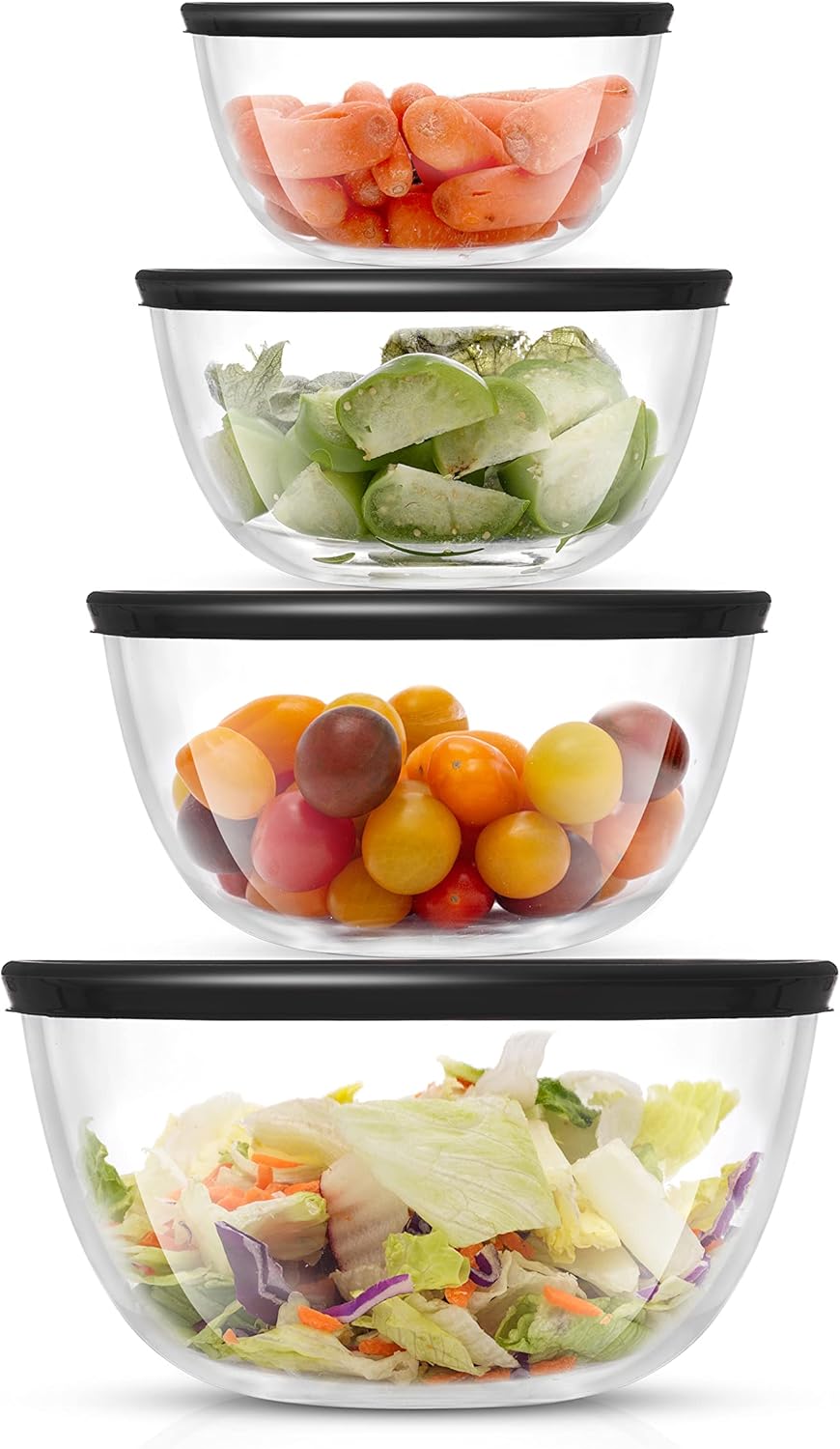 JoyJolt Kitchen Mixing BowlsBest compact glass set with lidsCheck price on Amazon
Prices move up and down on Amazon, so we never print a price here that could be stale by the time you read it. Use the price check button to see the current price.
The Best Mixing Bowl Sets Under 40, Reviewed in Full
Ten sets verified inside the band, ordered by how completely each one covers everyday mixing before extras are counted.
FineDine Stainless Steel Mixing Bowls
Six stainless bowls step from 0.75 quart through 1.5, 3, 4 and 5 quart to a full 8 quart, which is the widest ladder in this guide and the reason this set leads it. At this band a large bowl is usually the first thing cut, and here it survives: bread dough, a double cookie batch and a party salad all have a home. Capacity is marked on the outside of each bowl, the rims are rolled for grip and cleaner pouring, and flat bases keep the bowls level on the counter. The trade is weight, or the lack of it. The whole stack weighs about 2 lb, so the steel flexes and dents more easily than a heavy trio, and no lids come in the box. The bowls nest, and they are dishwasher safe and freezer safe. Buy it if you cook in several sizes and want one stack to replace a cupboard of single bowls. Skip it if lids or a planted, heavy feel under a hand mixer matter more than range.
Pros
- Six sizes from 0.75 to 8 quart, the widest ladder here
- Capacity marked on the outside of every bowl
- Rolled rims and flat bases for grip and steady pouring
- Nests into one stack, dishwasher and freezer safe
Cons
- No lids at any size
- Light steel dents and flexes more readily than heavier sets
- No non-slip base under any bowl
Cuisinart CTG-00-SMB Mixing Bowl Set
Three stainless bowls in 1.5, 3 and 5 quart sizes, each with a tight fitting lid, cover the standard mixing ladder and then keep working as storage. Dough can be mixed in the 5 quart bowl, covered and chilled without a transfer, and a marinade can sit in the 3 quart under its own lid instead of under wrap. At this band, a lid for every bowl from an established kitchen brand is the exception rather than the rule, and it is what this money buys. The bowls nest, the rims are rolled for clean pouring, and bowls and lids go in the dishwasher. There is no non-slip base, so hard whisking is a two-handed job or asks for a damp towel underneath. Buy it if your routine runs mix, cover, chill as one motion. Skip it if you whisk one-handed daily and want the base to do the holding.
Pros
- A tight fitting lid for every bowl, at 1.5, 3 and 5 quart
- Stainless bowls nest for compact storage
- Rolled rims pour batter and marinades cleanly
- Dishwasher safe bowls and lids
Cons
- No non-slip base, so the bowl can travel during hard whisking
- Stainless steel cannot go in the microwave
- No bowl below 1.5 quart for eggs and glazes
Priority Chef Stainless Steel Mixing Bowls
This stainless set pairs its bowls with a lid for each one, three grater attachments and non-slip silicone bases, which is the fullest feature list in this guide. The bases answer the commonest budget complaint, a light steel bowl skating under the whisk, and the graters turn the largest bowl into a prep station for cheese and vegetables without a separate board-side bowl to wash. Priority Chef sells the lids as airtight, which is a maker's claim to read as a storage promise rather than a guarantee for carrying soup across town. The set sits near the top of this band, so what you are paying for is the combination, not exotic steel. Buy it if lids, grip and graters would all see weekly use in your kitchen. Skip it if you only mix, because the plainer stacks below do that job for less of the budget.
Pros
- A lid for every bowl, for mixing and storage in one vessel
- Three grater attachments work over the bowl
- Non-slip silicone bases hold the bowls while you whisk
- Stainless bowls chill dough quickly in the fridge
Cons
- Grater attachments are extra parts to wash and store
- Stainless steel cannot go in the microwave
- Sits near the top of the band, so sale timing matters
COOK WITH COLOR Glass Mixing Bowl Set
Six borosilicate glass bowls run from about 27 oz up to about 150 oz, roughly 0.8 to 4.7 quart, and every bowl carries its own coloured lid. That makes this the one set under the ceiling that follows a recipe through the microwave: butter melts in the bowl it will be mixed in, and a dough rise is visible through the side. The glass is microwave, freezer and dishwasher safe, and the bowls nest into one stack. Glass still asks for respect around sudden temperature changes, and the Pyrex safety and usage guidance for glassware makes the general point plainly: no direct heat, no freezer to hot oven moves, and let hot glass cool before washing. Buy it if microwave work and visible proofing are part of your cooking week. Skip it if your kitchen drops things, or if a bowl above 5 quart is on your list.
Pros
- Six glass bowls from about 0.8 to 4.7 quart, each with a lid
- Borosilicate glass suits mixing, microwaving and freezing
- Clear walls make rises and leftover levels easy to see
- Bowls nest and are dishwasher safe
Cons
- Glass can break if dropped or knocked
- Largest bowl stops below 5 quart
- No direct heat and no sudden temperature changes
Lazycorner Stainless Steel Mixing Bowls
A seven piece stainless set with lids and three grater attachments, this is the bundle end of the band: bowls, covers and prep tools arriving in one box for a first kitchen or a restock. The steel is rust resistant, the bowls go in the dishwasher, and the graters handle the slicing, grating and shredding jobs that otherwise need a second tool out. Two cautions keep it below the Priority Chef set. The washing guidance pulls in two directions, dishwasher safe and hand wash both appearing, so the lids are safest treated as hand wash parts. And the piece count includes the attachments, so judge it by its bowls rather than by the number on the box. Buy it if you are equipping a kitchen from near zero and want lids and graters included. Skip it if you already own graters and would rather spend the whole budget on the bowls alone.
Pros
- Lids included for covered fridge storage
- Three grater attachments for slicing, grating and shredding
- Rust resistant stainless steel bowls
- Bowls are dishwasher safe
Cons
- Grater attachments add parts to wash and store
- Stainless steel cannot go in the microwave
- Piece count includes attachments, not seven bowls
COOK WITH COLOR Stainless Steel Mixing Bowls
Six stainless bowls that nest into a single stack, with no lids, no graters and no attachments to account for. That plainness is the value case: at the lower end of this band you get the material and the count, and nothing you have to store, lose or wash separately. Stainless brings its usual strengths, fast chilling, no staining from tomato or turmeric, and a tolerance for hand mixers and metal whisks that plastic never quite matches. What it never brings is microwave use, and this set adds no non-slip base, so plan on a second hand or a damp towel for hard whisking. Buy it if you want a simple steel stack that will outlast trends in attachments. Skip it if covered storage in the mixing bowl is part of your routine.
Pros
- Six stainless bowls nesting into one stack
- No attachments or extra parts to store
- Steel resists stains and odours and chills food fast
- Light to carry, even when the largest bowl is full
Cons
- No lids included at any size
- Stainless steel cannot go in the microwave
- No non-slip base for one-handed whisking
Glad Mixing Bowls with Pour Spout
Four plastic bowls in 1.2, 1.9, 2.8 and 3 quart sizes, each with a pour spout and a non-slip base, and a handle on the largest bowl. For pancake mornings and cake batters, that combination is worth more than a fifth bowl: the bowl stays put while you whisk, then pours from the spout instead of down its own side. The bowls nest, go in the dishwasher and are freezer safe. The limits are size and heat. The ladder stops at 3 quart, which is a single batter ceiling, and the bowls are not microwaveable, so melting happens in another vessel. No lids are included. Buy it if your mixing is mostly batters, dressings and marinades in small to medium batches. Skip it if bread dough or double batches are regular work in your kitchen.
Pros
- Pour spouts on every bowl for cleaner batter transfer
- Non-slip bases hold the bowl while you whisk
- Handle on the 3 quart bowl for a steadier pour
- Dishwasher safe and freezer safe, nesting storage
Cons
- Largest bowl is 3 quart, small for dough or double batches
- Not microwaveable, so melting needs another vessel
- No lids included
Weyrinice Plastic Mixing Bowls Set
Read this one as a prep kit that contains two mixing bowls, not as a bowl set with bonuses. The large bowl holds 4.8 quart, the small one 0.5 quart with measurements, and between them sit a 3 litre colander, a fine mesh sifter and six measuring pieces running from a 250 ml cup down to a half teaspoon. For a small kitchen that bakes from scratch, the sifter and colander do weekly work that an extra mid-size bowl would not. The honest gap is the middle: nothing sits between 0.5 and 4.8 quart, so a single cake batter lands in the big bowl or nowhere. The set is plastic, light and forgiving of drops and shared sinks. Buy it if flour sifting, rinsing and measuring are part of your baking and cupboard space is tight. Skip it if you want three or four true mixing sizes above all else.
Pros
- Large 4.8 quart bowl plus a measured 0.5 quart bowl
- Colander and fine mesh sifter included for flour and rinsing
- Six measuring cups and spoons cover the standard sizes
- Light plastic set that forgives drops
Cons
- Only two mixing bowls, with a wide gap between them
- No mid-size bowl near 2 or 3 quart
- No lids for fridge storage
COOK WITH COLOR Prep Bowls with Lids
Four deep plastic bowls in 210 ml, 550 ml, 1150 ml and 3500 ml sizes, roughly 0.2 to 3.7 quart, each with its own lid and a non-slip base. Deep rather than wide is the point: a tall bowl splashes less under a whisk, stores marinades and chopped ingredients upright in a crowded fridge, and nests into a small footprint. This is the set for the cook whose mixing is really prepping, salads chopped ahead, doughs and batters in modest amounts, leftovers covered in the bowl they were made in. The smallest two bowls are prep sizes rather than mixing sizes, and plastic keeps hot work out of the picture. Buy it if covered prep and fridge order matter more than a big dough bowl. Skip it if your regular batch needs more than the 3.7 quart top size gives you.
Pros
- A lid for every bowl, in deep splash-resistant shapes
- Non-slip bases on all four bowls
- Largest bowl reaches about 3.7 quart for a single batter
- Bowls nest into a compact stack
Cons
- Two smallest bowls are prep sizes, not mixing sizes
- Plastic bowls keep hot mixing work off the menu
- No bowl above 3.7 quart for dough or double batches
JoyJolt Kitchen Mixing Bowls
Four glass bowls with four lids, eight pieces in total, nesting into one short stack. The bowls are sized by diameter, from 5.5 inches up to 8 inches across, which tells you honestly what this set is: a compact glass kit for eggs, dressings, small batters and leftovers, not a dough station. Glass brings microwave work and a clear view of what is mixing, the lids are BPA free, and the whole set suits a small kitchen that would rather own one short stack than a tall one. Capacity figures are not published in quarts for this set, so judge it by the diameters and buy it for small work. Buy it if your mixing is small batch and your storage space is smaller. Skip it if you need a bowl that takes a full bread dough.
Pros
- Four glass bowls, each with its own lid
- Glass suits mixing and microwave work in one vessel
- Nesting stack suits a small cupboard
- BPA free lids for covered storage
Cons
- Bowls are sized by diameter, with no quart figures published
- Largest bowl is modest, at 8 inches across
- Glass can break if dropped
What This Budget Does and Does Not Buy
This budget buys a complete mixing kit. It does not buy a premium one, and the difference is specific rather than vague. You still get a full size ladder, lids on every bowl if you choose a lidded set, non-slip bases on several sets, and glass that works in a microwave. What goes is the insulation of double wall steel, the heavy gauge that shrugs off dents for a decade, the long brand warranties, and the largest designer finishes. The real differences in ceramic mixing bowl set vs stainless steel mixing bowl set still apply here, with one budget twist: ceramic barely appears under this ceiling at all, so the material fight at this band is steel against glass against plastic.
| Decision point | What this budget buys | What it does not buy |
|---|---|---|
| Size ladder | FineDine steps to 8 quart; Cuisinart and the lidded steel sets cover 5 quart | A large bowl plus insulated walls in the same set |
| Lids | Cuisinart, Priority Chef, Lazycorner, both glass sets and the COOK WITH COLOR prep bowls include lids | Lids on the two plain steel stacks, FineDine and COOK WITH COLOR Stainless Steel |
| Grip | Non-slip bases on Priority Chef, Glad and COOK WITH COLOR Prep Bowls | A gripping base on the plain steel stacks |
| Heat work | Glass sets cover microwave melting and warming | Any microwave use from steel, and hot work from the plastic sets |
| Build | Steel, borosilicate glass and sturdy plastic that handle daily mixing | Heavy gauge steel, double wall insulation and long warranties |
The cheap against expensive question, answered plainly: an expensive set buys thicker material, insulation, finish and warranty length. It does not buy a different ladder, a different lid or a different base, because all three exist below this ceiling. If your mixing is weekly rather than daily, the expensive differences are the ones you will notice least.
Also considered
- OXO Good Grips 3-Piece Mixing Bowl Set (plastic): a sound plastic trio in 1.5, 3 and 5 quart sizes with non-skid bases, handles and pour spouts. It missed the ten because the set showed as currently unavailable at research time, and an unavailable pick helps nobody.
- Wildone Mixing Bowls with Lids: a five bowl stainless set with lids, graters, measurement marks and non-slip bottoms. It missed the ten because a current price inside the band could not be verified on the US store without a coupon, and coupon prices do not pass this guide's band check.
- Pyrex Smart Essentials 8-Piece Mixing Bowl Set: the glass set with lids that leads wider rankings. It missed the ten on price alone, sitting above this ceiling at research time.
- Joseph Joseph Nest 9 Plus: a compact nine piece prep system with two bowls, a sieve, a colander and measuring cups. It missed the ten because this guide holds its pillar repeats to two, and the Weyrinice kit covers the prep system ground at a lower point in the band.
- Anchor Hocking 10-Piece Mixing Bowl Set: a ten bowl tempered glass ladder strong on small sizes. It missed the ten because its observed price straddled the ceiling between sources, which is exactly the ambiguity the band check exists to catch.
Who this guide is for
First kitchens and restocks
You need bowls, lids and basic prep tools in as few purchases as possible. The Lazycorner and Priority Chef bundles were built for you, and the FineDine stack is the pick if tools are already covered and only bowls are missing.
Bakers on a firm ceiling
Your money has to land on the ladder first. The FineDine set reaches 8 quart, the Cuisinart trio covers the classic 1.5, 3 and 5 quart steps with lids, and the COOK WITH COLOR glass set is the one that keeps microwave melting inside the budget.
Small kitchens and shared houses
Space and breakage rule your choices. The JoyJolt glass stack is short, the Weyrinice kit folds sifting and straining into one purchase, and the Glad and COOK WITH COLOR plastic sets forgive the drops and crowded sinks of a shared house.
Cooking for two
Small batches are your normal, so a set whose smallest bowl is genuinely small earns its place. Look at the Weyrinice measured 0.5 quart bowl, the FineDine ladder that starts at 0.75 quart, or the deep COOK WITH COLOR prep bowls for covered ingredients for two.
What to look for in a budget mixing bowl set
The full framework sits in how to choose a mixing bowl set. At this band, these checks do the protective work.
- Bowls, not pieces: attachments, graters and measuring spoons inflate the count. Count the actual bowls and read their quart sizes before anything else.
- A largest bowl with headroom: 5 quart covers dough and double batches, 3 quart covers a single batter and no more. Match the top size to your biggest regular job.
- Lids you will actually use: a lid per bowl turns mixing into storage. If you always decant into containers, a plain stack spends the same money on bowls instead.
- A base plan: non-slip bases free a hand for pouring. A smooth base is fine with a damp towel under the bowl, as long as that habit is realistic for you.
- Features that survive the band: under this ceiling you can still get measurement marks, pour spouts, graters and glass that microwaves. What you cannot get is all of them in one set, so rank them by your own week.
Mixing bowl set sizes and capacity on a budget
Capacity is a brim figure, and working room is roughly two thirds of it once a whisk is moving or a dough is rising. Budget sets are honest about sizes more often than about anything else, so use the figures hard.
- Small bowls (0.5 to 1.5 quart): eggs, glazes, spice mixes and melted butter. The Weyrinice 0.5 quart measured bowl and the small COOK WITH COLOR prep bowls live here.
- Mid bowls (2 to 3.5 quart): a single cake batter, pancake batter for a household, salads for two to four people. The Glad ladder tops out in this band, which defines what that set is for.
- Large bowls (4 to 5 quart): double cookie batches and bread dough with room to double. FineDine, Cuisinart and the COOK WITH COLOR glass set all reach this band.
- Extra large (8 quart): only the FineDine stack goes there at this budget. It earns its shelf space on preserving days and party batches, and wastes it in a kitchen that never cooks at that scale.
How much does a good mixing bowl set cost?
Within this band, the drivers are the same as anywhere, compressed. Material comes first: glass with lids and branded steel sit at the top of the band, plain steel stacks and plastic sets at the bottom. Piece count misleads in both directions, because a bundle full of attachments can cost the same as a plain stack of more bowls.
Running costs are where budget sets quietly differ. Replacement lids for a proprietary set can be hard to source, so a lost lid can shorten the whole set's useful life. Grater attachments and measuring pieces are cheap to replace individually. A plain steel stack has almost no running costs at all, which is part of its case. Budget for a spare large bowl only if your top size is 3 quart, because that is the one upgrade budget kitchens reliably end up buying later.
Common mistakes when buying a cheap mixing bowl set
- Trusting the piece count: twenty pieces can mean six bowls. Count bowls and read quart sizes, and let the attachments be a bonus rather than the reason.
- Buying a set whose largest bowl is too small: a 3 quart ceiling turns every dough and double batch into a two-bowl job. Size the top bowl to your biggest regular recipe.
- Assuming the lids in the photograph are included: variants share photographs across a range. Check that the variant you are buying names its lids, and follow the care routine in how to clean a mixing bowl set so lids and silicone bases stay grippy and fresh.
- Putting steel in the microwave: no stainless bowl goes in a microwave, at any price. Keep one glass bowl in the kitchen for melting if your main set is steel.
- Heating food on melamine or the wrong plastic: the FDA guidance on melamine tableware advises against heating food or drink on melamine in a microwave at all, and hot acidic dishes are the combination singled out for extra care. Melt and warm in glass, then mix where you like.
Mixing bowl set pros and cons at this budget
Pros
- A complete ladder, lids and gripping bases all exist below this ceiling
- Plain steel stacks at this band are close to running-cost free
- Glass sets here still cover microwave melting and visible proofing
- Bundles replace several separate purchases for a first kitchen
Cons
- Thin steel flexes and dents sooner than heavy gauge sets
- No set at this band combines a big ladder, lids, grip and insulation
- Ceramic is effectively absent, so the serve-from-the-bowl option costs more
- Proprietary lids can be hard to replace when one is lost
Who should not buy a budget mixing bowl set
If you bake daily with a hand mixer and expect a set to last a decade untouched, the thin steel in this band will annoy you within a year, and the heavier sets above the ceiling are the honest buy. If every bowl must go in the oven, none of these sets fits, because that is bakeware rather than mixing ware. And if you only cook twice a month, a single large bowl plus one glass bowl for the microwave covers your life for less than any set here.
Mixing Bowl Set: Frequently Asked Questions
Is a cheap mixing bowl set worth it under this budget?
Yes, for the jobs most kitchens actually do. The sets above cover the full size ladder, lids, gripping bases and microwave safe glass, which is the working core of any set. What the money does not buy is thickness, insulation and warranty length, so a cheap set is worth it when your mixing is weekly and varied, and less worth it when one set must survive daily heavy use for years.
What do you give up with a budget mixing bowl set?
Mainly material weight and extras at the margins. Steel is thinner and dents sooner, double wall insulation disappears, ceramic leaves the category, and warranties shorten. You do not give up the ladder, the lids or the non-slip base, because all three are available inside the band if you choose the set that prioritises the one you need.
Which features do you still get under this budget?
More than the price suggests. Lids for every bowl, non-slip silicone bases, measurement marks, pour spouts, grater attachments, nesting storage and dishwasher cleaning all appear in the sets above, and glass sets still bring microwave and freezer use. The catch is distribution: each feature lives in a different set, so the skill is picking the set whose features match your routine.
How do you spot a bad cheap mixing bowl set?
Four tells show up before the first use. The piece count is large but the bowl count is small. The largest bowl is under 3 quart while the photographs make it look generous. The lids belong to a different variant than the one in your basket. And no quart sizes are published at all, only diameters or photographs, which means the set is asking to be bought on looks.
When is the best time to buy a mixing bowl set on sale?
Around the big storewide sale events and the autumn baking season build-up, when kitchenware bundles are discounted to pull in holiday bakers. Sets near the top of this band move in and out of it with those sales, so a set that sits just above your ceiling in a quiet month is worth rechecking during a sale week rather than settling for a weaker set immediately.
Keep researching this mixing bowl set
the wider ranking with no ceiling, where insulated steel, ceramic and the biggest ladders enter the picture.
ComparisonCeramic Mixing Bowl Set vs Stainless Steel Mixing Bowl Setsteel against ceramic, weighed honestly: counter presence and serving looks against light weight, fast chilling and drop survival.
How to ChooseHow to Choose a Mixing Bowl Setmaterials, size ladders, bases and lids worked through in order, so the set you buy fits how you actually bake.
Use & CareHow to Clean a Mixing Bowl Setwashing, stain and odour care for glass, steel and plastic bowls, plus lid and base care.
More in Kitchen & Cookware
Kitchen & CookwareAll Pick Hearth guides in this categoryHow we check mixing bowl sets like these
Read the full Pick Hearth methodology- Band checked per set: every pick was verified inside the title's ceiling on its Amazon.com listing at research time, with the observed price and its source recorded in our research notes rather than printed here.
- Sizes, lids and bases checked against maker and listing documents: quart ladders, lid counts, grater attachments and base types are recorded per set, and piece counts are never taken at face value.
- Recall check run for the whole pool: every brand and model line here was checked against CPSC recall records, including the older glass bowl recalls that touch this category.
- No brand can pay for a place, and affiliate earnings never change the order: the ranking follows ladder completeness, lid provision and grip, in that order.
First published · Updated in place as products and specs change