Our top picks at a glance
The costly mistake at this level is not picking the wrong chair from a photo. It is spending an evening building a 50 lb chair, sitting in it for a fortnight, and then discovering that returning it means rebuilding the box and arranging freight. Every chair here was chosen to make that mistake unlikely: each one publishes its weight rating, its seat dimensions and its warranty terms, so the fit decision happens before the box arrives, not after.
What separates the ten is where the money visibly goes. The contract brands put it into certification paperwork and warranties that run past a decade. The direct brands put it into adjustment counts and mesh. One gaming chair earns its place because its lumbar support is a mechanism rather than a pillow. The Steelcase Series 1 is the top pick because it pairs the highest weight rating here with the longest cover and a seat that adjusts in every direction a workday needs.
Start from your body, not the styling. If you are near a capacity figure, read the high rating cards first. If your room is small, read the compact cards first. Then let warranty length break any remaining tie.
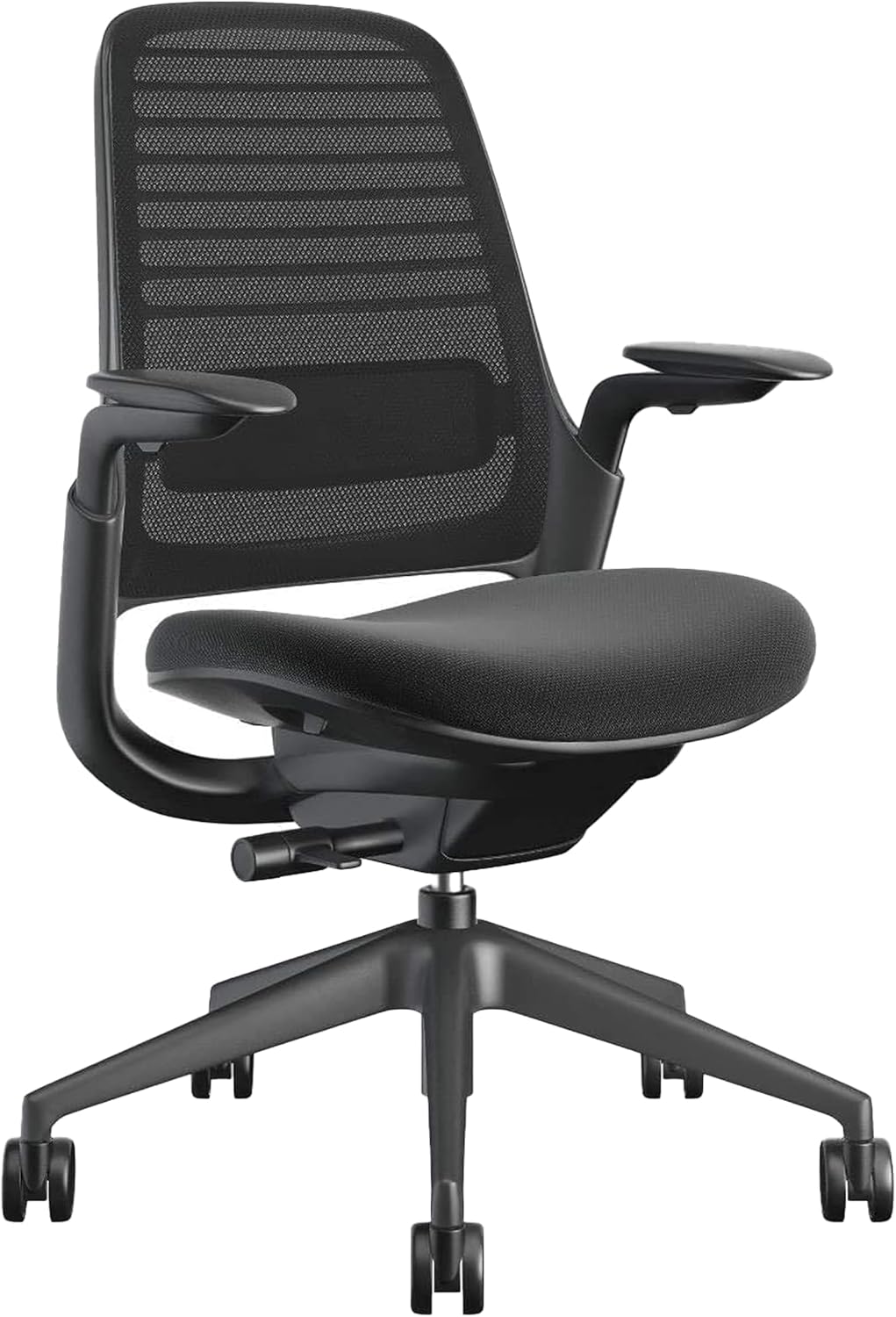 Steelcase Series 1Best overallCheck price on Amazon
 Haworth SojiBest with no assemblyCheck price on Amazon
 HON Ignition 2.0Best contract valueCheck price on Amazon
 Branch Ergonomic Chair ProMost adjustment pointsCheck price on Amazon
 SIDIZ T50Best for compact framesCheck price on Amazon
 SIHOO Doro C300Best self adjusting meshCheck price on Amazon
 Hbada E3 AirBest deep recline in meshCheck price on Amazon
 Nouhaus Ergo3DBest for hard floorsCheck price on Amazon
 AndaSeat Kaiser 3Best gaming style for workdaysCheck price on Amazon
 Autonomous ErgoChair ProBest fit range for tall sittersCheck price on Amazon
Prices move up and down on Amazon, so we never print a price here that could be stale by the time you read it. Use the price check button to see the current price. These chairs ship as heavy flat boxes, and delivery charges vary by seller, so check the total at checkout.
The Best Office Chairs Under 500, Reviewed in Full
Each review below sticks to what can be verified: the published capacity and seat dimensions, how the lumbar support and arms adjust, what the seat and back are made of, and the warranty terms that govern the years after the first.
Steelcase Series 1
Two numbers carry this chair. The rating is 400 lb, the highest in this guide, and Steelcase's compliance certificate records testing to the ANSI/BIFMA X5.1 and X5.11 standards at that weight, which is the paperwork a capacity figure should come with. The cover runs the same way: Steelcase's warranty document puts mechanisms, lumbar parts, cylinders, foam and casters at 12 years, with parts and labor covered and multi-shift use included, so the chair is warranted the way offices actually use chairs.
The working parts match the paperwork. The back flexes in sections as you move instead of hinging at one point, the tilt tension sets itself from your weight, and the lumbar support moves through 2.25 in of travel. Seat depth adjusts by the same 2.25 in, seat height runs from 16.5 to 21.5 in with shorter and taller cylinders available, and the 4D arms shift 4 in across their width. It arrives in two pieces and goes together without tools in under two minutes. Buy it if you want the strongest rating and the longest cover in one chair. Skip it if your desk budget also has to cover a headrest, because that is a separate configuration at a different price point.
Pros
- 400 lb rating, the highest in this guide, with certification paperwork behind it
- 12 year warranty covering parts and labor, multi-shift use included
- Seat depth, lumbar height, arm width and height all adjust
- Tool free assembly in under two minutes
Cons
- Headrest and hard floor caster builds are different configurations
- Weight activated tilt gives less manual control than a tension knob
- Restrained contract styling, the plainest look in the ten
Haworth Soji
The Soji removes the worst hour of chair buying entirely: it arrives fully assembled, so the first thing you do in it is work. Under that convenience sits a proper contract specification. Haworth rates the chair to 325 lb and covers it for 12 years, the same warranty class as the maker's flagship lines, and the certification file carries GREENGUARD Gold and BIFMA LEVEL 3 entries under Haworth's name.
The adjustment set is the sensible core rather than the full catalogue. The lumbar support moves, the seat slides for depth, the back locks and the tilt tension adjusts, and the armrests work in four directions over a foam seat and a flexible mesh back. What this configuration does not offer is forward tilt, so sitters who perch on the front edge of the seat to type should look at the Branch or SIDIZ cards instead. Buy it if you want a contract chair with zero build time and a decade of cover. Skip it if you weigh past 325 lb or know you use forward tilt daily.
Pros
- Arrives fully assembled, no build at all
- 12 year warranty and a 325 lb published rating
- Adjustable lumbar, seat depth, back lock and tilt tension
- Mesh back with a foam seat, the cooler contract combination
Cons
- No forward tilt on this configuration
- 325 lb ceiling rules out the heaviest sitters here
- Fewer adjustment points than the direct brands at this money
HON Ignition 2.0
Office fleets buy this chair by the hundred, and the reasons survive the move to a home desk. The rating is 300 lb, the back is a four way stretch mesh that gives as you lean, and the synchro-tilt keeps the seat and back moving in proportion rather than tipping you as one board. The chair is backed by the HON Limited Lifetime Warranty, which is the longest promise in this guide, attached to the most workmanlike chair in it.
Fit adjustment covers the points that decide a workday. The lumbar support adjusts, the seat slides forward and back for depth, and the arms move for height and width, over a seat height range of about 17 to 22 in. HON publishes a BIFMA LEVEL 3 sustainability certification for the model. Assembly is required and the styling is honest fleet furniture, which will bother some home offices more than others. Buy it if warranty length per dollar is your deciding figure. Skip it if you want a foam seat, a headrest in the box, or a chair that looks designed rather than specified.
Pros
- Limited lifetime warranty, the longest cover here
- 300 lb rating with a synchro-tilt mechanism
- Adjustable lumbar and a sliding seat for depth
- Stretch mesh back that moves with the sitter
Cons
- Assembly required, unlike the Haworth above
- Fleet styling, plainly an office chair
- Arms adjust for height and width only, no depth or pivot
Branch Ergonomic Chair Pro
One check comes before the feature list. In September 2026 the CPSC recalled Branch's standard Ergonomic Chair (recall 26-735) after backrests detached, and the CPSC recall notice covers the standard model's SKUs only. The Pro is a separate model line, its SKUs do not appear in that notice, and it is the Pro that is reviewed here.
On adjustment count nothing else in the ten keeps up. Fourteen points in total, with 5D armrests that move for height, width, depth and pivot and slide at the pad, a lumbar cushion that adjusts vertically and for depth, forward tilt, and a seat depth that extends from 16.7 to 19.7 in over a moulded foam seat and mesh back on an aluminium base. Branch covers the Pro for seven years and offers a 30 day trial, with return shipping deducted from the refund and the original box required, so keep the packaging until the fit is settled. The ceiling is the trade: 275 lb is the lowest rating among the top priced chairs here. Buy it if you fine tune everything and sit inside that rating. Skip it if you are near 275 lb, where the Series 1 is the safer spend.
Pros
- Fourteen adjustment points, the most in this guide
- 5D armrests with pivot and sliding pads
- Seat depth extends to 19.7 in, generous for longer legs
- Seven year warranty and a 30 day trial
Cons
- 275 lb capacity, low for a chair at the top of the band
- Trial returns deduct shipping and need the original box
- Foam seat runs firmer than the mesh chairs here
SIDIZ T50
Most adjustable armrests only move outward. The T50's 3D arms also move inward, which is why this chair fits narrower shoulders and smaller frames that swim inside the wide chairs elsewhere in this guide. It comes from SIDIZ, the seating arm of a contract furniture group, and the engineering shows in the details: a two way lumbar that adjusts for height and depth, a sliding seat for depth, forward tilt, and five tilt lock positions behind a mesh back, with a fabric covered foam seat and an adjustable headrest in the box.
SIDIZ rates the chair at 275 lb to the ANSI/BIFMA standard and certifies it to GREENGUARD as well. The warranty paperwork needs a careful read, because the Amazon page gives three years while SIDIZ's own current pages advertise cover running up to twelve, so confirm which term attaches to your order. The seat height starts at about 18.1 in, high for shorter legs even with the depth slid forward. Buy it if you are compact framed and want contract grade adjustment. Skip it if your feet need a lower seat or your weight sits near the rating.
Pros
- 3D armrests that move inward as well as outward
- Two way lumbar, seat depth slide and forward tilt
- Headrest included on this configuration
- Compact backrest profile suits smaller frames
Cons
- Seat height starts at about 18.1 in, high for shorter sitters
- Warranty terms conflict between the Amazon page and the maker's pages
- 275 lb rating, mid pack at best
SIHOO Doro C300
The C300 takes the opposite route to the Branch Pro: instead of fourteen dials, the lumbar support is a dynamic unit that flexes against your back as you shift, so there is nothing to set and nothing to drift out of setting. The backrest itself moves through four height positions, the headrest travels about 1.8 in up and down and 2.6 in fore and aft, and the tilt mechanism reads your weight and stops at 92, 100 and 112 degrees. Seat and back are both mesh.
SIHOO publishes BIFMA and TUV testing for the C300 with an SGS certified Class 4 gas cylinder, and covers the chair for three years. The load figures need the usual care: the maximum runs to 330 lb, while the maker's UK store works to a recommended figure of about 300 lb, so shop to the lower number. The 3D armrests on this version are linked to the backrest and move as it moves, which some sitters love and some fight. At about 51 lb it is also one of the heavier boxes here. Buy it if you want mesh everywhere and adjustment that happens by itself. Skip it if you want arms that stay exactly where you left them.
Pros
- Dynamic lumbar that adapts without dials or levers
- Full mesh seat and back for warm rooms
- Backrest height and headrest both adjust over real travel
- Three year warranty and published load figures
Cons
- Linked armrests move with the backrest
- Maximum and recommended load figures differ by 30 lb
- Mesh seat feel is firmer than any foam seat here
Hbada E3 Air
This is Hbada's premium line, a different product family from the budget chairs the maker is better known for, and the specification shows the gap. The recline runs to 140 degrees with five locking positions, the tilt tension reads your weight rather than asking for a knob, and the whole chair, seat included, is mesh, so a long afternoon in a warm room never turns into a foam heat soak. The headrest and armrests both adjust four ways, the seat depth travels about 2 in, and the elastic lumbar band flexes across the lower back instead of pressing at one point.
Hbada rates this 2026 edition to a 330 lb maximum load, the joint highest figure among the mesh chairs here. The warranty splits by part: Hbada covers the base, gas lift and casters for five years, and the mechanism, arms, backrest and lumbar parts for three, which is honest paperwork but shorter cover on the parts that move most. The recommended height range runs from 5 ft 1 in to 6 ft 5 in. Buy it if you recline between tasks and want mesh under you as well as behind you. Skip it if you prefer a cushioned seat or one single warranty term.
Pros
- 140 degree recline with five locking positions
- Full mesh seat and back, nothing to trap heat
- 330 lb maximum load and a wide height range
- 4D headrest and armrests at this price
Cons
- Warranty splits, with moving parts covered for three years
- Mesh seat will feel firm to foam converts
- No footrest on this configuration
Nouhaus Ergo3D
The detail that earns this chair its place rolls. A set of blade wheels comes in the box alongside the standard casters, so on hardwood or laminate the chair glides on the floor friendly set from day one instead of marking the boards while you shop for replacements. The rest is a full mesh build on an aluminium base: ElastoMesh across seat and back, 4D armrests, a dynamic lumbar that shifts with the backrest, an adjustable headrest, and a recline to 135 degrees that locks in three positions.
Two paperwork points need plain speaking. Published capacity figures for this chair disagree, running from 275 lb to 330 lb depending on the document, so heavier sitters should work to the lower figure or choose a chair with one clean number. On warranty, Nouhaus's current product page puts the term at five years, longer than the three years in the printed manual the chair launched with. The seat depth is a shallow 16.3 in, which suits shorter thighs and limits taller ones. Buy it for hard floors and a compact seat. Skip it if you are tall, or near any of the published capacity figures.
Pros
- Blade wheels included for hard floors
- Full mesh build on an aluminium base
- 4D armrests, dynamic lumbar and an adjustable headrest
- Five year warranty on the maker's current product page
Cons
- Published capacity figures conflict, from 275 lb to 330 lb
- Shallow 16.3 in seat depth limits taller sitters
- Older manuals show a shorter warranty than the current page
AndaSeat Kaiser 3
Judge this one as a desk chair that happens to wear gaming clothes. The reason it works office hours is inside the backrest: the lumbar support is built in and adjusts for height and depth on two knobs, so it stays where you set it through a working week, unlike the strap on pillows that slide down by Wednesday. The arm tops and neck pillow are magnetic, clicking off for cleaning or replacement as separate parts, and the cover on this size is linen fabric, which cannot peel the way coated gaming chairs do in their third year.
Read the capacity the careful way. The maximum figure is 400 lb, and the recommended working figure is 260 lb, and daily sitting should be planned against the second number. AndaSeat covers functional parts for two years in the US, the shortest term in this guide, and that is the honest trade for the fittings and the fabric at this price. The wheelbase spans 28 in, so measure your floor. Buy it if your desk chair also does evening duty and you want fabric and a real lumbar mechanism. Skip it if you weigh past the recommended figure or want a warranty measured in decades.
Pros
- Built in lumbar adjustable for height and depth
- Linen fabric cover, no coating to peel
- Magnetic arm tops and neck pillow, replaceable as parts
- Full size fittings in a standard desk footprint
Cons
- Recommended working figure is 260 lb against a 400 lb maximum
- Two year warranty, the shortest in this guide
- 28 in wheelbase needs clear floor around the desk
Autonomous ErgoChair Pro
Tall sitters run out of chair before they run out of budget, and this one is built to a longer measure: the fit range runs from about 5 ft 4 in to 6 ft 6 in, with a headrest included rather than sold on. The lumbar support adjusts for height and depth, the armrests work in four directions, the seat slides for depth, and nine adjustment points in total sit over a mesh back and foam seat, with a 300 lb capacity.
The warranty is where this card earns its caution. Autonomous now advertises lifetime cover on the frame and mechanism for new orders, after years of shorter published terms that still appear in older documents and on the Amazon page, so the term printed on your own order confirmation is the one to keep and rely on. The frame is reinforced nylon where several chairs here use aluminium bases, and assembly is required. Buy it if you are tall and want the headrest and the long fit range in the box. Skip it if unsettled warranty paperwork bothers you more than a shorter chair would.
Pros
- Fit range reaches about 6 ft 6 in, the tallest here
- Headrest included, lumbar adjusts for height and depth
- 300 lb capacity with seat depth adjustment
- Mesh back with a foam seat
Cons
- Warranty terms conflict between current and older documents
- Reinforced nylon frame where rivals use aluminium
- Assembly required, and the box is a two person lift for some
Contract Chair, Gaming Chair or Big and Tall: Where the Ten Split
Under $500 buys three different ideas of what a chair is for. The contract brands, Steelcase, Haworth and HON, build for facilities managers: certification paperwork, restrained looks, and warranties that assume the chair will be sat in by a decade of different people. The gaming style chairs build for one owner who reclines hard and wants to be held in place. The big and tall builds spend the money on rating and seat size first and everything else second. The direct brands in this guide, Branch, SIDIZ, SIHOO, Hbada, Nouhaus and Autonomous, borrow from all three, which is why the table below compares the two poles and the verdicts after it place the middle.
| Point of difference | Contract brand task chairs | Gaming style and big and tall builds |
|---|---|---|
| Warranty cover | 12 years at Steelcase and Haworth; a limited lifetime term at HON | 2 years on the Kaiser 3's functional parts; split terms on the E3 Air |
| Weight rating | 400 lb on the Series 1, 325 lb on the Soji, 300 lb on the Ignition 2.0 | 400 lb maximum on the Kaiser 3 against a 260 lb recommended figure; 330 lb maximum on the E3 Air |
| Lumbar approach | Adjustable mechanisms placed by hand, on all three | Built in dual knob lumbar on the Kaiser 3; an elastic flexing band on the E3 Air |
| Seat and recline | Foam or mesh seats, workday reclines, forward tilt rare | Deep reclines to 140 degrees, larger seats, wider wheelbases |
| Fit evidence | Certification files and published dimension sheets | Two figure capacity ratings that need careful reading |
Choose the contract side if the chair is a once a decade purchase and the paperwork matters to you: the Series 1 for the rating, the Soji for zero assembly, the Ignition 2.0 for the lifetime term. Choose the gaming and big build side if you recline between tasks or need seat room first: the Kaiser 3 in fabric for work and play, the E3 Air if you want the deep recline in mesh rather than upholstery.
Per reader, the verdicts run like this. The full day remote worker should start with the Series 1 or the Branch Pro, the two chairs whose adjustment sets cover every workday variable. The tall sitter should start with the ErgoChair Pro for its fit range, or the Series 1 on its taller cylinder. The small office should start with the Soji or the T50, the two compact footprints here. And the buyer who wants the longest warranty per dollar should read the Ignition 2.0 card twice, because a limited lifetime term at this money has no rival in the ten.
Also considered
- Steelcase Series 2: the taller backed sibling of our top pick, held out because its current Amazon price sits over this guide's cap, while the Series 1 covers the line inside it.
- Herman Miller Sayl: the suspension back design piece, held out on price over the cap by a wide margin on the day of checking.
- Secretlab TITAN Evo: the gaming flagship we reviewed in our gaming guide, held out here because its current price sits over the cap, so the Kaiser 3 carries the gaming style slot instead.
- FlexiSpot C7: a well specified direct brand chair, held out because no clean Amazon.com listing for the standard model could be verified for a buy link.
- Colamy: an Amazon native executive line, held out on premise, because a one year warranty and thin maker documentation fail the standard this guide sets.
Who this guide is for
The full-time remote worker buying once, properly
You have done the sub $200 round and watched the foam go flat. Your question is no longer what feels fine in week one, it is which chair publishes the rating, the dimensions and the warranty that make year three predictable, and every card above is written to answer that question first.
The taller or heavier sitter who needs numbers that hold up
You need a published weight rating with headroom, seat depth that reaches your thighs, and a back tall enough to matter. The Series 1, the ErgoChair Pro and the high capacity mesh chairs are your starting points, and the two figure ratings in this guide are printed in full so you can shop to the honest number.
The small home office where space is part of the spec
Your chair shares a room with the rest of your life, so footprint, arm clearance under the desk and behaviour on your floorboards count alongside comfort. The Soji and the T50 keep the smallest footprints here, and the Ergo3D is the one that thinks about your floorboards out of the box.
What to look for when buying an office chair
- A published weight rating with headroom: a rating is only useful if your daily weight sits comfortably under it, and where two figures appear, a maximum and a recommended limit, the recommended one is your working number.
- Warranty length, by part: frame and mechanism terms run far longer than foam and caster terms on several chairs here, so read the split rather than the headline; the BIFMA Compliant registry lists seating verified against the ANSI/BIFMA X5.1 and X5.11 standards behind the certification badges.
- Lumbar support you can place: fixed arches fit the back they were shaped for, adjustable mechanisms fit yours, and dynamic systems flex as you move, so choose the approach that matches how much you like to fiddle.
- Arms that clear the desk: height adjustment is the minimum; width and depth adjustment decide whether the chair tucks under a standard desk top or parks beside it all day.
- A return route you can actually use: these chairs arrive flat and heavy, so a trial only protects you if you keep the box and can rebuild it; check the terms before the first bolt.
Sizes, fit and space for an office chair
Start with seat height, because it decides whether your feet rest flat. The Series 1 spans 16.5 to 21.5 in and offers shorter and taller cylinders either side of that, while the T50 starts at about 18.1 in and the C300 at about 18.5 in, both high for shorter legs. Seat depth is the second measurement: it should support most of your thigh without the front edge pressing behind your knee, the same fit test the OSHA workstation chair guidance sets out, and the chairs here answer it with sliders that run from about 2 in of travel on the E3 Air to a full extension of 19.7 in on the Branch Pro.
Width and floor come next. Overall widths run from about 28 in on the Ergo3D to 29.3 in on the Branch Pro, and the Kaiser 3's wheelbase spans 28 in, so measure the gap the chair lives in, not just the desk. On floors, match the casters to the surface: the Series 1 configuration reviewed here carries carpet casters, the Ergo3D includes blade wheels for hard floors in the box, and standard hard casters on wood or laminate will mark boards over a year of rolling. Leave clear space behind the desk for the recline you paid for, since a 140 degree backrest needs roughly its own length again in open room.
What office chairs at this level cost to own
The warranty map is the ownership story of this guide. At one end, Steelcase and Haworth run 12 year terms and HON a limited lifetime term. In the middle sit Branch at seven years, Nouhaus at five, and the split terms from Hbada, five years on the base parts and three on the moving ones. At the short end, SIHOO runs three years and AndaSeat two, so the same failed gas lift is a claim on one chair and a purchase on another. Two chairs here, the SIDIZ T50 and the Autonomous ErgoChair Pro, carry warranty paperwork that conflicts between documents, and in both cases the term on your order confirmation is the one that will be honoured, so save it.
Running costs are otherwise modest and predictable. Casters are the first consumable and a set is a small, routine purchase; fitting floor friendly wheels early is cheaper than refinishing a marked board. Arm tops and pillows come next, and on the Kaiser 3 they are magnetic parts sold separately, which is the practical point of that system. Assembly is the other hidden cost, paid in time: nothing at all for the Soji, under two minutes for the Series 1, and around twenty minutes for most of the rest. Returns are the cost to avoid entirely, because sending back a built chair means part stripping it, rebuilding the packaging and arranging collection for a box between 42 and 51 lb, and trial terms can put the carriage cost on you.
Common mistakes when buying an office chair
- Throwing the box away on day one: trial and return terms at this level can require the original packaging, and a built chair without its box is close to unreturnable; flatten it and store it until the fit is certain.
- Shopping to the maximum load figure: a maximum is a ceiling, not a working recommendation, and sitters who live at the ceiling wear foam, lifts and mechanisms at the fastest rate.
- Assuming every configuration sits under the cap: contract chairs move across the $500 line with colour, casters and headrests, so check the exact build in your basket, not the model name.
- Ignoring the caster and floor match: carpet casters drag on hard floors and hard casters score wood, and the fix costs more after a year of rolling than the right wheels cost at checkout.
- Buying recline your room cannot use: a 140 degree recline needs clear floor behind the desk, and in a small room that depth becomes a daily collision rather than a feature.
Office chair pros and cons
Pros
- Decade plus warranties are genuinely available at this money
- Published ratings and dimensions detailed enough to buy by fit
- Adjustment sets that cover arms, lumbar and seat depth together
- Replaceable casters, arm tops and pillows on several designs
Cons
- Warranty paperwork conflicts on some direct brands
- Heavy flat boxes make a wrong choice expensive to undo
- Mesh seats divide sitters who expect a cushioned feel
- Famous lines cross the cap in many of their configurations
Who should not buy an office chair at this level
Skip this money if your sitting is light and occasional, because a simple task chair serves a few hours a week just as well and leaves most of the budget unspent. Skip it too if you need a rating beyond 400 lb, since nothing here is published past that figure, and if your room cannot give a chair its floor space, because a wide wheelbase and a deep recline in a cramped corner become daily irritations. In each of those cases the honest purchase sits outside this guide, not in a cheaper row of it.
Best Office Chair Under 500: Frequently Asked Questions
What does $500 buy in an office chair that $200 does not?
Published evidence, mostly. At this level you get a weight rating with certification paperwork behind it, seat dimensions detailed enough to check against your own body, adjustment for arms, lumbar and seat depth in one chair, and warranty terms measured in years or decades rather than months.
How long a warranty should I expect at this level?
Anywhere from two years to a limited lifetime term, and the spread is the sharpest split in this guide. The contract brands run 12 years or lifetime cover, the direct brands run two to seven, and several terms split by part, so the mechanism and foam can expire years before the frame does.
Which of these chairs suits a taller or heavier sitter?
For weight, the Steelcase Series 1 carries the highest published rating here at 400 lb, with the Hbada E3 Air at a 330 lb maximum behind it. For height, the Autonomous ErgoChair Pro publishes the longest fit range, to about 6 ft 6 in, and the Branch Pro extends its seat depth to 19.7 in for longer legs.
Is mesh or a foam seat better for a full workday?
Mesh runs cooler and cannot pack down, and the full mesh chairs here, the C300 and the E3 Air, stay the same shape all day. Foam seats feel softer at first contact and insulate in a cold room, which is why the contract chairs pair a foam seat with a mesh back. Neither is a health question; it is a room and preference question.
What should I check before ordering so I do not have to return the chair?
Three measurements and one habit. Check the seat height range against your leg length, the seat depth against your thigh, and the overall width and wheelbase against your floor gap. Then keep the box, flattened, until you have sat in the chair for a full working week, because returns at this weight need the packaging.
Keep researching
If the open question is still fit, take the three measurements in the sizes section against the cards before you order, because at this weight the return is the expensive part of any mistake.
- Office chair hub: every Pick Hearth office chair guide, from budget picks to this premium level.
- Office & Work From Home hub: the wider home office range, including desks, monitors and accessories.
More in Office & Work From Home: browse the full Office & Work From Home hub for the rest of our home working guides.
How we check office chairs like these
Read the full Pick Hearth methodology- Premise and specifications checked against manufacturer documents and listings, including capacities, dimensions and warranty terms for the exact configuration reviewed -
- Conflicting figures printed as conflicts rather than resolved quietly, including two figure weight ratings and warranty terms that differ between documents -
- No brand can pay for a place, and affiliate earnings never change the order
First published · Updated in place as products and specs change