Our top picks at a glance
Picture the scene this purchase is really about. You come out to the car, notice one tyre sitting a little low and soft at the edges, and the light is already going. A small car gives you no spare room to waste: whatever you buy has to tuck into a corner of the boot, a glovebox or under a seat, and it has to work standing in a puddle with the engine running. A garage compressor fails that test before it starts, because it stays in the garage. Every pick below passes it. Each one is maker-rated for car tyres, runs from the car's own 12V socket or a battery it carries itself, and costs less than the band in the title at the time of checking. The AstroAI S1 leads the list because it does the ordinary job best: plug in, set the pressure, let it stop itself. Drivers who hate cables should look at the L7 and the Powools further down, and anyone who wants a pump that works even with a flat battery of its own should end at the OlarHike.
 AstroAI S1Best overallCheck price on Amazon
 EPAuto 12V DC Portable Air CompressorBest proven simple 12VCheck price on Amazon
 AstroAI AIRUN HBest airflow for top-upsCheck price on Amazon
 CARSUN Digital Air Compressor (CAP-001)Best low-cost digital 12VCheck price on Amazon
 FORTEM Tire Inflator (FRTM-DAC)Best with a carrying caseCheck price on Amazon
 Slime 40047 Tire InflatorBest rugged buildCheck price on Amazon
 AstroAI CZK-3674Best compact 12V with onboard storageCheck price on Amazon
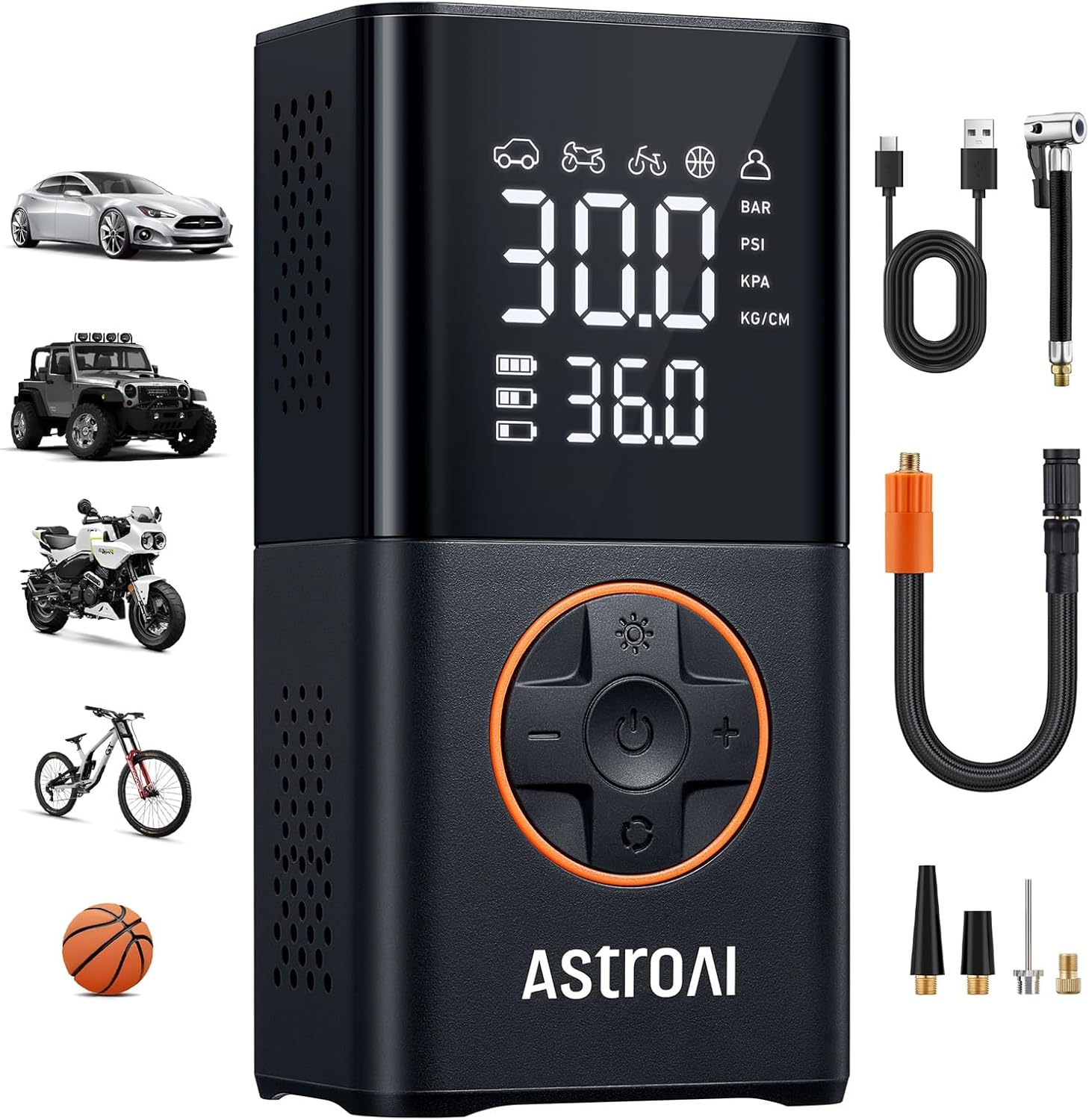 AstroAI L7Best glovebox cordlessCheck price on Amazon
 Powools Cordless Tire Inflator (ATJ-6988)Best cordless for bikes and balls tooCheck price on Amazon
 OlarHike Tire Inflator (TIC3V401)Best dual powerCheck price on Amazon
Pick Hearth is reader supported. When you buy through links on this page we may earn a commission from Amazon, at no extra cost to you. Prices and availability change; the price check button on each pick shows the current Amazon price.
The Best Portable Tire Inflators Under 50, Reviewed in Full
AstroAI S1
If a small-car driver wants one recommendation and no homework, the S1 is the one to hand them. An 185/55 R14 tyre goes from 30 to 36 PSI in under a minute, and from fully flat at 0 to 36 PSI in under five minutes. Those are the two jobs a boot inflator actually does. The digital gauge lets you set the target once and walk away while it stops itself, which matters when the target is only a few PSI away. It runs for up to 15 minutes continuously before it needs a rest, long enough for four small tyres with room to spare. There is no airflow figure to lean on here, so the timed claims carry the speed story. Buy it if you want the default choice. Skip it if you want a battery unit that also pumps up bikes away from the car.
Pros
- Tops up an 185/55 R14 tyre from 30 to 36 PSI in under a minute
- Preset pressure with auto shut-off and a clear digital gauge
- Small and light enough for a glovebox or a corner of a small boot
- Full adapter kit and a replacement fuse in the box
Cons
- No airflow figure published, so speed rests on the maker's timed claims
- 12V only, so it is useless away from the car
- Maximum continuous run of 15 minutes before a cool-down
EPAuto 12V DC Portable Air Compressor
The EPAuto has been the default budget 12V pump for years, and its honesty is part of the appeal: it tells you plainly that it does not support truck tyres and that it plugs into a 12V socket and nothing else. Its airflow of 1.06 CFM is modest, which is exactly why it suits a small car, where the job is adding a few PSI rather than seating beads on a pickup tyre. The display reads in four units, the pump stops at the pressure you set, and overheat protection cuts it off if you push it too long. One wrinkle worth knowing: EPAuto's own figures do not agree on the ceiling, with 70 PSI maximum working pressure in the listing and 60 PSI for passenger vehicles in the manual. Either figure clears a small car's needs with room to spare, but we would not buy it for anything that needs more. Buy it if you want the proven, simple option. Skip it if your next car is an SUV on high-pressure tyres.
Pros
- Long-running, widely owned design with straightforward controls
- Auto shut-off plus overheat protection
- Light at 1 lb, with adapters for balls and inflatables included
- Four pressure units on the display
Cons
- EPAuto's own documents disagree on the max pressure (70 PSI in the listing, 60 PSI for passenger vehicles in the manual)
- Modest airflow, so a fully flat tyre takes patience
- 12V socket only; it will not run from a wall outlet or a battery
AstroAI AIRUN H
Headlines go to pressure ceilings, but you feel airflow while you wait at the kerb. The AIRUN H gives 35 L/min, joint highest here, and a 195/65 R15 tyre goes from 30 to 36 PSI in under a minute in ideal conditions. Treat the words "ideal conditions" seriously, because a cold morning and a tired car battery will stretch that time, but the direction is right: for the monthly top-up round, this is the corded pick that gets you back indoors soonest. The 100 PSI ceiling is lower than the 150 PSI figures elsewhere in this guide, and for a small car that is a fair trade, since the tyre only ever asks for around 30 to 36 PSI and the pump's effort goes into moving air instead of building pressure you will never use. Buy it if top-ups are your main job. Skip it if you also need to inflate anything that genuinely needs high pressure.
Pros
- 35 L/min airflow, the joint highest here
- A 195/65 R15 top-up in under a minute
- Digital preset with auto shut-off
- Valve extender and quick connector included
Cons
- 100 PSI ceiling, the joint lowest in this guide
- Size and weight are not given
- Corded only, like every 12V pick here
CARSUN Digital Air Compressor (CAP-001)
The CAP-001 is the cheapest route in this guide to the full modern checklist: digital gauge, preset pressure, auto shut-off, 35 L/min of airflow and a 10 ft cord that reaches the back tyres of a small car without unplugging between corners. It inflates a 195/65 R15 tyre from 0 to 35 PSI in under five minutes, a proper flat-to-full claim rather than a top-up one, and it is plainly not suitable for trucks or motor lorries, which is the kind of honesty we look for at this price. One caution: CARSUN's own figures disagree on the motor's power rating, so no wattage is settled for this pump. Judge it on airflow and its timed claim. Buy it if you want the full feature set for the least money. Skip it if a fully flat tyre is a weekly event rather than an emergency; a stronger pump earns its keep there.
Pros
- Digital preset and auto shut-off at the lowest price point here
- 35 L/min airflow with a flat-to-full timed claim
- 10 ft power cord reaches all four corners of a small car
- Trucks are ruled out, plainly
Cons
- The maker's own spec tables disagree on motor power, so treat wattage claims with suspicion
- Hose length is not given
- Build and finish are a step behind the AstroAI units
FORTEM Tire Inflator (FRTM-DAC)
Most cheap inflators turn into a pump plus a tangle, and six months later the nozzles are lost in the boot carpet. The FORTEM suits people who know that about themselves. It comes in a case, the cable tucks inside, and the three nozzle attachments have a place to live. The digital gauge, preset and auto shut-off match the rest of the guide, and the LED light covers the night-time top-up. Two honest weaknesses. There is no airflow figure for it, and its maximum continuous working time is only eight minutes, the shortest in this guide, so a full set of four flat tyres means working in bursts with rests between. Its power cable length is not settled either; what holds throughout is that the cable is long and stores away inside the housing. Buy it if tidiness decides whether a tool stays in the car. Skip it if you regularly inflate from fully flat.
Pros
- Carrying case included, and the cable stores inside the unit
- Digital gauge with preset and auto shut-off
- LED light and three nozzle attachments in the box
- 1-year warranty
Cons
- Shortest duty cycle here: eight minutes of continuous work per review documentation
- Airflow: no figure at all
- Its power cable length is unsettled
Slime 40047 Tire Inflator
Slime made its name on tyre repair, and the 40047 is built for a boot that is rough on tools. Rubber armour, a proper handle on top, and a body made to be grabbed, dropped and grabbed again. Its Inflate Right system is the auto shut-off under a brand name: set the pressure and the pump stops there. It inflates a standard car tyre from flat to full in four minutes. The trade for the tough shell is information: this pump comes with less of it than the others here, with no airflow figure and no settled hose or cord lengths. Buy it if your boot kit lives a hard life. Skip it if you compare spec sheets before you buy, because this one will frustrate you.
Pros
- Rubber-armoured housing and a grab handle, built for rough storage
- Inflate Right automatic shut-off at your set pressure
- Four minutes from flat to full on a standard car tyre
- LED light for night use
Cons
- No airflow figure to judge speed by
- Display range tops out at 99 PSI, so it is a car-only tool in practice
- Hose and cord lengths are not given
AstroAI CZK-3674
This is the other AstroAI 12V pump, and the difference from the S1 is storage rather than muscle. The adapters and the spare fuse live in a compartment inside the unit, which sounds like a small thing until you are kneeling at a rear tyre at night with a needle valve adapter missing. Airflow is 25 L/min, and a top-up from 29 to 36 PSI takes one minute; that top-up does not name a tyre size, so treat it as a top-up figure rather than a promise for your exact tyre. Cord and hose together reach 11.1 ft, enough to walk around a small car from one socket. Like the AIRUN H, the ceiling is 100 PSI, and like the S1 it needs a ten-minute rest after 15 minutes of continuous running. Buy it if loose accessories are your personal failure mode. Skip it if you want the S1's timed claims on a named tyre size.
Pros
- Adapters and spare fuse store inside the unit
- 25 L/min airflow
- Cord and hose together reach 11.1 ft
- Digital preset with auto shut-off and an LED light
Cons
- 100 PSI ceiling, shared with the AIRUN H as the joint lowest here
- The one-minute top-up claim does not name a tyre size
- Weight is not given
AstroAI L7
At 0.88 lb, the L7 is the one pick here that genuinely disappears into a glovebox. There is no cord to trail through a wet car park: you walk to the soft tyre, connect, set the pressure on the dual-values display and let it stop itself. The battery charges over USB-C and can give some charge back to a phone in a pinch, which is a thoughtful touch in a breakdown tool. The compromises are the honest cordless ones. Airflow is 17 L/min, the lowest figure in this guide, so a fully flat tyre is a slow job. Its limits are clear: rest it for ten minutes after 15 minutes of continuous use, and do not use it on tyres larger than 25 inches or heavy-duty tyres. And a cordless pump that sat in the glovebox for a year is only as good as the charge you left in it. Buy it if you top up little and often and hate cables. Skip it if the pump will sit untouched for months; a corded pick never goes flat on you.
Pros
- 0.88 lb and truly glovebox-sized
- No cord: walk to any tyre, including a bike in the shed
- USB-C charging, and it can charge a phone back
- Digital display with auto shut-off
Cons
- 17 L/min airflow is the slowest here; flat tyres take a while
- Not for tyres over 25 inches or heavy-duty tyres
- A forgotten charge turns it into a paperweight
Powools Cordless Tire Inflator (ATJ-6988)
If the pump's second job is a household one, bikes, a pram, footballs and a paddling pool by the weekend, the Powools earns its place. An independent tool trial of this model recorded a standard car tyre going from 30 to 36 PSI in under a minute, about two car tyres or around 25 bike tyres or 60 balls from one charge, and roughly 25 minutes of total runtime, which tells you exactly what it is: a quick, willing top-up tool rather than a flat-tyre rescue service. The airflow of 20 L/min sits above the L7, and the storage bag and four adapters come in the box. Standard and Large Capacity variants sit side by side with different sizes and weights, so check which variant is in the cart before you pay. Buy it if bikes and balls share the pump with the car. Skip it if you want one clearly specified model with no variant homework.
Pros
- Independently trialled at under a minute for a 30 to 36 PSI car tyre top-up
- About two car tyres, 25 bike tyres or 60 balls per charge in the same trial
- Storage bag and four adapters included
- 20 L/min airflow, a step up from the glovebox L7
Cons
- Two capacity variants, sized and weighted differently
- Roughly 25 minutes of runtime per charge is top-up territory, not flat-tyre territory
- Battery still needs periodic charging to be ready
OlarHike Tire Inflator (TIC3V401)
Dual power is the answer to the cordless pump's one real fear. Run the OlarHike from its battery for a quick top-up at the kerb, and if the battery is flat when you reach for it, plug in the 12V cord and inflate anyway. A 195/65 R15 tyre goes from 30 to 35 PSI in 55 seconds, with up to 18 car tyres per charge on top-ups like that, and the 24 L/min airflow is the strongest figure among the battery picks here. It also works as a phone charger and comes with a storage bag and a full adapter set. Now the honesty paragraph, because this one needs it. Its title claims 150 PSI while its own specification field says 160 PSI, so no maximum pressure for it is settled; a separate note also caps car and pickup tyres at 51 PSI of working pressure. None of that stops it topping up a small car, whose tyres live around 30 to 36 PSI. Buy it if you want cordless freedom with a corded safety net. Skip it if contradictory spec sheets put you off a product entirely; we would understand.
Pros
- Battery and 12V cord in one unit, so a flat battery never strands you
- 24 L/min airflow, the best among the battery picks
- 55 seconds for a 195/65 R15 top-up, 30 to 35 PSI
- Storage bag, adapters and a phone-charging USB output included
Cons
- The listing contradicts itself on maximum pressure: 150 PSI in the title, 160 PSI in the spec field
- Car and pickup tyres are capped at 51 PSI working pressure
- Hose and cord lengths are missing
What This Budget Does and Does Not Buy
This band buys a real tool, not a toy, but it buys a specific kind of tool: a top-up pump for cars that live on ordinary tyres. The split that matters most is power. A 12V corded inflator never needs charging and can sit in a boot for years, then work the one night you need it; a cordless battery inflator walks to any tyre and doubles for bikes and balls, but a flat battery makes it a paperweight until it has charged. The OlarHike at pick 10 exists because some drivers refuse to choose. What this band does not buy is a garage compressor's stamina. If the real question is whether one of these replaces the compressor on the garage wall, we work through that separately in Portable Tire Inflator vs Air Compressor. Here is the honest shape of the trade:
| Point of difference | Option A | Option B |
|---|---|---|
| Power source | 12V corded: always ready, never charged, tied to the car | Cordless battery: free of the cable, useless if left flat |
| Gauge and shut-off | Digital preset with auto shut-off on all ten of our picks | Simpler pumps below this band often make you watch a dial and guess |
| Speed on a small car | Top-ups of a few PSI in about a minute on named tyre sizes | A fully flat tyre still takes several minutes, whatever the headline PSI says |
| Continuous running | Short bursts: 8 to 15 minutes, then a rest, by design | A garage compressor runs as long as the job takes |
| Pressure ceiling | 100 to 150 PSI on most picks, far above the 30 to 36 PSI a small car needs | High ceilings alone do not inflate faster; airflow does that |
Read the speed row twice, because it is where budget listings mislead politely. A maximum pressure figure tells you the ceiling a pump can reach, not how fast it gets your tyre from 28 to 34 PSI. Airflow, in litres per minute or CFM, is the number that shortens the wait.
Also considered
Xiaomi Portable Electric Air Compressor 2: a beautifully made little pump, but its Amazon.com price sat above the band at research time, so it misses a guide defined by that band.
GSPSCN dual-cylinder 12V inflators: strong airflow and a metal build, but the Amazon.com prices sit above the band and the sizing suits bigger vehicles than this guide's small cars.
UUP double-cylinder inflators: fast on paper, but a 25 amp draw is more than many small-car sockets are fused for, and the range is built truck-first.
Fanttik X9 Ace Mini Bike Pump: a bicycle pump, whatever the marketing hints; it fails this guide's rule that every pick must be maker-rated for car tyres.
VacLife VL701 (ATJ-1166): a long-running 12V favourite, but its own manual caps car tyres at 50 PSI, its listing copies disagree on cord length, and we could not verify a current in-band Amazon.com offer for it at research time.
Who this guide is for
If you run a small car
Your tyres are modest, your boot is smaller, and your 12V socket is fused for sensible draws. Every pick here was screened against exactly that car: compact enough to store, maker-rated for car tyres, and happy at the 30 to 36 PSI your door sticker most likely asks for. Start at pick 1 and only move down the list if a specific feature, cordless freedom or a case, matters more to you.
If you drive with kids in the back
A soft tyre with children aboard is a different problem: you want the fix to be quick, boring and done at the roadside without unloading the boot onto the verge. The corded picks with preset auto shut-off, the S1 and the EPAuto, let you set the pressure, connect and keep your attention on the traffic and the kids. The Slime 40047 is the other sensible choice here, because it survives being stored under everything else you carry.
If you take long drives
Distance changes the maths. A cordless pump that was charged in spring may not be charged by the autumn trip, so long-distance drivers should lean corded, or take the OlarHike's dual power and get both. Check pressures the day before a long drive rather than the morning of it, top up at home where it is calm, and any of these pumps then only has to handle the emergency you hope never happens.
What to look for when buying a portable tire inflator
Start with power, because it decides the habit. Corded 12V pumps suit drivers who will forget a battery exists; cordless pumps suit drivers who will actually charge one, and who gain the bikes and balls use as a bonus. Second, read airflow before maximum pressure: for a small car, anything around 20 to 35 L/min handles top-ups comfortably, while the PSI ceiling only needs to clear your tyre pressures with headroom. Third, insist on a digital gauge with preset auto shut-off at this money; it is the feature that turns a roadside chore into a set-and-wait job. Fourth, check the duty cycle, the minutes of continuous running before a rest, and treat a missing figure as a warning. Fifth, measure reach: cord plus hose has to get from your socket to the far rear tyre. Our longer How to Choose a Portable Tire Inflator guide walks through each of these in more depth, including the socket fuse ratings worth checking on older cars. Finally, buy the storage you will actually use: a case or onboard compartment is worth more than a second nozzle set.
Portable Tire Inflator Sizes and Storage
The corded pumps in this guide are roughly the size of a thick paperback book or a small lunchbox, and the cordless ones are closer to a drinks bottle or a chunky torch. In a small car, that difference decides the storage spot. A glovebox takes the L7 and not much else on this list. Under a front seat suits the flatter corded units, the S1 and the AIRUN H, as long as the seat still slides. The boot corner is home for everything else, ideally inside the spare wheel well if your car has one, or strapped against a side wall so the pump is the first thing you find rather than the last. Two habits keep a stored pump useful: keep its adapters with it, in its case or compartment, because a pump without its valve connector is a paperweight with a motor; and if it is a battery model, put a note with your service paperwork to charge it twice a year, because storage is where cordless pumps quietly die.
How much does a good portable tire inflator cost
Enough to cover a digital gauge, auto shut-off and an honest airflow figure, and not much more: that is what this band is. Below it, you start meeting analogue dials you have to watch, missing duty cycle figures, and listings whose wattage changes from one spec table to the next. Above it, money buys stamina and speed rather than new features: dual cylinders, longer continuous running, metal bodies and faster flat-to-full times. Drivers who want the wider picture, including the models that sit above this band and earn it, should read our main guide, Best Portable Tire Inflator for Small Cars. One cost nobody prints on the box: a pump this size replaces the pay-per-use air line at the petrol station a few times a year and, more importantly, removes the excuse for driving on a soft tyre because the machine was out of order or the queue was long. Running costs are close to zero beyond that: a replacement fuse now and then, and for battery models, a charge cycle you were already spending on a phone.
Common mistakes when buying a portable tire inflator
The classic mistake is buying on maximum pressure alone, then discovering that a 150 PSI mini pump still takes five minutes on a flat tyre because its airflow is tiny. Pressure is a ceiling, not a speed. Second: buying a bicycle mini pump in car clothing, which is why this guide screens every pick against its own maker's car tyre claims. Third: never checking your car's socket fuse rating, then blaming the pump when a high-draw unit pops the fuse. Fourth: storing a cordless pump and forgetting it for a year, then meeting it again, flat, on the one night it matters. Fifth: throwing the adapters loose into the boot, where they vanish. And sixth: ignoring the first sign of trouble, a pump that runs but does not inflate, a hose that hisses at the valve, a gauge that reads nonsense. Those are repairable, understandable faults, and our Portable Tire Inflator Not Working notes walk through the checks in order, starting with the fuse and the valve connection. A budget pump cared for like this outlasts a careless driver's expensive one.
Budget Portable Tire Inflator Pros and Cons
Pros
- The full modern checklist, digital gauge, preset and auto shut-off, is available at this band
- Every pick stores in a small car without giving up real boot space
- Corded models can sit ready for years; cordless models cover bikes and balls too
- Top-ups at home end the petrol station air queue and the driving-on-soft-tyres habit
Cons
- Duty cycles are short: these are top-up tools, not workshop compressors
- Fully flat tyres take minutes, not seconds, whatever the pressure ceiling says
- Battery models are only as ready as their last charge
- Spec sheets at this price sometimes contradict themselves, as two of our ten picks show
Who should not buy a portable tire inflator
Skip this purchase if your car lives at a workshop with a compressor you can use freely, or if you would honestly never check a pressure between services; a pump in a boot you never open helps nobody. Skip the whole category, and spend more or go to a tyre shop, if you run a large SUV, a van or a pickup on high-pressure or oversized tyres: several picks here rule those vehicles out by name, and the rest are built for small car work. And skip the budget band itself if you inflate from flat weekly, for a slow leak you have been meaning to fix: fix the tyre, because no inflator is a repair, and repeated full inflations will cook a small pump's duty cycle and your patience together.
Best Portable Tire Inflator Under 50: Frequently Asked Questions
Is a cheap portable tire inflator worth it under 50?
Yes, for the job it is actually for. At this band you get a digital gauge, preset auto shut-off, a work light and top-up times around a minute on small car tyres, which covers the monthly pressure check and the slow puncture that needs air to reach a tyre shop. What you do not get is workshop stamina. Judge it as a top-up tool that lives in the car, and it earns its money the first time it saves a trip or a tyre.
What do you give up with a budget portable tire inflator?
Mostly time and stamina. Duty cycles run from about 8 to 15 minutes before a rest, against a garage compressor that runs as long as you like. Fully flat tyres take minutes rather than seconds. Cases, spare fuses and tidy cable storage appear on some models and not others. And you give up a little certainty: at this price, spec sheets occasionally contradict themselves, as two of the ten picks here show.
Which features do you still get under 50?
More than you might expect. Every pick here has a digital gauge and automatic shut-off at a pressure you preset, which is the pairing that matters most at the roadside. Work lights are standard across the ten. Seven of the ten give an airflow figure, up to 35 L/min on the corded AstroAI AIRUN H and CARSUN. Adapters for Presta valves, needles for balls and spare fuses appear again and again. What stays rare at this band is a proper case and dual power, which is why the FORTEM and the OlarHike hold their slots.
How do you spot a bad cheap portable tire inflator?
Look for a listing that leads with a huge pressure figure but gives no airflow figure, no duty cycle, and no tyre size behind its speed claims. Treat shifting spec tables as a warning too: if one page gives two different wattages or two different maximum pressures for the same pump, believe neither and judge the product on what is consistent. A bicycle mini pump dressed in car language is the other regular offender; a genuine car inflator names car tyre sizes and car tyre times in its claims.
How long does a budget portable tire inflator last?
Used as a top-up tool and rested inside its duty cycle, there is no reason a pump here should not give years of monthly service; the moving parts work a few minutes at a time and rest for weeks between jobs. The killers are heat and neglect: long continuous runs on flat tyres, storage in a damp boot, and, for battery models, being left empty for a year. Keep the adapters with the pump, let it cool when it asks, charge battery models a couple of times a year, and a budget inflator stops being a disposable purchase.
Keep researching this portable tire inflator
Our main guide to portable tire inflators for small cars, with the full range including models above this budget.
ComparisonPortable Tire Inflator vs Air CompressorWhen a portable pump is enough, and when the garage compressor is genuinely the better tool.
How to ChooseHow to Choose a Portable Tire InflatorPower sources, airflow, gauges, duty cycles and reach, explained before you spend anything.
Buying GuidePortable Tire Inflator Not WorkingThe checks to run, in order, when a pump runs weakly, reads wrongly or will not inflate at all.
More in Automotive
AutomotiveAll Pick Hearth guides in this categoryHow we check portable tire inflators like these
Read the full Pick Hearth methodology- Premise first: every pick had to prove, from its own listing, that it serves a small car: compact enough for a small boot, glovebox or under a seat, maker-stated car tyre capability, and power from a 12V socket, a rechargeable battery or both. Bicycle-only mini pumps and mains-only workshop compressors were excluded, however good their reviews.
- Specs from the listing, checked against themselves: we took each figure from the maker's listing copy and cross-read the tables and manuals behind it. Where a listing contradicts itself, on maximum pressure for the OlarHike and on power figures for the CARSUN, we did not print the contested number and said why on the card.
- Band discipline: every pick had an Amazon.com offer under the band at research time on 12 November 2026, checked from dated listing copies. A price that only existed through a coupon code, a bundle variant or a different model in the same listing did not count, and products that failed that test were replaced and named in our notes.
First published · Updated in place as products and specs change