Our top picks at a glance
Salad prep splits into three jobs, and the ten picks divide cleanly across them. Grid dicers (Fullstar, Mueller, Cuisinart, OXO, Alligator, Vidalia) press produce through a fixed blade grid, which is the only way to get true cubes for chopped salads, salsas and garnishes. Pull and pump choppers (Kuhn Rikon, Chef'n, Brieftons) spin blades inside a bowl, trading perfect cubes for speed on onion, herbs, nuts and slaw. The Joseph Joseph set stacks four tools on one base for kitchens where storage, not speed, is the problem. Capacities run from 2 cups to 8.5 cups, so match the box to your bowl before you match it to your budget.
 Fullstar The Original Pro ChopperBest overallCheck price on Amazon
 Mueller Pro-Series 10-in-1Most versatileCheck price on Amazon
 Cuisinart PrepExpressBest for uniform diceCheck price on Amazon
 OXO Good Grips Vegetable and Onion Chopper with Easy Pour OpeningEasiest to emptyCheck price on Amazon
 Alligator Vegetable ChopperBest precision diceCheck price on Amazon
 Kuhn Rikon Pull ChopBest pull chopperCheck price on Amazon
 Chef'n VeggiChopBest for small kitchensCheck price on Amazon
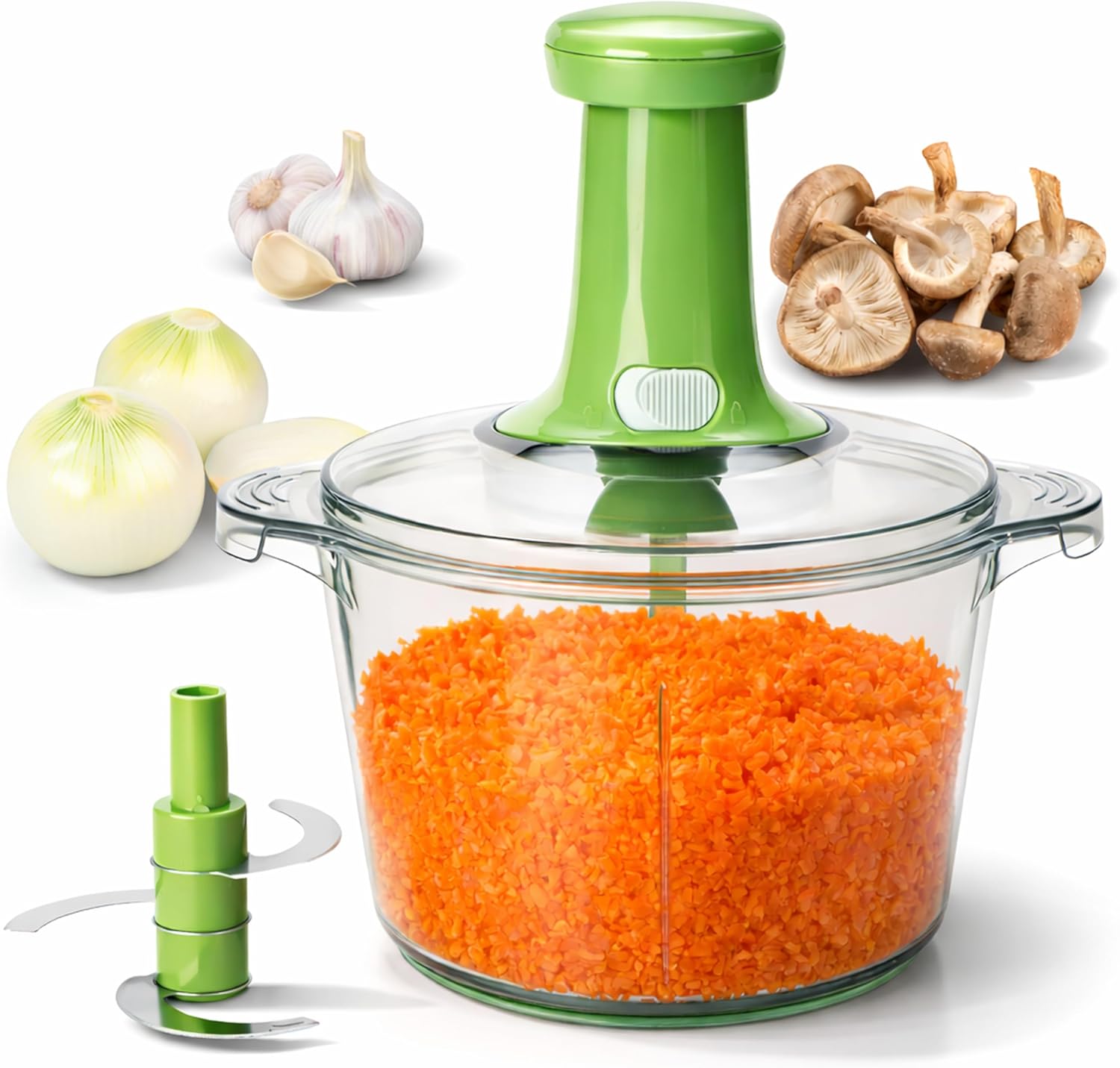 Brieftons ExpressBest for big batchesCheck price on Amazon
 Vidalia Chop WizardBest simple dicerCheck price on Amazon
 Joseph Joseph Multi-Prep CompactBest for small cupboardsCheck price on Amazon
We do not print prices in this guide. Prices move, and a printed figure would be stale within days; check the live price on Amazon before you decide.
The Best Vegetable Choppers for Salads, Reviewed in Full
Fullstar The Original Pro Chopper
The Original Pro is the chopper that covers the most salad work in one box. Four interchangeable blades handle the whole bowl: a small dicer for onion and celery, a large dicer for cucumber, pepper and zucchini, and two spiralizer blades, a ribbon and a julienne, for carrot and cucumber garnishes that make a plain salad look deliberate. The blades are 420 stainless steel, the container holds 1.2 litres, so a full chopped salad for two lands inside it without overflow, and the whole unit goes in the dishwasher when you are done. A safety lock keeps the lid shut under pressure, and the soft-grip handle and non-skid base keep the box planted while you press. Buy it if your salads mix diced and spiralized vegetables and you want one tool for both. Skip it if you also want flat slices or grated cheese, because neither blade is in this box.
Pros
- Small and large dicers cover fine onion and chunky cucumber in one set
- Ribbon and julienne spiralizers add garnish cuts no plain dicer offers
- 1.2-litre container catches the whole salad, nothing scattered on the board
- Dishwasher safe, with a safety lock and a non-skid base
Cons
- No slicing or grating blade in the box
- Spiralizer blades are extra loose parts to store
- 1.2 litres is tight for a family-size batch
Mueller Pro-Series 10-in-1
No other pick here changes jobs as often. Eight blades ride on the container and the mandoline top: two dicers, at 1/4 inch for a fine chop and 1/2 inch for a chunky one, plus a slicer, a wavy cutter, a julienne blade and three graters, so cucumber slices, carrot sticks and grated cheese all come off the same base. The kit includes a food container, a food holder for the slicing blades, storage cases that keep the loose blades corralled, and cleaning forks and a brush for the grids. One point needs stating plainly, because this brand has a history: Mueller's older Onion Chopper Pro, model M-700, was recalled in 2020 after its locking tab was found able to detach in use. The Pro-Series 10-in-1 in this guide is a different, later model line (models MC-710 and MC-780) and was not part of that recall, but check the model number on any Mueller chopper before you buy, and run it through the CPSC recalls database if you are ever unsure. Buy the 10-in-1 if you want one base that dices, slices and grates. Skip it if eight blades sounds like eight things to wash, because on a two-ingredient salad night, it is.
Pros
- Two dice sizes plus slicer, wavy, julienne and three graters on one base
- Blade storage cases keep the sharp parts together in the drawer
- Food holder included for safe work on the slicing blades
- Cleaning brush and forks included for clearing the grids
Cons
- The most parts to wash and store of any pick here
- The blades keep their edge longer washed by hand
- The brand's older M-700 recall makes the model check essential
Cuisinart PrepExpress
The PrepExpress is the precision pick among the box dicers. Two stainless steel blade grids, a small and a large, produce the uniform dices and long cuts it is built around, and the chopping platform sits at an angle, which means onion halves and pepper quarters need less trimming before they fit under the lid. The collection container holds 4 cups, the largest of any grid dicer here, carries measurement markings for building a salad to a recipe, and stands on a non-slip base. Both grids and the cleaning tool store inside the container, so the whole kit packs into its own footprint. Buy it if even dice matter to you more than blade count and you chop for three or four people. Skip it if you want slicing or grating, because the two grids are the whole toolkit.
Pros
- Two stainless grids cut genuinely uniform dice and long fry-style cuts
- Angled platform takes bigger pieces with less pre-trimming
- 4-cup marked container is the biggest grid-dicer box here
- Grids and cleaning tool store inside the container
Cons
- Two grids only; no slicer or grater
- Plan on hand washing; the dishwasher guidance is inconsistent
- Longer body than the compact dicers, at just over 10 inches
OXO Good Grips Vegetable and Onion Chopper with Easy Pour Opening
Most grid dicers make you dismantle the lid to get the salad out. This one pours. The easy-pour opening lets you tip diced onion, pepper or cucumber straight from the 2.5-cup body into the bowl without lifting the lid or scraping around the grid, which is the small daily convenience you end up valuing most. The grid itself removes for cleaning, so the bits trapped between the blades rinse out instead of drying in place, then snaps back into the lid for storage. The lid shape gives your palm real leverage on firm vegetables, the cutting area is recessed so pieces stay put while you load, and the base is non-slip. Buy it if you dice one or two vegetables at a time and hate fiddly cleanup. Skip it if you prep big salads, because 2.5 cups fills fast.
Pros
- Pour opening empties the chopper without dismantling the lid
- Removable grid rinses clean between the blades
- Lid shape gives good leverage on firm vegetables
- Dishwasher safe, with a non-slip base
Cons
- One grid size only, so one dice size
- 2.5-cup capacity is small for family salads
- No slicing, grating or spiralizing options
Alligator Vegetable Chopper
The Alligator is the connoisseur's dicer, a Swedish lever design in stainless steel that has outlasted waves of plastic imitators. Three interchangeable grids cut at 3x3 mm, 6x6 mm and 12x12 mm, and that finest 3 mm grid is the reason to buy it: herbs, garlic and onion come out in a mince-sized dice no other pick here can match, while the 12 mm grid handles potato and beetroot for cooked salads. Cut pieces collect in the BPA-free trap under the grid, and the grid insert slides up afterwards to lift out the scraps that wedge in the blades. Alligator backs the chopper with a two-year manufacturer warranty. Buy it if fine, exact dice is your whole reason for owning a chopper and you are happy to pay for steel. Skip it if you want one tool that also slices and grates, because this is a dicer, purely.
Pros
- 3 mm grid produces the finest dice in this guide
- Three stainless grids span mince to chunky 12 mm cubes
- Grid insert lifts trapped scraps out for cleaning
- Stainless build with a two-year manufacturer warranty
Cons
- Dicing only; no slicing or grating
- Three grids and two bases are a small kit to keep together
- Heavier in the hand than the plastic box dicers
Kuhn Rikon Pull Chop
The Pull Chop replaces the press with a cord. Load the 2-cup container, seat the lid, and pull: the cord spins the stainless blades through onion, garlic, herbs, nuts or hard-boiled egg, and you control the finish by counting, a few pulls for a coarse chop and 15 to 20 for a fine, almost pureed texture. That control is exactly what salad dressings, salsas and egg salad want, and it needs no electricity and almost no cupboard, which is why this design keeps winning small kitchens. The blade carries a protective cover and stores inside the container, the base is non-slip, and the container itself is microwave and dishwasher safe. Buy it for herbs, dressings, salsa and egg or tuna salad in small batches. Skip it if you want cubes, because spinning blades chop, they do not dice.
Pros
- Pull count sets the texture, from coarse chop to near puree
- 2-cup size suits herbs, dressings, salsa and egg salad
- No electricity, tiny footprint, blade stores inside
- Container is microwave and dishwasher safe
Cons
- Chops rather than dices; no true cubes
- Only the container is dishwasher safe; the lid needs hand care
- 2 cups at a time makes big batches slow
Chef'n VeggiChop
The VeggiChop works on the same pull-cord principle as the Kuhn Rikon, with one addition that changes how you use it: a sealing storage lid. Chop your salsa, pesto, guacamole or salad topping in the bowl, swap the cord lid for the storage lid, and the bowl goes straight into the fridge or the lunch bag, with nothing decanted and nothing extra washed. The blades turn through fruit, vegetables, boneless meat, herbs, nuts and even ice, and the bowl, blades and storage lid are top-rack dishwasher safe, with only the pull lid needing a hand wash. With no cord and no plug, it travels as happily as it stores, which makes it the dorm room and camper pick as much as the small kitchen one. Buy it if you chop small amounts often and want to store in the same bowl. Skip it if uniform dice matters, because a spinning blade gives you a chop, not a cube.
Pros
- Sealing storage lid lets you chop and store in the same bowl
- Handles herbs, nuts, salsa, pesto and guacamole as well as vegetables
- Bowl, blades and storage lid are top-rack dishwasher safe
- No electricity needed; suits dorms, RVs and travel
Cons
- Rotating blades chop unevenly compared with a grid dice
- Pull-cord lid is hand wash only
- Bowl is sized for toppings and small salads, not family batches
Brieftons Express
Every other pick here works in cups. The Express works in party bowls: its 8.5-cup bowl is more than double the next largest container in this guide, and the pump handle drives a three-leaf stainless blade through load after load of carrot, cabbage, onion and pepper for coleslaw, chopped salad platters and salsa for a crowd. More pumps mean a finer result, so you stop at chunky for slaw or keep going for a fine salsa texture. The blade stays concealed inside the bowl while you work, and the pump handle locks down flat afterwards, which keeps a tall tool from dominating the cupboard. The trade is care: this one is hand wash only, with no dishwasher option. Buy it if you prep salads for gatherings, meal-prep Sundays or a big household. Skip it for nightly salads for two, where its size is mostly washing up.
Pros
- 8.5-cup bowl is the largest capacity in this guide by far
- Pump count controls the finish, chunky to fine
- Blade stays concealed inside the bowl during use
- Pump handle locks down for flatter storage
Cons
- Hand wash only; not dishwasher safe
- Rotary chop, not a true dice
- Oversized for a nightly salad for one or two
Vidalia Chop Wizard
The Chop Wizard is the original press dicer, on sale since 2004, and its appeal is that there is almost nothing to learn. Vegetables sit on the stainless blade grid, the lid presses them through, and the dice land in a 2-cup base that doubles as a measuring cup, so you can see at a glance when you have enough onion. Interchangeable blades swap the cut, and the two-part design has fewer hinges, latches and inserts to lose than any modern multi-blade kit. It will not slice, spiralize or grate, and the 2-cup base caps your batch, but for a nightly chopped salad for two it is the lowest-friction tool here. Buy it if you want dicing with the fewest possible parts. Skip it if you prep for a family or want more than dice from the purchase.
Pros
- Two-part design is the simplest to use and clean here
- 2-cup base doubles as a measuring cup
- Interchangeable stainless blades change the cut
- A design on sale since 2004, with nothing fragile to learn
Cons
- 2-cup base limits batch size
- Dicing only; no slicing or grating blades
- Fewest extras in the box of any pick
Joseph Joseph Multi-Prep Compact
The Multi-Prep Compact answers the storage question differently: instead of one machine with loose blades, it is four slim tools, a chopper, a slicer, a grater and a julienne cutter, that each sit on top of the same clear collecting base, then stack together on that base when the prep is done. The whole kit occupies roughly the footprint of the base alone, which makes it the pick for shallow drawers and crowded counters. A finger guard is included for the slicing and grating tools and clips underneath the grater when it is not needed. The chopper tool dices for salads, the julienne makes carrot and zucchini strands, and the clear base shows your fill level as you go. Buy it if storage space, not batch size, is your binding constraint. Skip it if you cook salads for a crowd, because the compact base fills quickly.
Pros
- Four tools stack onto one base for a very small footprint
- Chopper, slicer, grater and julienne cover most salad cuts
- Finger guard included for the flat blades
- Clear base shows the fill level while you work
Cons
- Hand wash care for the tools
- Compact base is small for family-size salads
- One tool at a time; swapping mid-recipe adds steps
Press, Pull or Stack: How the Formats Compare
Shoppers often ask for a foldable vegetable chopper, and the honest answer is that none of these tools folds. What the best of them do instead is collapse their own storage footprint: blades nest inside the container (Fullstar, Cuisinart), blade cases stack beside the base (Mueller), a pump handle locks down flat (Brieftons), or four tools stack onto a single base (Joseph Joseph). If storage is your real question, shop the last column of this table first, then choose your cutting format.
| Format | Picks | The cut you get | Batch size | Storage behaviour | Cleaning load |
|---|---|---|---|---|---|
| Press grid dicer | Fullstar, Mueller, Cuisinart, OXO, Alligator, Vidalia | True uniform cubes | 2 to 4 cups | Blades nest in the container or cases | Grid needs a brush or comb |
| Pull cord | Kuhn Rikon, Chef'n | Chop, coarse to fine by pull count | About 2 cups | Bowl-sized, blade stores inside | Bowl rinses; lid wiped or hand washed |
| Pump handle | Brieftons Express | Chop, chunky to fine by pump count | 8.5 cups | Handle locks down flat | Hand wash only |
| Stacking tools | Joseph Joseph | Dice, slice, grate, julienne | Small base | Four tools stack on one base | Hand wash |
Choose a press dicer when the salad itself is the point: chopped salads, Greek salads and salsas where even cubes dress evenly and look right. Choose a pull chopper when the job is flavour work, herbs, garlic, onion for dressings, egg salad, and small fast batches where texture matters more than geometry. Choose the pump model when volume rules, and the stacking set when the cupboard, not the recipe, is the constraint.
Also Considered
Fullstar Vegetable Chopper (2 in 1) - the same maker's simpler dicer, with two interchangeable blades and the same 1.2-litre tray. It missed out because the 4-in-1 Original Pro covers the identical dicing role and adds the spiralizer blades for a small step up, and one brand did not need two near-identical boxes in a ten-pick guide.
Zyliss Easy Pull - a well-made pull chopper in the same 750 ml class as the Kuhn Rikon, with a booster arm on the lid. It missed out because the pull-chop roles were already held by the Kuhn Rikon Pull Chop and the Chef'n VeggiChop, and it offered no storage lid or texture advantage over either.
PrepNaturals Vegetable Chopper - a two-blade grid dicer with a built-in container that sells on value. It missed out because it overlaps the Fullstar and Mueller dicing roles directly, and its verified record was thinner than either once blade sizes and container details were checked.
Vidalia Chop Wizard Pro Max - the larger Chop Wizard, with a 3-cup base and extra slicing blades. It missed out because the original Chop Wizard holds the simple-dicer role with fewer parts, and the Pro Max's additions push it toward the Mueller's territory without matching it.
Who This Guide Is For
Salad-first cooks. If a chopped salad is a weekly fixture and even dice is the difference between a bowl you serve proudly and one you apologise for, start with the grid dicers, Fullstar, Cuisinart and Alligator in particular.
Cooking for two. The 2 to 4 cup boxes (Vidalia, OXO, Cuisinart, Fullstar) are sized for a nightly salad for two without leftovers climbing the walls of an oversized container. The Brieftons is the exception to skip at this household size.
Dorm rooms and small kitchens. No pick here needs an outlet, but the pull choppers and the Joseph Joseph set earn their keep where counters and cupboards are measured in inches: the Kuhn Rikon and Chef'n store at bowl size, and the Multi-Prep Compact stacks four tools into one base's footprint.
Batch preppers. If Sunday you is chopping for the week's lunches, the Brieftons Express at 8.5 cups is the only pick that treats that as a single load rather than a queue.
What to Look for in a Vegetable Chopper for Salads
Dice size before blade count. A salad chopper earns its place on two grids at most: a fine dice around 1/4 inch (6 mm) for onion, celery and herbs, and a chunky dice around 1/2 inch (12 mm) for cucumber, pepper and tomato wedges. The Alligator's three grids (3, 6 and 12 mm) and the Mueller's two (1/4 and 1/2 inch) bracket that range exactly. Extra blades only matter if they are cuts you genuinely make, slices for cucumber, julienne for carrot.
A container that matches your bowl. Dice that lands in a container is dice that is not on the floor, and the container's size sets your batch. Two cups suits toppings and salads for one or two; 4 cups covers a family side salad; anything above that is batch prep. Measurement markings, as on the Cuisinart and the Vidalia base, help when a recipe calls for two cups of diced onion rather than a guess.
A grid you can clear. Every press dicer traps scraps in its grid. Look for a removable grid (OXO), a lift-out insert (Alligator), or an included cleaning comb or brush (Cuisinart, Mueller, Fullstar). A grid you cannot clear quickly is a grid you will stop using.
Blade safety you can verify. These are exposed blades by design, so buy on specifics: a food holder for slicing blades, a finger guard on stacking tools, a lid lock on press boxes, and a model number you can check. Choppers have a real recall history in this category, one is flagged in the Mueller review above, so confirm the exact model against the CPSC recalls database before any chopper in this guide goes in your basket.
Hygiene for food you eat raw. Salad vegetables skip the cooking step that kills bacteria, so wash all produce under running water before it meets the blade, scrub firm items like cucumbers with a clean brush, and dry them so the dice is not watery; the FDA's guidance on selecting and serving produce safely sets out the full routine, including keeping raw-eaten produce away from raw meat and its utensils.
For the fuller walk-through of these checks, blade materials and hinge designs included, How to Choose a Vegetable Chopper works through the decision step by step.
Vegetable Chopper Sizes and Capacity, Explained
Capacity in this category is quoted in cups or litres, and the numbers decide more than any blade list. A 2-cup chopper (Kuhn Rikon Pull Chop, Vidalia Chop Wizard) dices one large onion or enough topping for a salad for two, and no more; you will run it twice for a family bowl. The middle band, 2.5 to 4 cups (OXO at 2.5 cups, Fullstar and Mueller at about 1.2 litres, Cuisinart at 4 cups), is the daily-driver zone: a full chopped salad for two to four people in one load. The Brieftons Express at 8.5 cups sits alone above it, sized for coleslaw heads, party platters and meal prep.
Dice size is the second number to read. Fine grids near 3 to 6 mm (1/8 to 1/4 inch) suit onion, garlic, herbs and celery, the ingredients you want distributed through every bite. Coarse grids near 12 mm (1/2 inch) suit cucumber, zucchini, pepper and cooked potato or beetroot, where the piece should stay distinct. Soft produce is the exception to every grid: ripe tomato pushed through a fine grid gives you juice and skins, so dice tomato by hand or use the coarsest grid and a single firm press.
How Much Does a Good Vegetable Chopper Cost?
We do not print prices in this guide, because they move too often for a printed figure to stay honest. What drives the price is consistent, though: the blade set, the build material and the mechanism. Simple two-part dicers and pull choppers sit at the low end, multi-blade kits with storage cases and mandoline tops in the middle, and stainless steel construction, as on the Alligator, at the top. The practical rule is to pay for the grids and the container you will use weekly, not for a blade count you will use once; a two-grid dicer that matches your dice sizes beats a ten-blade kit whose extra blades live in a drawer.
If your budget is the first filter rather than the last, Best Vegetable Chopper Under 40 runs the same checks across the lower-priced end of the category.
Common Mistakes When Buying a Vegetable Chopper
Buying blade count instead of dice size. Ten blades that never leave the drawer lose to two grids in your exact sizes. Check the millimetre or inch size of the dicing grids before anything else.
Loading pieces that do not fit. A whole onion half forced under a lid bends grids and cracks hinges. Cut produce to sit flat inside the cutting area; the Cuisinart's angled platform forgives more, but no grid forgives a wedge jammed in sideways.
Putting soft fruit through a fine grid. Ripe tomato, avocado and soft cheese crush rather than cube. Keep a coarse grid for them, or a knife, and save the fine grid for firm vegetables.
Dulling blades in the dishwasher. Several makers here recommend hand washing blades even when the container is dishwasher safe, because detergents and rattling racks take the edge off. The grids are the product; treat them like knives. How to Clean a Vegetable Chopper covers the full routine, grid clearing included.
Leaving chopped salad out. A chopped salad sitting on the counter while the rest of dinner happens is a food safety problem, not a convenience: perishable food should be refrigerated within two hours, in a fridge at 40°F or below, per the FoodSafety.gov four steps to food safety.
Vegetable Chopper Pros and Cons
Pros
- Uniform dice that dresses evenly and looks deliberate in the bowl
- A whole onion diced in one press, with no tears and no board full of strays
- Repeatable results: the same salad comes out the same way every time
- Contained mess, with the dice landing in a container instead of across the counter
Cons
- Another tool to store, and loose blades need a home
- Grids and blades demand careful washing, mostly by hand
- Soft produce crushes instead of cubing
- Small capacities mean family batches run in loads
Who Should Not Buy a Vegetable Chopper
Skip the category if your salad prep is one cucumber and a handful of leaves twice a week; a knife you already own does that job, and a chopper would only add washing up. Skip it, too, if what you really make is sauces, purees and baby food, because spinning-bowl choppers only imitate that work at small scale, and a food processor does it properly; Vegetable Chopper vs Food Processor weighs the two head to head. And if your household's salads feed six people nightly, even the Brieftons becomes a chore of loads and hand washing, where a processor with a dicing kit is the honest recommendation.
Vegetable Chopper: Frequently Asked Questions
What should I look for when buying a vegetable chopper for salads?
Two dice sizes first: a fine grid near 1/4 inch for onion, celery and herbs, and a chunky grid near 1/2 inch for cucumber and pepper. Then a container sized to your usual batch, a grid you can clear with a comb or by removal, and safety specifics you can verify, a food holder or finger guard for flat blades and a model number you can check against recall records.
What size vegetable chopper do I need for salads?
For one or two people, 2 to 2.5 cups handles a nightly salad in a single load. For a family side salad, look at the 4-cup class, such as the Cuisinart PrepExpress. For meal prep, coleslaw and party batches, only the 8.5-cup Brieftons Express works in one load; everything else runs in batches.
How much does a good vegetable chopper cost?
Prices move too often for us to print a figure that stays honest, but the structure is stable: simple dicers and pull choppers cost least, multi-blade kits with cases and slicing tops sit in the middle, and stainless steel builds cost most. Pay for the two grids and the container size you will use weekly, not for the longest blade list.
What are the most common mistakes when buying a vegetable chopper?
Buying on blade count rather than dice size, forcing oversized pieces under the lid until a grid bends, pushing ripe tomato through a fine grid and getting juice instead of dice, and dulling the blades in the dishwasher when the maker recommends hand washing them like knives.
Who should not buy a vegetable chopper?
Anyone whose chopping is a twice-a-week cucumber, anyone whose real workload is purees and sauces, which belong to a food processor, and anyone feeding six or more salad eaters nightly, who will outgrow even the largest manual box and spend the difference in loads and hand washing.
Keep Researching Vegetable Choppers
The same premise checks run across the lower-priced end of the category, for buyers whose budget is the first filter.
ComparisonVegetable Chopper vs Food ProcessorDice quality, batch size, washing up and counter space, weighed head to head to settle which tool your kitchen needs.
How to ChooseHow to Choose a Vegetable ChopperGrid sizes, container capacity, hinge and lid design, and blade materials, worked through as a step-by-step decision.
Use & CareHow to Clean a Vegetable ChopperClearing grids without dulling them, washing blades safely, and the parts that should never sit in dishwasher water.
More in Kitchen & Cookware
Kitchen & CookwareAll Pick Hearth guides in this categoryHow We Check Vegetable Choppers Like These
Read the full Pick Hearth methodology- Every pick was premise-checked against its own Amazon.com listing and maker details before inclusion; anything we could not verify was dropped and replaced.
- Blade grids, dice sizes and container capacities were checked twice over, once against the listing and once against the maker's own specifications; where the two disagreed, the disagreement sits in our research notes rather than being smoothed over.
- Every model line was screened by name against CPSC recall records; the one brand here with a recalled older model is flagged in its review with the model numbers, and the recalled model itself is not a pick.
- Photos were downloaded per ASIN and read individually to confirm each shows the exact product and variant the buy link sells.
- Prices were recorded in our research notes only; this guide prints none, so nothing here goes stale.
- No ratings or review counts appear anywhere in this guide; our judgements rest on specifications and fit for the job.
First published · Updated in place as products and specs change