The stem test
Forget brand, colour and handle shape for a moment and look at the stem in your other hand. Three questions sort nearly every garden cut. Is it woody, with bark and a hard core, or soft and green all the way through? How thick is it, roughly finger thick or pencil thin? And is it standing alone where you can get a tool around it, or buried inside a cluster of stems you must not touch?
Woody and finger thick points one way. A pruner holds that stem deep in its throat, close to the pivot, and a curved blade sweeps past a hook so the wood is sliced rather than squeezed. The three pruners in this guide carry limits of 3/4 inch and 1 inch, and those figures are ceilings for live wood, not invitations. Soft, green and crowded points the other way. Scissors and snips put the work out at the tip of two straight blades, where your eye can follow it, and they ask almost nothing of your grip because there is almost nothing to resist them.
That is also why swapping the tools damages more than the plant. A scissor blade bent on a shrub stem stays bent. A pruner used as a florist tool does not break, it just bruises, knocks and hides, cut after cut, until the bunch looks handled. Gardeners who own both rarely describe one as better. They describe reaching without thinking, and the reaching follows the stem.
Here are the six tools this guide uses to make the split concrete, three on each side, picked to spread across price, build and blade shape rather than to crown a single winner.
 Felco F2 Pruning ShearsShears: the repairable bypass for branches up to 1 inchCheck price on Amazon
 Corona BP 3180D Pruning ShearsShears: forged steel you sharpen, not swapCheck price on Amazon
 gonicc GPPS-1003 Pruning ShearsShears: coated bypass on a tighter budgetCheck price on Amazon
 Fiskars Micro-Tip Pruning SnipsScissors: fine tips for flowers, herbs and budsCheck price on Amazon
 ARS HP-300L Needle Nose SnipsScissors: a long nose for clusters and pickingCheck price on Amazon
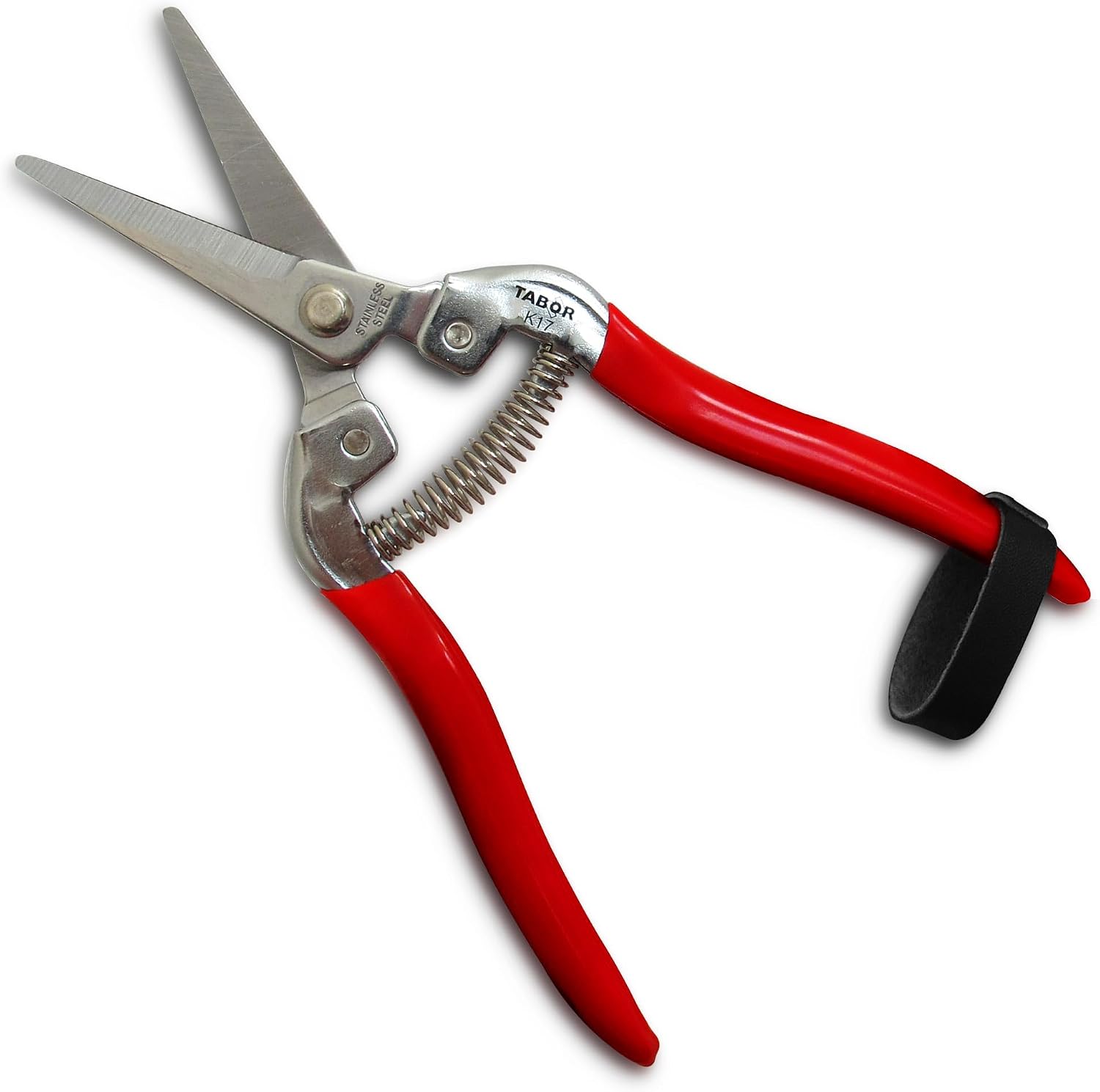 TABOR TOOLS K17A Florist ScissorsScissors: straight florist blades for bunch workCheck price on Amazon
We leave prices off the page on purpose. They shift, and a figure printed today can mislead next week. The button beside each pick shows the live one.
Capacity first: how each side earns its cut
Read the numbers on this page in two different languages, because the two sides publish two different things. Pruners speak in stem diameter. Scissors mostly speak in jobs.
A bypass pruner earns its diameter figure from geometry. The stem rests against a hook, the blade passes beside it, and the handles act as levers around a short, stiff pivot. Sap grooves, found on the Felco and the gonicc below, give sticky juice somewhere to go so the head keeps moving freely. A spring between the handles pushes the tool open again, which matters more than it sounds: over a winter afternoon of rose pruning, reopening the pruner by hand would tire your grip long before the cutting did. Sizing the frame to the hand matters for the same reason, and Felco's guidance on matching a pruner to a hand treats that fit as the first decision, before model or price. Our own How to Choose a Pruning Shears guide walks the same ground for every pruner type, including the anvil and ratchet designs that suit dead wood.
Scissors earn their keep at the opposite end of the blade. Two straight edges cross at a pivot, the cut travels outward, and the finest part of the work happens at the tips, in plain sight. There is no throat to hold wood and no lever worth the name. When a scissors maker publishes a millimetre figure, check what it measures before comparing it with a pruner: on the ARS pick below, 46 mm is the cutting width, the opening of the blades, not a promise about branch thickness. Two of the three scissors picks have no stem figure published at all, and instead name their material plainly: flowers, herbs, small stems, leaves. That is not missing information. It is the honest unit for this side.
| Where they part | Pruning shears | Scissors and snips |
|---|---|---|
| The material the design assumes | Living wood with bark on it: shrub branches, rose canes, vines, young fruit wood | Green, yielding growth: flower stems, herb stalks, buds, leaves, fruit stalks |
| How the figure on the box should be read | Thickest live stem the tool is built to take, 3/4 inch to 1 inch among the picks here | Usually a description of the work, not a thickness; any width figure is a blade opening |
| Where the cut happens | Deep in the head, stem cradled by a hook, blade passing beside it | Along straight blades and out at the tips, where you can watch it land |
| Help your hand gets | A proper spring to reopen the tool, solid handles for a full grip, geared and ratchet cousins for harder work | A light spring on the snips here, or none; two of the three picks can be used in either hand |
| The failure you can picture | A hook barging through a flower head, a thick blade hiding a thin stem | A woody stem folding instead of slicing, a fine tip bending and never quite recovering |
| Keeping it working | Sharpen the blade; on one pick here, unbolt and replace blades, springs and grips as they wear | Wipe, dry, store covered or strapped; there is no parts system behind the picks here |
Length and weight complete the picture below. Notice how little they overlap: the lightest pruner frame and the heaviest scissors pick sit close on paper, yet they feel unrelated in the hand because the weight is arranged around completely different heads.
| Product | Side | What it is built to cut | Blade | Length | Weight |
|---|---|---|---|---|---|
| Felco F2 Pruning Shears | Pruning shears | Live wood up to 1 inch | Steel, can be swapped out | 9.25 in | 8.8 oz |
| Corona BP 3180D Pruning Shears | Pruning shears | Stems and branches up to 1 inch | Steel alloy the maker calls MAXFORGED | 8.5 in | 0.85 lb |
| gonicc GPPS-1003 Pruning Shears | Pruning shears | Live stems up to 3/4 inch | SK-5 steel coated with titanium | 8 in | Not given |
| Fiskars Micro-Tip Pruning Snips | Scissors | Flower stems, herbs, buds, small plants | Stainless steel, ground to a precise edge | 6 in | Not given |
| ARS HP-300L Needle Nose Snips | Scissors | Picking, flowers and thinning; 46 mm cutting width | High carbon steel, in a straight needle nose | 190 mm | 115 g |
| TABOR TOOLS K17A Florist Scissors | Scissors | Flower arranging, plant trimming, herb and produce harvesting | Stainless steel with a straight edge | 7.5 in | 0.29 lb |
Pruning shears in detail
One design, three budgets and three philosophies of wear. The Felco assumes you will keep it for decades and hands you the parts to prove it. The Corona assumes you own a sharpening stone. The gonicc assumes the blade coating and the forging matter more to you than a spares drawer.
Felco F2 Pruning Shears
Hold the F2 next to any scissor in this guide and the intent is obvious before you cut anything: a deep throat, a bolt you can adjust as the head wears, a spring tucked under a metal cover where sap cannot gum it. Felco builds the F2 as a working tool with a long memory: the parts that wear can be replaced, and spares are sold for all of them. Gardeners with large hands who prune weekly will feel the point of every one of those choices. Gardeners whose cutting is mostly bedding flowers will feel only the bulk.
Pros
- A full 1 inch of live wood capacity, shared only with the Corona here
- Worn blades and springs are a parts order, not a new tool
- Forged aluminium keeps a big frame surprisingly light at 8.8 oz
- The head can be adjusted as it wears, so cuts stay tight for years
Cons
- A large, right handed frame is a poor fit in a smaller hand
- The hook and head are blunt instruments around delicate flower heads
- You pay for the spares system whether you use it or not
Corona BP 3180D Pruning Shears
Corona takes the opposite route from Felco on wear. The BP 3180D pairs a blade matched by hand to its hook, meant to be sharpened back to life rather than unbolted. The whole tool is forged steel, spring included in plain view, and it feels like something inherited from a shed rather than bought from a display. That solidity suits muddy allotment work and shrubs that fight back. It is also the heaviest pruner here, and an afternoon of overhead cuts will let you know it.
Pros
- Forged through and through, blade and handles alike
- The same 1 inch capacity as the premium pick
- A groove that clears sap as it cuts keeps resinous work moving
- Nothing coated or delicate to chip, peel or baby
Cons
- At 0.85 lb, the weight adds up on long sessions
- Keeping it sharp is your job, on a stone, forever
- Bare steel asks for a film of oil before it goes away damp
gonicc GPPS-1003 Pruning Shears
The interesting question with the GPPS-1003 is where the savings were taken, and on paper they were not taken from the cutting head. You still get a forged aluminium body, a coated Japanese-style SK-5 blade and a sap groove, in an 8 inch frame that fits the run of everyday beds, pots and shrubs. What disappears is everything around the head: no spares, no adjustment story, no heritage. For a gardener pruning a few times a month, that trade reads sensibly. For someone reshaping an orchard each winter, the missing parts drawer will eventually send them back to the Felco.
Pros
- A coated SK-5 blade that shrugs off sap better than bare steel
- Forged aluminium handles at a value end of the side
- The 3/4 inch figure covers most stems a home garden produces
- Compact 8 inch frame suits smaller plots and container work
Cons
- A quarter inch less capacity than the two picks above it
- When the blade is done, so is the pruner
- The coating wants a wipe after sticky, resinous sessions
Scissors and snips in detail
Three answers to the same soft problem. Fiskars shortens the blade until only the tip matters. ARS lengthens it until it can thread through a cluster. TABOR TOOLS splits the difference and aims at the arranging table as much as the flower bed.
Fiskars Micro-Tip Pruning Snips
Deadheading is a hundred small decisions made quickly, and this is a tool shaped by exactly that rhythm. The blades are short, the point is the working end, and the spring hands the tool back to you open after every snip, so the pace is set by your eye rather than your grip. Herbs come away without the stem beside them getting crushed, which is the entire reason scissors exist in a kitchen garden. Keep it away from anything with bark. The pivot is honest about what it is, and wood will punish it.
Pros
- The cut stays clean right out to the very tip
- Spring reopening keeps long deadheading sessions easy on the hand
- Short blades go where a pruner head simply cannot fit
- The cover makes it safe to carry in an apron pocket
Cons
- Anything woody will crush, twist the blades or both
- Short reach means your hand enters the plant instead
- A bent tip cannot be replaced, only mourned
ARS HP-300L Needle Nose Snips
Picture thinning a bunch of grapes. The stalk you want is in the middle of twenty you do not, everything is soft, and a wide tool head would damage fruit on the way in. That picture is the 300L's whole design brief: a long, narrow, high carbon blade that threads into the cluster, sprung handles for a cut repeated all morning, and a weight of 115 g that disappears in the hand. The steel choice cuts both ways, literally and in upkeep. High carbon takes a finer edge than stainless, and it will rust if it is put away wet, so this pick belongs to someone who wipes a blade without being reminded.
Pros
- The slim nose reaches stalks hidden inside clusters and bunches
- High carbon steel holds the kind of edge florists and pickers want
- Sprung handles and 115 g of weight suit hours of picking
- The closing strap keeps those long blades safe in a basket
Cons
- Carbon steel needs drying and oiling, every time
- Long fine tips are the easiest blades here to bend on wood
- Too specialised to be anyone's only garden cutter
TABOR TOOLS K17A Florist Scissors
Where the Fiskars pick hides in a flower head and the ARS pick threads through a bunch, the K17A works in the open: longer stainless blades you can follow with your eye, from a rose stem on the plant to the same stem being trimmed to vase length an hour later. The handles are steel under their coating rather than a light moulding, which gives this scissor a steadier, slower feel than the other two, closer to a workshop tool than a paper scissor. If your scissors work is mostly cutting, gathering and arranging in one unbroken session, that steadiness is the appeal.
Pros
- Blade length suits cutting in the garden and trimming at the table
- A comfort spring and thickly coated handles for steady, repeated work
- Stainless blades forgive a damp potting bench
- The leather strap is simple, replaceable and hard to lose
Cons
- Longer blades feel vague in truly tight growth
- No thickness figure to plan woody work by, because there should be none
- Steel handles make it the heaviest scissors pick here
Side by side: where each side wins and loses
Pruning Shears
Pros
- Wood is a solved problem: a held stem, a passing blade, a clean face left on the plant
- The published limits mean you can plan a job before you start it
- Maintenance extends life instead of postponing replacement, above all on the Felco
- Springs, handle shapes and frame sizes exist because the work is forceful and long
Cons
- In a flower head, the tool becomes the clumsy thing in the way
- Weight, bulk and a head designed around a hook, all wasted on soft stems
- A frame that does not fit your hand will punish you by the fiftieth cut
- Bypass models are the wrong pruner for dead hardwood, whatever their quality
Scissors
Pros
- The tip is a precision instrument your eye can steer between stems
- Featherweight frames and either-hand layouts suit fast, repetitive snipping
- Soft material is cut, not bruised, squeezed or knocked about
- Upkeep is a cloth, a dry shelf and a strap or cover
Cons
- The first woody stem you force can end the tool's useful life
- With no thickness rating on most models, the limit is learned by feel
- Fine long blades demand respect in storage and in a crowded tool basket
- Nothing here can be rebuilt when a blade or pivot gives up
Match the tool to the job in front of you
Choose pruning shears if your shrubs set the gardening calendar
Choose pruning shears if winter roses, summer shrub shaping and fruit tree thinning are the jobs that fill your year. Those are woody cuts in quantity, and they reward capacity, springs and a frame fitted to your hand. Our pillar guide, Best Pruning Shears for Gardening, takes over from there and compares pruners against each other, including designs for dead wood that this page deliberately leaves aside.
Choose scissors if you garden with a vase in mind
Choose scissors if most of what you cut comes indoors: flowers for the table, herbs for supper, stems being conditioned and arranged. The work is soft, visible and stem by stem, and a fine tip with a light spring will serve it better in an afternoon than a pruner will in a season.
Choose pruning shears if you are renovating, not tidying
Choose pruning shears if the job list says take it back, thin it out or reshape it. Renovation means older, thicker live wood, cuts in the hundreds, and bark you want left clean on what remains. Scissors have no honest role in that work, and pretending otherwise costs you the scissors.
Choose scissors if the plant is crowded and the stems are precious
Choose scissors if you thin fruit clusters, pick grapes, deadhead in dense heads or harvest from plants where the neighbouring stem matters as much as the one you take. Reach and a visible tip are the whole job there, and the needle nose pick in this guide exists for precisely those minutes.
Choose pruning shears if one cutter has to live in the shed alone
Choose pruning shears if the budget and the shelf allow exactly one tool and your planting leans woody. A bypass pruner can deadhead carefully when it must, slowly and with apologies. The single-tool logic reverses in a flower and herb garden, where the florist scissor becomes the sensible lone resident, but a scissor asked to deputise on shrubs will not survive the deputising.
The money over a tool's life
Start with the question the budget guides usually skip: are you paying for a better version of the right tool, or a better version of the wrong one? A premium scissor is still a scissor. A budget pruner, honestly made, still slices wood. Tier money improves a tool inside its own job. It never moves it into the other job.
Inside the shears side, the tiers buy three different futures. The Felco route costs most up front and then charges you in small parts: a blade here, a spring there, across what can be a very long life. The Corona route moves the cost into your own time, a stone and five minutes, whenever the edge dulls. The gonicc route keeps the entry cost low and accepts that the tool is finished when its coated blade is. None of those futures is irrational. They suit different intensities of use, and the shortlist in Best Pruning Shears Under 150 lets you compare the shears side on spend alone once the type decision is settled.
Inside the scissors side, tiers buy edge and finish rather than machinery, because there is barely any machinery to buy. The clearest step up here is steel: the ARS pick's high carbon blade against two stainless blades, keener and more demanding in return. Springs, straps and covers are cheap features that all three picks manage to include. The dominant cost on this side is not purchase or upkeep at all. It is the replacement you force on yourself the day a good pair meets a woody stem, which is why the cheapest scissors strategy in a mixed garden is owning a pruner as well.
Four tools we looked at and left out
Fiskars PowerGear2 Pruning Shears: a bypass pruner from the main guide's pool whose geared mechanism and rolling handle ease thicker live cuts, with a 3/4 inch limit. It missed the six because the gonicc already fills the 3/4 inch shears slot, and adding gears would have turned a type comparison into a mechanism comparison.
VIVOSUN 6.5 Inch Gardening Scissors: a small spring loaded snip with straight stainless blades, 6.5 inches overall and a 2.1 inch blade, aimed at small stems, flowers and leaves. It stood too close to the Fiskars micro-tip pick in size, shape and job, and offered no cover story or tip control to separate it.
Fiskars Herb Garden Scissors: a compact 5 inch herb snip in stainless steel with pointed tips, a SoftGrip handle and a sheath. A perfectly sensible tool that would have given one maker two of the three scissors slots, in a guide trying to show how wide the scissors side runs.
ARS SS-330HNR Scissors: loop handled scissors, 6.25 inches, in hard chrome finished high carbon steel at 60 g, sold across garden, craft and light wire tasks. Its breadth was the problem: a tool marketed for tape and string as readily as stems makes a muddy representative for a garden comparison, and the TABOR TOOLS pick keeps the florist role cleaner.
Both in the basket, or neither in the hand
Most established gardens quietly settle this by owning both, and the settling usually happens after one tool has been misused once too often. Pruner in the holster for the shrubs and roses, snips in the apron for everything soft: that pairing covers the overwhelming run of home garden work, and each tool lasts longer for never being asked to improvise the other's job.
Neither belongs on three kinds of work. Branches beyond an inch want loppers or a saw, and forcing a pruner there damages tool, plant and wrist together. A long hedge wants proper hedge shears, whose blades turn an hour of single cuts into minutes of sweeping ones. And anything involving wire, ties or packaging wants workshop scissors kept for the purpose, because garden blades that meet metal come back to the plants with nicks in them.
Pruning Shears vs Scissors: Frequently Asked Questions
Can a premium tool stand in for the other type?
No, and the premium end is where the temptation is strongest, so it deserves a plain answer. Within pruners, yes, a premium model covers a budget model's work and adds parts support on top. Within scissors, a finer steel does the same delicate work better and for longer. Between the types, money changes nothing fundamental: the best scissors ever forged still close on a pivot with no throat for wood, and the finest pruner still arrives at a flower head wearing a hook.
Which side is easier on the hands?
Whichever side matches the material, because mismatch is what hands actually feel. Soft stems through light sprung scissors ask almost nothing of a grip. The same stems crushed through a heavy pruner, a hundred times, ask a surprising amount. Woody stems reverse the sums completely: a fitted pruner with a spring turns hard work into routine, while scissors make your fingers supply leverage the tool does not have, and they complain accordingly.
Which side will still be working in ten years?
A maintained pruner, and the gap is structural. Sharpening restores the Corona, spare parts renew the Felco, and even the gonicc's coated blade will outlast most scissors in woody company. Scissors live or die by alignment, and alignment does not forgive accidents. Both sides, though, are killed more often by storage than by work, which is why How to Clean Pruning Shears is worth ten minutes of any cutter owner's time: sap removed, blades dried, a touch of oil, and no damp shed corner doing slow damage all winter.
When does the cheaper tool make more sense than the premium one?
When the work is light, occasional or still being discovered. A new gardener with a few shrubs is well served by the gonicc pruner, and a windowsill herb grower needs nothing beyond a plain florist scissor. Premium money starts earning when the sessions get long and weekly, when a replaceable blade beats a replacement tool, or when stems are sold or shown and a crushed cut is a visible failure rather than a private one.
A large garden, both shrubs and flower beds: where do you start?
With the pruner, because the structural planting cannot wait and cannot be improvised. Shrubs, roses and fruit set the skeleton of a large garden, and they are the cuts that damage plants when they are done badly. Add the scissors second, at the moment the beds and the harvest start generating daily soft work, and let the needle nose or the florist scissor be chosen by whether you pick and thin, or cut and arrange. Large gardens are not a compromise case between these tools. They are the case that explains why both exist.
Keep Researching This Pruning Shears
every pruner type compared head to head, for readers who have settled on the shears side and want the strongest models in full.
Budget BuyingBest Pruning Shears Under 150the shears shortlist organised by spend, useful once capacity and hand size have narrowed the field.
How to ChooseHow to Choose a Pruning Shearscapacities, steels, springs and sizing worked through in order, so the next pruner is bought on fit rather than habit.
Use & CareHow to Clean Pruning Shearssap, sharpening, oil and storage, the routine that decides whether a cutter ages well or rusts early.
More in Garden & Outdoor Living
Garden & Outdoor LivingAll Pick Hearth guides in this categoryHow We Check Comparisons Like These
Read the full Pick Hearth methodology- Every figure in this guide was taken from a maker or listing record we kept: capacities, blade materials, lengths and weights are printed in the units each maker chose, and a blade opening is never dressed up as a branch rating.
- The verdicts lean on mechanics you can inspect yourself, throat and hook against pivot and tip, spring against bare handles, parts drawer against none, rather than on price bands or badge appeal.
- Six tools were picked to span each side honestly, three budgets and three blade shapes among them, and four more that we verified and then set aside are named above with the reason each one missed out.
First published · Updated in place as products and specs change