Start here: the decision in brief
The expensive mistake is buying the wrong pattern: a tall mapping robot that cannot fit under your sofa, a dockless robot in a home with two shedding dogs, or a suction port with no brush in carpeted bedrooms. Listings will not warn you: each leads with the number that flatters it. Decide in order: navigation, brush, bin and dock, then height against furniture, runtime against floor plan, and filtration if allergies are in the house. Suction comes last. The four examples below are not a ranking: each is a pattern met again under other brand names.
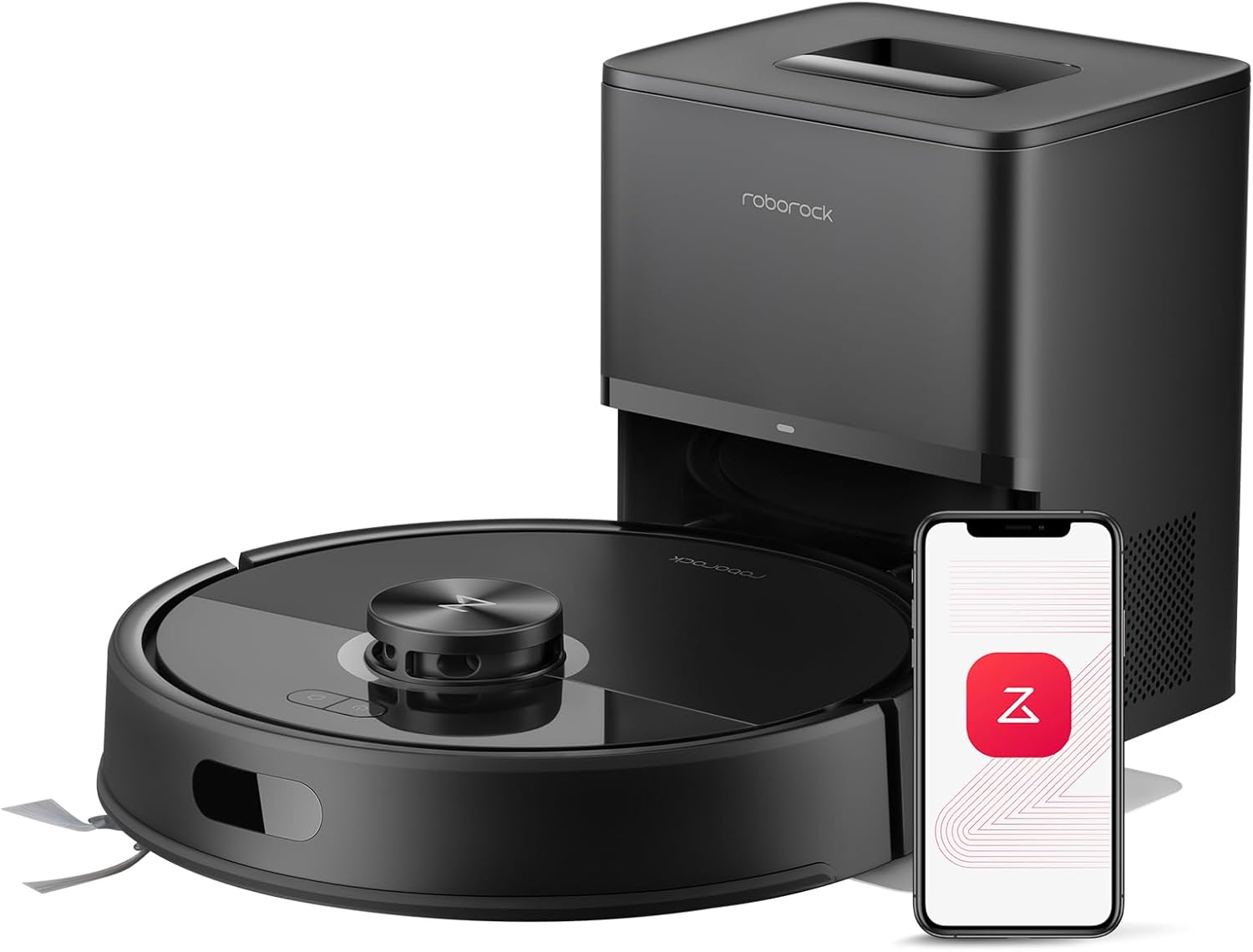 Roborock Q7 M5+Pattern: the mapping robot with a self-empty dock Check price on Amazon
 Shark AV2501AE AI Robot VacuumPattern: the LiDAR all-rounder with a bagless base Check price on Amazon
 Lefant M310Pattern: the slim, simple, no-mapping robot Check price on Amazon
 ILIFE V3s ProPattern: the suction-only pet-hair specialist (no brushroll) Check price on Amazon
Prices move on Amazon, so we never print one here that could go stale. Use the price check button for the current price.
Navigation: types of robot vacuum explained
Navigation has three classes. The simplest use contact and sensors (bump navigation, obstacle avoidance; the Lefant and ILIFE examples): they drive until they meet an obstacle, turn, and cover small, simple floors by persistence. With no stored map there is no room targeting, no-go zone, or sending it to the one room that needs it.
The middle class adds direction: gyroscope and row-cleaning robots travel in rows or a zig-zag, finishing faster than a wander. The Lefant M310 pairs sensors with Auto, Spot, Edge and Zig-zag modes but builds no map, so scheduling stays whole-home and missed patches wait for the next run.
The top class maps. A LiDAR turret builds a floor plan; the robot cleans room by room, stores the map, and allows no-go zones, room schedules, targeted cleans and recharge-and-resume. Roborock calls its system PreciSense LiDAR, described in Roborock's official Q7 M5+ product page; Shark pairs LiDAR with Matrix Clean grid passes. Trap: "smart" alone can mean a full map or a clever bumper. Require a named system plus "mapping", "room targeting" or "no-go zones"; otherwise assume none.
Brush design and materials compared: the pet hair criterion
The brush decides weekly upkeep in a pet home: it must lift hair and hand it to the suction without winding it around itself. A bristle brushroll agitates carpet well but wraps long hair tightly, needing cutting free. Rubber and dual rubber rollers flex instead of gripping, so hair slides into the bin and tangles far less. Self-cleaning and comb designs go further: Roborock's JawScrapers brush combs hair off itself; Shark's self-cleaning brushroll resists wrap. The fourth design removes the brush: a suction port (Lefant M310, ILIFE V3s Pro) pulls hair into the bin, with nothing to wrap around; Lefant's official M310 page presents it as tangle-free.
Trade-offs: suction ports cannot agitate carpet pile, so they suit hard floors and low pile; rubber rollers suit both floor types with modest upkeep; comb and self-cleaning systems keep agitation and cut detangling, on fuller machines. On a listing, require physical terms: rubber, dual roller, comb teeth, self-cleaning, or no roller at all. Trap: a bare "great for pet hair" claim over a standard bristle brush. Still deciding if a robot should be the main machine? Robot Vacuum vs Regular Vacuum compares this with an upright on deep pile.
Suction figures and jargon: what pascals can and cannot tell you
Suction figures in pascals are stated by each maker under its own conditions and cannot be ranked across brands. They are not readings on one shared scale: doubling a rival's number does not prove it cleans twice as well. One example below publishes no pascal figure.
Within one brand's range, the figure usually orders its models gentler to stronger, and a higher figure in the same family generally means more pull on carpet. Across brands, judge pickup by design: brush type, automatic carpet boost, and how well bin and filter keep airflow open. Other jargon: runtime is minutes per charge, usually in a gentle mode; bin size is millilitres onboard; dock capacity is litres in the base; E11 or HEPA labels name the filter grade. Trap: any league table lining up pascal figures from five brands and declaring a winner.
Bin size and self-empty docks: what the capacities mean in a pet home
Pet hair compresses badly, so generous bins fill fast. Onboard bins here run from 300 ml (ILIFE V3s Pro) to 550 ml (Lefant M310): in a shedding home, a handful of cleans at most. No flaw in a small flat; the deciding chore in a house with carpeted bedrooms and a shedding dog.
A self-empty dock changes the unit of effort: you deal with weeks of hair at once. Roborock states a 2.7L bag in its RockDock Plus, good for up to 7 to 9 weeks; Shark states a 60-day capacity for its bagless XL base. Those are maker figures for typical use: heavy shedding lands at the fast end, but even that turns a daily chore monthly. Bagged docks seal hair and dander away at disposal, at the cost of bags; bagless bases remove the bag bill but mean dust contact at emptying. Check: onboard millilitres, dock litres or stated days, bagged or bagless. Trap: a headline dock interval with no capacity behind it.
Height and clearance: robot vacuum size guide
A robot cleans only the hair it can reach; the worst reservoir sits under sofas and beds. The spread here: Lefant M310 2.99 inches, ILIFE V3s Pro 3 inches, LiDAR equipped Roborock Q7 M5+ 3.8 inches, because the turret needs its tower. Under an inch decides whole rooms of hidden floor.
Ask not "how big is it" but "what is the lowest gap I want cleaned". Diameter matters less, since a round body turns in its own space; height is absolute: it either fits under furniture or cleans around it forever. Slim sensor models trade mapping away for that low profile: the smallest robots here are the simplest navigators. On a listing, require a stated height in inches, not box dimensions, which describe the carton. Trap: a "slim design" claim with no number.
Runtime and recharge and resume: features that actually matter on a big floor
Stated runtime spans 120 minutes (Shark) to 180 minutes (Roborock), with the Lefant at 160 minutes. Treat these as best case figures, usually in a gentle mode on hard floors: carpet, boost modes and ageing batteries shorten real runs. A flat or single main level fits inside any of them; a large floor of several bedrooms can outlast the shorter models.
Recharge and resume covers that floor: the robot docks, charges, and returns to the exact point it left, finishing across two sessions without you. The AV2501AE has recharge and resume, and mapping robots generally pair the two, because resume needs a map. Without a map, a recharge only starts a fresh wander. For toddler homes, one predictable scheduled pass is easier to keep clear of toys and cables than random revisits. Check: stated runtime, the words "recharge and resume", and a map behind them. Trap: a long runtime headline with no resume, for a home too big for one charge.
Filtration: what allergy homes should check
Dander, not visible hair, is what matters to allergy sufferers. Check two places. In the robot: Roborock fits a washable E11 filter on the Q7 M5+; the M310 has HEPA filtration. On self-empty models check the dock too, because every self-empty pulls dusty air through the base: Shark filters at the base to true HEPA standard, capturing 99.97% of dust and allergens down to 0.3 microns, the strongest statement here. That figure is the defined HEPA benchmark: the US EPA's guide to what a HEPA filter is puts HEPA, as defined by the U.S. Department of Energy, at 99.97% of particles at 0.3 microns.
Disposal is the second half: a sealed dock bag leaves without opening to the room; a bagless base or bin tipped into a kitchen bin releases a puff of fine dust as you handle it. Allergy homes should weigh that deliberately. Check: filter type in words, filtration in robot, dock or both, sealed or open emptying. Trap: "HEPA" used loosely for a basic foam filter; look for the capture figure beside it. Skipping ahead? Best Robot Vacuum for Pet Hair compares the full field and its strongest filtration setups.
What to measure and check before you buy
- Measure the lowest furniture gap you want cleaned under, in inches, at sofa and bed frame. Compare with the stated height, leaving a margin for rug edges and thresholds.
- Count what the robot must cross: rooms, thresholds, rugs, level changes. Several rooms and stored routines point to mapping; one open level points the other way. Note any step it must never approach: only mapping models can be fenced off with no-go zones.
- Find a dock spot before you choose a dock model. A self-empty base needs a clear patch by a socket, with the clear space specified for the model. Confirm that figure, and that a toddler or pet cannot treat the dock as a climbing frame.
- Note your flooring split. Mostly hard floor favours suction ports and rubber brushes; mostly carpet favours an agitating brush and automatic carpet boost. Carpeted large bedrooms also push runtime and resume up the list.
- Check the upkeep. Every robot here needs filter washing or changing and brush clearing on a schedule; docks add bags or container emptying. How to Clean a Robot Vacuum gives the honest weekly picture.
The framework applied: four worked examples
Roborock Q7 M5+
The Q7 M5+ trades away only height. LiDAR mapping covers a multi-room home, the Dual Anti-Tangle system combs hair off its main brush, and the 2.7L dock bag makes emptying a weeks-apart job. Its 10000 Pa figure, as Roborock states it, says nothing comparable about rival brands. At 3.8 inches the turret keeps it out from under low furniture, and the washable E11 filter sits a grade below true HEPA. Suits a larger pet home wanting daily runs with minimal handling; not low sofas or allergy homes.
Pros
- PreciSense LiDAR mapping with room targeting
- 2.7L dock bag holds up to 7 to 9 weeks of hair
- Dual Anti-Tangle system with a self-combing main brush
- 180 minute runtime, the longest among the examples here
Cons
- 3.8 in height misses the lowest furniture gaps
- Dock bags are an ongoing purchase
- Washable E11 filter is not a true HEPA setup
Choose this pattern if you want mapped, scheduled cleaning and the longest gap between empties, and your furniture sits high enough to admit a turret robot.
Check price on AmazonShark AV2501AE AI Robot Vacuum
The Shark pattern swaps the bag for filtration. It maps with LiDAR in Matrix Clean grid passes, empties into a bagless 60-day base filtered to true HEPA standard, the strongest filtration here; its self-cleaning brushroll needs no comb system. Recharge and resume covers a bigger floor across charges. There is no pascal figure for it, and its 120 minute runtime is shortest here. Suits allergy aware pet homes that dislike buying bags; not anyone wanting a published suction figure.
Pros
- True HEPA base captures 99.97% of particles down to 0.3 microns
- Bagless 60-day base, so there are no bags to reorder
- LiDAR mapping with Matrix Clean grid passes
- Self-cleaning brushroll, with recharge and resume
Cons
- No published suction figure to compare
- 120 minute runtime is the shortest among the examples here
- The bagless base means dust contact at emptying time
Choose this pattern if dander control matters most in your home and you would rather empty a container than keep buying dock bags.
Check price on AmazonLefant M310
At 2.99 inches the M310 reaches under furniture that stops both LiDAR examples, and its brushless mouth removes the wrap problem by removing the roller, gathering hair at 4500 Pa. The 550 ml bin is generous dockless, HEPA filtration is fitted, and PSD sensors steer Auto, Spot, Edge and Zig-zag modes for 160 minutes. It gives up home knowledge: no map, room targeting, resume or self-empty, so you empty it yourself. Suits a small apartment or single hard floor level; not carpeted, multi-room homes.
Pros
- 2.99 in body fits under low furniture
- Brushless suction mouth, so hair cannot wrap
- 550 ml bin, generous for a robot without a dock
- HEPA filtration with four cleaning modes
Cons
- No mapping or room targeting
- No self-empty option, so the bin is emptied by hand
- Suction port pickup cannot agitate carpet pile
Choose this pattern if your floors are mostly hard, your furniture is low, and a simple daily sweep matters more than a stored map.
Check price on AmazonILIFE V3s Pro
Its stated figure is 600 Pa, by far the lowest here, yet the design exists for pet hair: no brushroll, so a tangle-free port pulls hair into the 300 ml bin with nothing to cut free. Navigation is bump and wander, with no map; control is by remote and daily schedule, no app; the 3 inch body self-charges. No runtime figure is given for it. Suits hard floors and light shedding; not carpet, heavy shedding or scheduled room cleaning.
Pros
- No roller brush, so hair has nothing to wrap around
- 3 in body, self-charging, with a daily schedule
- Remote control, so no WiFi or app is needed
- The simplest upkeep of any pattern here
Cons
- 600 Pa suction is the weakest figure among the examples
- No mapping, app control or room targeting
- 300 ml bin needs emptying often in shedding homes
Choose this pattern if you want the lowest upkeep daily sweeper for hard floors and you are happy to trade maps and power for a brush that can never tangle.
Check price on AmazonWhat the price bands actually buy
Read bands by specification added, not badge. The lowest band buys the basics done honestly: a suction port or simple brushroll, sensor navigation with no map, a small onboard bin, and a charging dock that only charges. The ILIFE and Lefant patterns live here, and for hard floors in a small home that specification is complete.
The middle band adds the two structural upgrades, usually one at a time: LiDAR mapping with stored plans and room targeting, or a self-empty dock with weeks between empties. Brushes improve alongside, toward rubber rollers and anti-tangle systems. A robot with both is the specification most pet homes actually need; Best Robot Vacuum Under 300 follows the models assembling it at the tightest budgets.
The upper band adds refinement, not a new cleaning principle: true HEPA filtration in the dock, bagless cyclone bases, longer stated dock intervals, better mop systems, and obstacle recognition steering around cables and pet waste. It changes how little you think about the machine, not whether hair gets picked up.
Common mistakes when choosing a robot vacuum
- Ranking robots by the pascal figure: Those numbers cannot be compared across brands; shopping the biggest number first walks past the better brush, dock and map.
- Skipping the height measurement: A 3.8 inch mapping robot that cannot fit under the sofa leaves the biggest hair store untouched. Measure first.
- Buying dockless for a heavy shedding home: A 300 to 550 ml bin holds a few cleans of pet hair, not a week. If hand emptying is the chore you are buying out of, the dock is the purchase.
- Assuming every robot maps: Sensor and bump models are honest for simple floors, but cannot target a room, respect a no-go zone or resume a clean.
- Ignoring where filtration sits: A good robot filter and an open bagless empty into the kitchen bin can undo each other for an allergy sufferer.
Robot Vacuum: Frequently Asked Questions
What questions should you ask before buying a robot vacuum?
Ask, in order: does it map or wander, what brush design handles my pet's hair, how many cleans sit in the bin or dock before I am needed, will it fit under my lowest furniture, and what happens when the battery runs out mid-floor. Those five answers predict ownership best.
What do robot vacuum specifications and jargon actually mean?
Pascals state a maker's own suction claim and cannot be compared across brands. Runtime is stated minutes per charge, in a gentle mode. Bin size is millilitres onboard; dock size is litres or stated days in the base. LiDAR means laser mapping with a stored floor plan; HEPA names a high capture filter grade; recharge and resume means the robot charges mid-clean and continues where it stopped.
How do you compare robot vacuum reviews without being misled?
Trust verifiable listing facts over prose: navigation class, bin and dock capacity, stated height, filter type and brush design can be checked against the maker's specification, while power claims rest on pascal figures never measured on a shared scale. Wording that invents categories is a warning sign: every robot vacuum is a battery machine returning to a dock to charge, so no corded robot vacuum category exists.
What size robot vacuum do you need?
A height, more than a size. Measure the lowest gap you want cleaned and choose one stated shorter: slim sensor models stand around 3 inches, LiDAR models around 3.8 inches because of the turret. Diameter rarely decides anything. A self-empty base also needs its own measured patch of floor.
Which robot vacuum features actually matter for pet hair?
Brush design first (rubber roller, comb system or suction port decides whether hair wraps or clears), dock capacity second (daily hair is a volume problem), filtration third in allergy homes, and mapping in multi-room homes. Mopping extras, voice control and app polish pick up no hair.
Keep researching this robot vacuum
the full pet hair guide, with premium docks, camera avoidance and the strongest brushes at every level.
Budget BuyingBest Robot Vacuum Under 300pet-capable robots that keep the hair handling and drop the expensive docks.
ComparisonRobot Vacuum vs Regular Vacuumwhat a robot replaces, what it cannot, and when the upright still wins.
Use & CareHow to Clean a Robot Vacuumbrush, filter and dock care that keeps suction honest in a pet home.
How we check buying guides like these
Read the full Pick Hearth methodology- Every threshold traced to the guidance named beside it: navigation classes, capacities, heights and runtimes in this guide are printed exactly as the makers state them in their own listings, and the one figure that cannot be compared across brands, suction in pascals, is labelled as such wherever it appears.
- Example products checked against their own listings: each worked example was verified against its Amazon listing record, including the fields that could not be verified, which are left out of its specification line rather than filled in by guesswork.
- No brand can pay for a place, and affiliate earnings never change the framework: the four examples were chosen to show four genuine patterns in the category, and the criteria above would read the same whichever models illustrated them.
First published · Updated in place as products and specs change