There is a genuine overlap to clear up first. Most modern electric pressure cookers carry a slow cook mode, and two of the three pressure picks below do slow cooking as one function among many. That overlap does not end the argument, because a dedicated slow cooker shapes its whole design around the long cook: the crock, the lid, the way the heat wraps the food for hours. This guide puts three of each side by side so the trade shows up in real machines, not in slogans.
The short answer
Pick the pressure side when dinner is decided late. A sealed pot turns dried beans, frozen-adjacent mistakes and tough cuts into food on a weeknight timescale, and the three pressure picks here all hold the result warm once the cycle ends. The price of that speed is presence: somebody loads the pot, starts it, and deals with the steam release when it finishes.
Pick the slow side when dinner is decided early. Fill a crock before work and it will hold its contents for hours at roughly 170°F to 280°F, the span set out in the USDA guidance on slow cookers and food safety, while programmable versions move over to Warm on their own once the timed period ends, even when you arrive later than planned. The price of that calm is the clock: there is no speeding a slow cooker up at six in the evening.
If one machine must do both jobs, start on the pressure side, where slow cook modes live inside two of these three picks. If your cooking is planned a day ahead and your evenings are unpredictable, start on the slow side and accept that speed was never its offer.
 Instant Pot DuoPressure side: the stainless all-rounder that slow cooks tooCheck price on Amazon
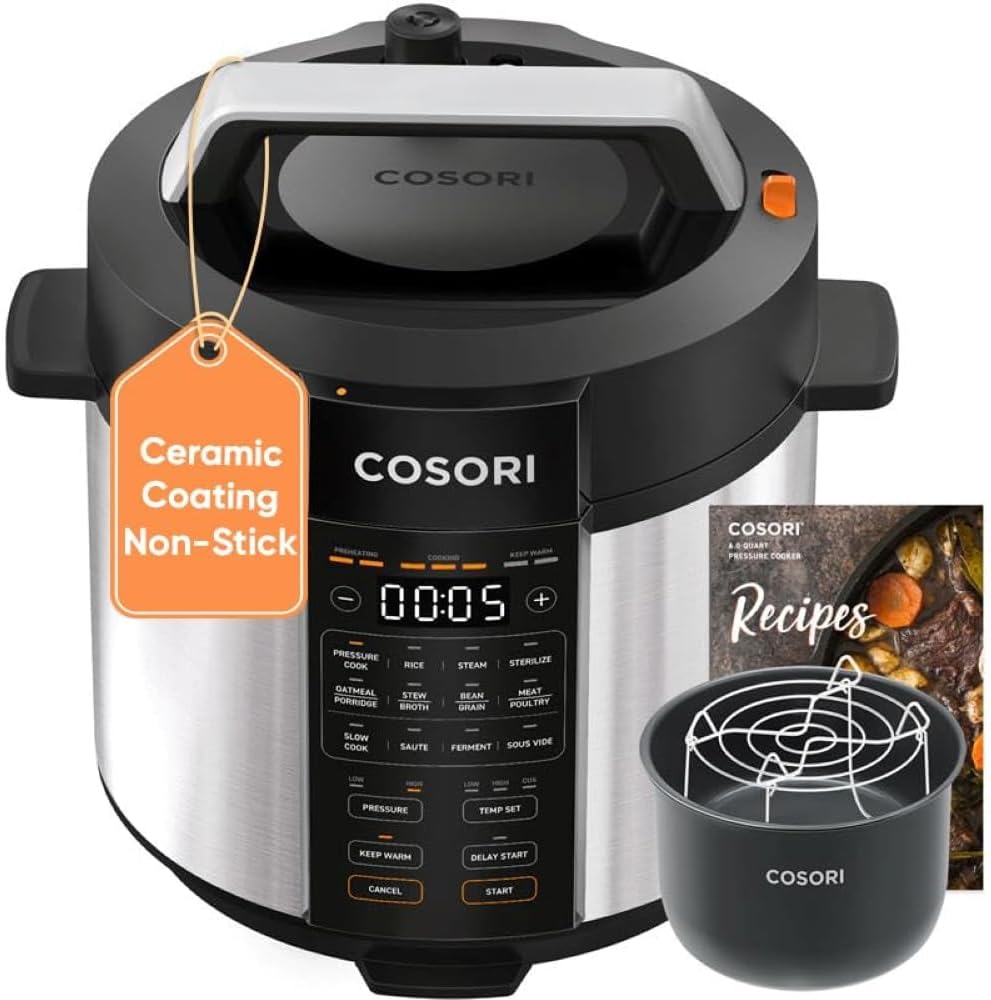 COSORI Pressure CookerPressure side: the ceramic pot with two pressure bandsCheck price on Amazon
 Ninja Foodi OL501Pressure side: the one-lid cooker that crisps after pressureCheck price on Amazon
 Crock-Pot Cook & Carry Programmable Slow CookerSlow side: timed family cooking in a pot built to travel lockedCheck price on Amazon
 Hamilton Beach Set & Forget Slow Cooker 33969ASlow side: roasts finished by internal temperature, not by the clockCheck price on Amazon
 Crockpot 3-Quart Manual Slow CookerSlow side: the simple dial pot for small householdsCheck price on Amazon
Prices move up and down on Amazon, so we never print a price here that could be stale by the time you read it. Use the price check button to see the current price.
Pressure Cooker vs Slow Cooker: The Key Differences
Time is the headline, and it runs in opposite directions. Pressure cooking traps steam inside a locked lid until the pressure forces hot liquid through food faster than a simmer ever could, so beans that want an afternoon in a crock are ready inside an evening. Slow cooking does the reverse trade on purpose: low, steady heat over four to ten hours, breaking down connective tissue gently while the cook is somewhere else entirely. Neither method browns food inside the pot, and both reward the same cheap, tough cuts, which is why the two appliances get compared at all.
Attention is the second split, and for many households it decides more than speed does. A pressure cycle is short but it has edges: filling to the right line, waiting for the pot to seal, then releasing steam at the end, quickly for vegetables or slowly for foamy dishes. A slow cook has no edges at all. Once the lid is on, the kindest thing you can do is leave it there, because every lift spills the built-up heat and the pot spends time climbing back. For a fuller way to weigh pressure models against each other, see How to Choose a Pressure Cooker.
Safety habits differ in kind rather than in seriousness. Pressure cookers concentrate their rules at the lid: respect the fill lines, keep the valve clear, and never force a lid that is still holding pressure. With a slow cooker the safety points are spread through the whole day. Start with thawed meat and poultry, put vegetables in first since they need the longest time, get leftovers into shallow containers and into the fridge inside two hours, and keep food that is waiting to be served at 140°F or above, the holding temperature given in the FoodSafety.gov guidance on hot foods and leftovers.
Capacity reads differently on each side, which catches people out. A 6 quart pressure pot cooks grains and beans to the half line and ordinary food to two thirds, so its usable amount is smaller than the number suggests. A 6 quart slow cooker wants that same half to two thirds fill, though here the risk runs the other way. Put too little in a large crock and it sits in a thin layer, losing moisture around the edges during hours of cooking. Match the pot to the meal either way.
| Point of difference | Pressure cooker | Slow cooker |
|---|---|---|
| How it cooks | Sealed lid, steam pressure above atmospheric | Vented lid, gentle heat below a rolling boil |
| Working temperature | Above boiling point under pressure | About 170°F to 280°F |
| A tough stew takes | About an hour at pressure, plus sealing and release time | Four to ten hours, depending on the setting |
| Attention pattern | Present at the start and at the release | Load it, then leave it alone |
| Dried beans | Cooked from dry in one session | Cooked after soaking, over hours |
| Frozen meat | Thaws and cooks inside the cycle, with added time | Goes in thawed only |
| Lid during cooking | Locked, opened only when pressure is gone | Stays on, lifting it costs heat |
| Best natural home | Late decisions, weeknight cooking | Planned cooking, all-day cooking |
The six models that follow show that contrast in concrete numbers. Read capacity and insert material together: they decide what the pot will hold and how it will wash up for years.
| Product | Side | Capacity | Insert material | Controls | Keep-warm behaviour |
|---|---|---|---|---|---|
| Instant Pot Duo | Pressure | 6 quarts | Stainless steel | Seven functions with thirteen customisable programs | Automatic after the cycle |
| COSORI Pressure Cooker | Pressure | 6 quarts | Ceramic-coated pot | Named programs across two pressure bands | Automatic after the cycle |
| Ninja Foodi OL501 | Pressure | 6.5 quarts | Ceramic-coated pot | Fourteen functions across three lid modes | Automatic after the cycle |
| Crock-Pot Cook & Carry Programmable Slow Cooker | Slow | 6 quarts | Stoneware, oval | Countdown timer, 30 minutes to 20 hours | Automatic when the countdown ends |
| Hamilton Beach Set & Forget Slow Cooker 33969A | Slow | 6 quarts | Stoneware, oval | Program, Probe and Manual modes | Automatic at the set time or temperature |
| Crockpot 3-Quart Manual Slow Cooker | Slow | 3 quarts | Stoneware, round | Dial with Off, Low, High and Warm | Warm is a dial position you choose |
The Pressure Cooker Options, in Full
Three electric pressure cookers that show the fast side's range: a stainless all-rounder that also slow cooks, a ceramic pot with gentler pressure on offer, and a one-lid machine that crisps what it pressure cooks.
Instant Pot Duo
The Duo is the overlap made physical, and that is exactly why it leads the pressure side of a guide like this. Alongside pressure cooking it carries a slow cook function, plus rice, sauté, steam, yogurt and warming modes, seven functions in one 6 quart body with thirteen customisable programs behind them. Run as a pressure cooker it does the fast work this side exists for, at 1000 watts with a stainless steel inner pot that no coating will ever lift from. Run as a slow cooker it covers a planned stew honestly, though without the thick stoneware crock the slow side below is built around. Keep warm starts by itself when a cycle ends on either route. The valve is a manual one you turn by hand, so the steam release asks for a careful moment rather than a switch flick. Buy it if you want a single pot for fast and slow cooking alike, and you would rather have stainless than a coated insert. Skip it if all-day slow cooking is your main pattern, where a stoneware crock holds heat the way this pot does not try to.
Pros
- Pressure and slow cook functions in one 6 quart body
- Inner pot in stainless steel, with nothing coated to peel or wear away
- Automatic keep warm after pressure and slow cycles
- Seven functions and thirteen customisable programs
Cons
- Manual steam valve needs a careful hand at the release
- Slow cooking happens in a steel pot, not a heat-holding crock
- Only a single rice setting, leaving brown rice to a time you set yourself
COSORI Pressure Cooker
Where the Duo argues breadth, the COSORI argues touch. Its working pressure comes in two published bands, a gentler low band for eggs, vegetables and delicate grains and a firmer high band for beans and tough meat, so one pot can treat a cheesecake and a brisket as different jobs. Inside, the 6 quart pot carries a ceramic coating, so rice and beans come away with a wipe rather than a long soak, while the release for steam leans back at 30 degrees, pointing away from your hand, and sits apart from the controls you use to work it. The official COSORI pressure cooker page sets out the lid lock and safety layout behind that design, and the cooker carries a 2 year limited warranty. At 1100 watts it reaches pressure briskly, and slow cook sits among its programs for planned days. Buy it if you put a gentle, out of the way steam release ahead of having an insert that never needs replacing. Skip it if your kitchen stirs with metal spoons daily, because the coating asks for gentler tools.
Pros
- Two pressure bands, gentle and firm, for different foods
- Beans and grains come away from the ceramic coating without a soak first
- Vent for steam leans away from the hand that opens it
- 2 year limited warranty
Cons
- Coating eventually wears and the pot becomes a replacement cost
- Non-metal utensils only around the inner pot
- Plenty of programs to get used to over the first few uses
Ninja Foodi OL501
The OL501 answers the one complaint pressure cooking never escapes: nothing comes out crisp. Its one lid carries a slider that shifts among fourteen functions across its air fry, steam crisp and pressure modes, letting a chicken finish cooking under pressure and then brown its skin without leaving the pot, with no need for an oven tray or another machine. Capacity runs to 6.5 quarts in the main pot and 4.6 quarts on the crisp plate, both layers can cook at once, and its 1460 watts make it the strongest performer covered here. One distinction needs care. This SmartLid model is not part of the CPSC recall of the earlier OP300 series Foodi cookers under recall number 25-247, which covers the older two-lid design; the OL501 uses one lid and a slider, and its model number sits outside that list. Buy it if your pressure cooking usually ends with a wish for a crisp top. Skip it if all you need is quick sealed cooking, since the air fry side would sit unused in your cupboard.
Pros
- Air fry, steam crisp and pressure all work under the same single lid
- Main pot of 6.5 quarts plus a 4.6 quart crisp plate, with room to cook on two levels
- Pressure cooking and a crisped finish in a single pot
- Dishwasher cleaning for the ceramic coated pot and its parts
Cons
- Largest footprint and heaviest build on the pressure side
- Far more functions than a plain stew will ever call for
- Earlier Foodis in the OP300 series sit under a recall, making the model number worth a close look
The Slow Cooker Options, in Full
Three dedicated slow cookers that show the slow side's own spread: a family programmable built to travel, a probe model that reads the meat, and a small dial pot with nothing electronic in it at all.
Crock-Pot Cook & Carry Programmable Slow Cooker
This is the slow side in its most complete everyday form. You can set the timer on High or Low for as little as 30 minutes or as long as 20 hours, and when it finishes the cooker moves to Warm by itself, with nobody needing to be there, which is what makes it suit a working day. The oval stoneware pot holds 6 quarts, enough for a 6 lb roast surrounded by vegetables, and because the lid locks shut, a finished stew can travel in the same pot rather than being poured into something else for the journey. You can also put the stoneware into an oven heated to 400°F to give a dish colour on top at the end of a slow cook. Against the pressure side, the trade is written on the clock: this cooker will never rescue a forgotten dinner at six in the evening, and it does not pretend otherwise. Buy it if planned, unattended family cooking is your pattern and the pot sometimes travels. Skip it if most nights you cook only for one or two, since a half empty pot of this size will not cook evenly.
Pros
- Timed cooking up to 20 hours, starting at 30 minutes, followed by Warm without input
- Lid locks shut, so carrying the pot when full is practical
- Oval stoneware at 6 quarts, sized for a 6 lb roast
- Oven use for the stoneware up to 400°F to finish a dish
Cons
- Oversized for fresh cooking for just one or two
- Timer judges by time alone, with no temperature probe
- Stainless sides show splashes and fingerprints
Hamilton Beach Set & Forget Slow Cooker 33969A
Every other machine covered here, whichever side it sits on, stops cooking when a timer says so. This one can end it by the food. With Probe mode you choose a target temperature for the meat, insert the probe into its thickest section, and leave the cooker to follow the rising reading. Once that target arrives it switches to Warm, so a pork shoulder finishes according to its own temperature instead of a time you estimated in advance. Ordinary timed cooking runs through Program mode, Manual mode gives you a straightforward heat setting, and the stoneware crock, at 6 quarts, accommodates either a 4 lb roast or a 6 lb chicken. The gasket lid clips shut for carrying, and at 275 watts the long cook sips power compared with an oven doing the same work. The cost is counter: at about 17.5 in long this is the widest footprint here. Buy it if you slow cook roasts and whole birds often and care more about hitting the right doneness than about when the cook ends. Skip it if your pot is usually filled with soups and stews, since liquid gives a probe nothing solid to measure.
Pros
- Meat cooks to the temperature you set in Probe mode and is then kept warm
- Three modes on offer: Program for timing, Probe for temperature, Manual for plain heat
- Clipped gasket lid seals well for carrying a full pot
- Crock at 6 quarts holds a 4 lb roast or a 6 lb chicken
Cons
- Widest footprint in this guide at about 17.5 in long
- An extra probe to clean, put away and not lose
- More panel and modes than someone who prefers a simple dial will want
Crockpot 3-Quart Manual Slow Cooker
The smallest machine in this guide is also the clearest argument the slow side owns. Three quarts of round stoneware is the right volume for a stew for two with lunch left over, filled to the level where slow cooking works properly instead of spread across the floor of a family pot. All the dial gives you is Off, Low, High and Warm. Low and High both end up at the same soft simmer, around 209°F, with Low getting there more slowly and High more quickly, while Warm keeps food ready to serve at between 165°F and 175°F. Both the stoneware and the glass lid can go through the dishwasher, and the cooker as a whole comes in at 6.7 lb. With no timer fitted, cooking stops only when someone comes home and turns it off, a setup that works for households already back around dinnertime. Against the pressure picks it gives up speed entirely and gains a pot that asks nothing of you all day. Buy it if small, planned, unattended cooking is your routine. Skip it if your return time wanders, where the programmable picks above absorb the delay for you.
Pros
- At 3 quarts it reaches a good fill level for one or two
- Four positions on the dial, one of them set aside for Warm
- Dishwasher safe stoneware insert and glass lid
- Compact footprint suits small kitchens and small households
Cons
- No timer, so a delayed evening means an overcooked dinner
- No room for a family size stew or a whole chicken
- Long cuts sit less comfortably in a round pot than in an oval one
Pressure Cooker vs Slow Cooker: Pros and Cons Side by Side
Pressure cookers
Pros
- Tough cuts, dried beans and grains cook inside an evening rather than a day
- A sealed pot holds its liquid, so stews keep their depth without topping up
- Keep warm starts automatically on every electric pick here when the cycle ends
- Two of the three pressure picks here slow cook as well, covering planned days too
Cons
- Fill lines cap the usable amount well below the headline quarts
- Steam release needs a present, careful hand, and foamy dishes need a patient one
- Sealing rings absorb odours and wear out, becoming a running replacement
- Nothing browns or crisps inside a sealed pot without a second mode or a second appliance
Slow cookers
Pros
- Loading takes minutes in the morning and the cook needs no attention at all
- Gentle heat turns cheap, tough cuts tender without drying them out
- Programmable models hand over to Warm by themselves when the day runs late
- Stoneware crocks hold heat at the table and go in the dishwasher afterwards
Cons
- Dinner is decided hours ahead, with no way to hurry the pot at the end
- Food safety habits are stricter across the day: thawed meat in, lid left on, leftovers chilled fast
- Small meals suffer in a large crock, so pick a size that fits how many you feed
- Browning happens in another pan, before the pot or after it
Which Should You Choose
Choose a pressure cooker if weeknight dinners are decided late
Choose the pressure side if the question of dinner is usually asked at five in the evening. Beans from dry, a stew from tough meat, grains as a side: all of it fits inside the time a slow cooker needs just to warm through. Readers whose cooking centres on grains should go further into Best Pressure Cooker for Rice, where the pressure picks are judged on rice programs and pot materials alone.
Choose a slow cooker if your day is long and your evenings wander
Choose the slow side if you leave home in the morning and return when you return. A programmable crock loaded before work cooks through the day and holds dinner warm at the end of it, and the probe model above goes further, holding a roast at its temperature rather than at a guessed hour. No pressure cooker can be loaded at breakfast and left to start itself safely at four.
Choose a pressure cooker if freezer space and dried stores do your shopping
Choose the pressure side if your kitchen runs on dried beans, lentils, tough cuts and a freezer that needs rescuing at short notice. Pressure handles dried legumes without an overnight soak and brings frozen-adjacent cooking back inside a weeknight, while a slow cooker wants its ingredients thawed and its beans soaked before the lid goes on.
Choose a slow cooker if you cook for a table that gathers slowly
Choose the slow side if dinner at your house is an arrival window rather than a moment: family drifting in, a potluck dish that must travel and hold, a Sunday stew that waits for everyone. Stoneware holds heat at the table, a locking lid travels without drama, and Warm keeps food at serving temperature while the room fills up.
Choose a pressure cooker if counter space allows only one pot
Choose the pressure side if only one of these appliances can live in your kitchen. Two of the three pressure picks slow cook as a built-in function, so one body covers both patterns after a fashion, while no slow cooker here can pressure cook at all. The compromise is real but one-directional, and for a small kitchen it usually settles the question.
What Each Option Costs to Own
Neither side is expensive to keep, and the honest differences sit in wear parts and habits rather than in bills. Behind this comparison sits a question about price tiers, whether a budget model or a pricier one ends up cheaper to keep over its lifetime. The answer does not change across the divide. Inside either type, what you spend to run the machine hardly shifts with what you paid for it, and the small amount of ongoing spending is set by the type you chose. If your pressure cooker budget has a hard limit, Best Pressure Cooker Under 100 shows what is still available at that level.
On the pressure side, the recurring spend is the sealing ring. Rings tire, stretch and carry the smell of savoury cooking into the next pot of plain rice, and a spare ring is a small, predictable purchase every year or two of regular use. After foamy dishes the valves need clearing out, and How to Maintain a Pressure Cooker walks through washing the ring and checking the vents, the jobs that keep the seal working as it should. Coated inner pots are the one larger future cost: a ceramic pot that releases food beautifully today is a replacement part years from now, where a stainless pot simply continues. Energy per meal is small either way, and pressure shortens element time compared with a long simmer.
Move to the slow side and the list of things to replace shrinks to almost nothing. A stoneware crock has no wear parts at all, and its lifespan is decided by treatment: fill it half to two thirds, let it cool before cold water touches it, and it serves for years, while a crack from thermal shock ends it in a day. Electronics are the other lifespan driver, which is why the dial pot above may well outlive the programmable models around it. Power draw is gentle, a few hundred watts across hours, still far below an oven cooking the same dinner. Leftover handling costs nothing but attention: shallow containers, the fridge within two hours, and reheating outside the crock.
Also Considered
- SharkNinja Foodi OP300 series: the earlier two-lid Foodi pressure cookers, excluded under CPSC recall 25-247 because the pressure lid could be opened during use. The OL501 above is a different, single-lid design outside that model list, which is why a Ninja appears in the picks and these models never could.
- Sensio Bella, Bella Pro, Crux and Cooks pressure cookers: excluded under CPSC recall 23-256, which covers electric and stovetop models from those lines whose lids could unlock during use.
- Crock-Pot Express Crock Multi-Cooker SCCPPC600-V1: a pressure multi-cooker rather than a plain slow cooker, so it fails this side's premise outright, and it is also the model named in CPSC recall 21-035 for a lid that could detach under pressure. No place on the slow side goes to a pressure appliance under a recall.
- Instant Pot Pro: a pressure cooker at 6 quarts, with its own programs for white rice and for brown rice, plus settings you can save as favourites. It missed the six because the Duo already covers the stainless 6 quart pressure role here, and grain-by-grain settings belong to the rice guide's test rather than this one.
- Crock-Pot 8-Quart Programmable Slow Cooker: the largest programmable option in the Crock-Pot range, built for crowds, counting down for up to 20 hours before moving to Warm on its own. The Cook & Carry already fills the programmable place here at a family size, and it brings a locking lid that this larger model does not have, so this one stays out of the six.
When You Need Both, or Neither
Owning both suits homes that deliberately cook in both rhythms, with soups and stews planned for the crock through the day and last minute meals handled under pressure, letting each machine take the work the other handles poorly. The pairing works best at different sizes, a family slow cooker beside a mid-size pressure pot, rather than two large bodies fighting for the same cupboard.
Neither is right when your cooking does not match either rhythm. Fast fresh food, seared steaks, stir-fries and anything built on browning and crunch belong to a hob and a heavy pan, and a household that eats out or assembles most nights will store two appliances for a habit it does not have. One good Dutch oven covers the occasional stew for that kitchen, and the money stays in the food.
Pressure Cooker vs Slow Cooker: Frequently Asked Questions
What are the key differences between a pressure cooker and a slow cooker?
Pressure and patience. A pressure cooker seals its lid and cooks above boiling point under steam pressure, finishing tough dishes in about an hour with the cook present at the start and the release. A slow cooker, by contrast, cooks with a vented lid at roughly 170°F to 280°F, taking four to ten hours and needing nobody at home during that time. The ingredients overlap heavily; the day they ask for does not.
Which costs less to own, a pressure cooker or a slow cooker?
The slow cooker, by a small margin. A stoneware crock has no wear parts and asks only for careful handling, while a pressure cooker wants a fresh sealing ring every year or two and, on coated models, an inner pot years down the line. Running costs for energy stay low whichever side you choose, and the gap between them is too small to base a buying decision on.
For weeknight family dinners, which fits your needs?
It depends on when the decision happens. Decide at breakfast and the slow cooker wins, cooking unattended and holding dinner warm if the evening slips. Decide at five and the pressure cooker wins, turning dried beans and tough cuts into dinner inside the hour. Households that live in both patterns are the ones the both-appliances section above is written for.
Can a pressure cooker replace a slow cooker?
Partly, and in one direction only. Two of the three pressure picks here carry a slow cook function, so they cover planned stews as well as fast ones, though in a steel or coated pot rather than a heat-holding stoneware crock. No slow cooker can return the favour, because nothing about a vented crock builds pressure. For most households the pressure machine is the workable single purchase; for slow cooking purists the crock still earns its own space.
Which is easier to use, a pressure cooker or a slow cooker?
The slow cooker asks less of a beginner: load it, choose Low or High, leave the lid alone. A pressure cooker asks for a short routine to be learned properly, fill lines, sealing, and a release method matched to the food, and then runs just as automatically. Ease at the start favours the crock; ease across a busy month favours whichever machine matches how your dinners actually get decided.
Keep Researching This Pressure Cooker
the grain by grain test, rice programs, pot materials and keep warm behaviour ranked for rice first cooking.
Budget BuyingBest Pressure Cooker Under 100the pressure shortlist at the tight end of the market, where 6 quart electrics with a rice program are the pattern.
How to ChooseHow to Choose a Pressure Cookerthe full framework for sizes, pot materials, release designs and safety systems, in one place.
Use & CareHow to Maintain a Pressure Cookerring care, valve clearing and gasket checks that keep a cooker sealing and releasing properly.
More in Kitchen & Cookware
Kitchen & CookwareAll Pick Hearth guides in this categoryHow We Check Comparisons Like These
Read the full Pick Hearth methodology- Every model on both sides was matched against the specifications its maker publishes: capacities, insert materials, control types and keep-warm behaviour in this guide all come from those recorded figures, with the pressure and slow versions of the same dish kept separate rather than blended.
- The recommendations follow what the two types genuinely do differently, speed against unattended time, sealed against vented, ring against crock, and where a machine crosses the line, as the pressure picks with slow cook modes do, this guide names the overlap instead of hiding it.
- No maker can buy its way into these six places, and what this site earns from a purchase never moves a pick up or down: the full pool on both sides was screened against CPSC recall records before any ranking, which is why the OP300 series, the Sensio-made lines and the Express Crock model appear in Also Considered with their reasons and never in the picks.
First published · Updated in place as products and specs change