The overlap is real, and it is where the money gets wasted. Both tools chop an onion. Only one of them cubes it. Only the other one turns it into soup, carries a whole cabbage through a feed tube, or brings a dough together. This guide puts three choppers against three processors and judges each side on the work it genuinely does better.
The short answer
Buy the chopper side if your prep is pieces. All three choppers here work by hand, need no outlet, and put their effort into the cut itself: two press produce through steel grids for true cubes, and the third spins a blade through an 8.5 cup bowl for high-volume chopping. None of them purees smoothly, none kneads, and every load is worked by your arm rather than a motor.
Buy the processor side if your prep goes past pieces. All three processors here chop, the two full-size models slice and shred through feed tubes, and the range runs from a 3 cup mini that answers a single sauce to a 14 cup machine that works through a market shop in one session. What the motor gives up is geometry: a spinning blade chops unevenly compared with a grid, so the processor's dice never matches the chopper's cubes.
The deciding question is what leaves your board most often. Cubes for salads and salsas point one way. Sauces, slaws, purees and dough point the other.
 Fullstar The Original Pro ChopperVegetable chopper side: the dicer that also spiralizesCheck price on Amazon
 Mueller Pro-Series 10-in-1Vegetable chopper side: the multi-blade set that slices and gratesCheck price on Amazon
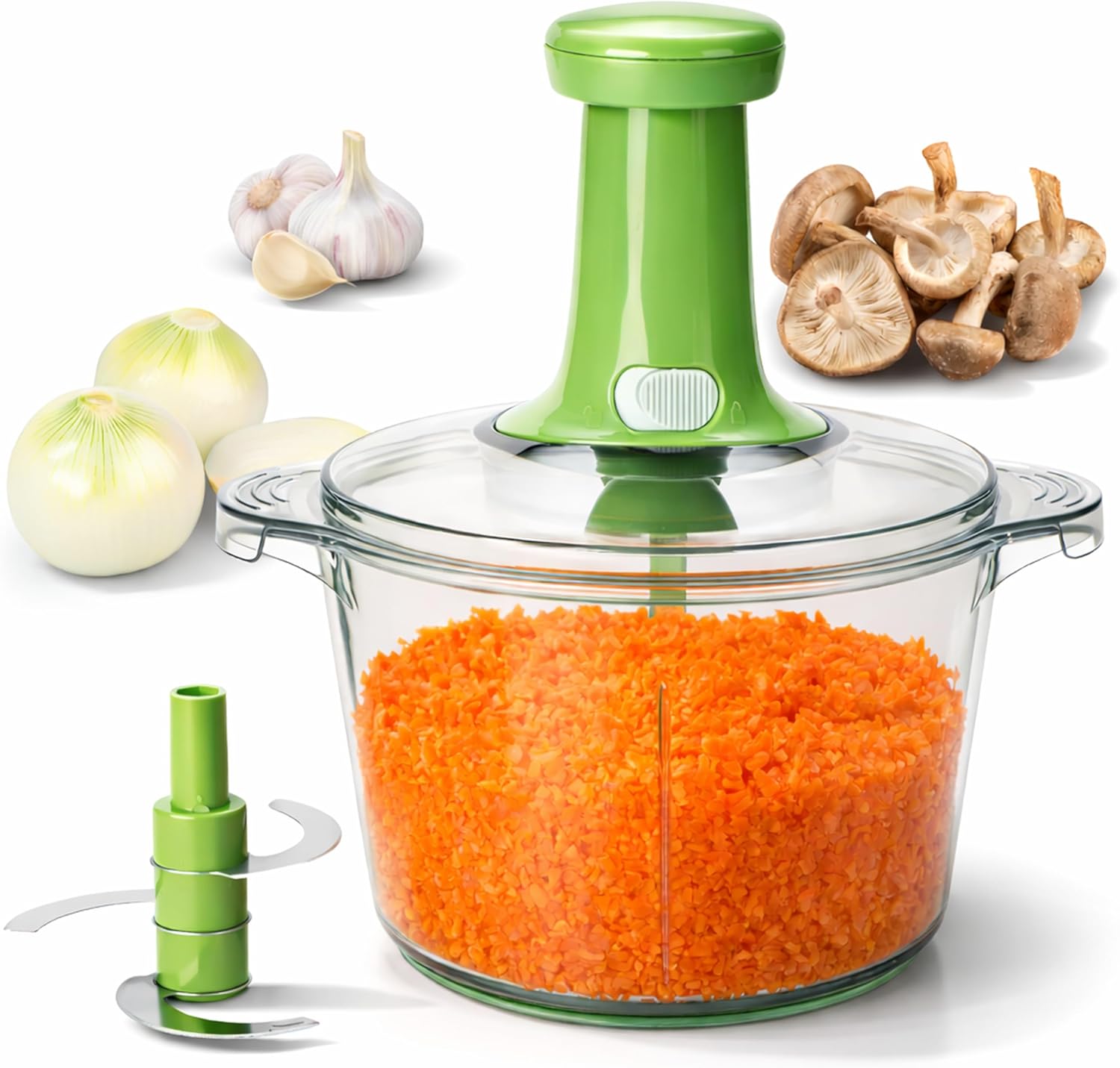 Brieftons ExpressVegetable chopper side: the big-load pump chopperCheck price on Amazon
 Cuisinart Custom 14-CupFood processor side: the full-size all-rounderCheck price on Amazon
 Ninja Professional PlusFood processor side: the strong mid-size motorCheck price on Amazon
 Hamilton Beach 72850Food processor side: the mini that runs while you pressCheck price on Amazon
Prices move up and down on Amazon, so we never print a price here that could be stale by the time you read it. Use the price check button to see the current price.
Vegetable Chopper vs Food Processor: The Key Differences
The deepest split is how the cut is made. A grid chopper forces each piece through fixed openings, so size is set by steel rather than by timing: every cube that comes through a 1/2 inch grid is a 1/2 inch cube, first press and fiftieth alike. A processor throws food at a moving blade, and size is set by how long the motor runs, which means one bowl always holds a spread of fine and coarse pieces. For chopped salads, salsas and garnishes, that difference is the whole purchase. For soup bases and sauces, it barely matters, because the pan or the puree forgives the spread.
Power draws the second line. Choppers here are worked by hand: a press down, a pump handle, your weight behind the lid. They are silent, they work during a power cut, and they stop the instant you stop. Processors bring 350 to 1000 watts to the same vegetables, and that motor unlocks jobs muscle cannot copy: continuous slicing through a feed tube, shredding a block of cheese without a break, pureeing to a smooth finish, and, on the mid-size pick, a dough blade that brings mixtures together. The motor also brings noise, a cord, and a base that wants permanent counter room.
Load handling cuts across the size labels. The largest chopper here holds 8.5 cups, more than the smallest processor at 3 cups, so a manual tool can win on volume against a mini. Where processors pull away is flow: a feed tube accepts piece after piece while the motor runs, while every chopper works one load at a time and then stops for emptying. Washing splits the same way. A chopper's work is a grid to clear and a box to rinse. A processor's work is a bowl, a lid, a blade and discs, more parts, but nearly all of them dishwasher safe on the full-size picks.
One habit matters on both sides, because both tools work on produce that is often eaten raw: rinse everything under running water before it meets a blade, scrub firm skins with a clean brush, and dry the pieces so the cut stays crisp, following the FDA guidance on selecting and serving produce safely. The wider framework for judging grids, bowls and blade sets sits in How to Choose a Vegetable Chopper.
| Point of difference | Vegetable chopper | Food processor |
|---|---|---|
| Power source | Hand pressure or a pump handle | Electric motor, 350 W to 1000 peak W here |
| How the cut is made | Produce forced through a fixed grid, or a hand-driven blade | Spinning blade and discs driven by the motor |
| Dice quality | True uniform cubes from grid models | Chopped pieces in a spread of sizes |
| Purees and sauces | Coarse chop at best, no smooth puree | Smooth purees on the full-size and mini picks |
| Dough | None | Dough blade on the mid-size pick |
| Slicing and shredding | One pick slices and grates with hand-fed blades | Feed tube and discs on both full-size picks |
| Working load | 1.2 L to 8.5 cups, one load at a time | 3 cups to 14 cups, continuous feed on full-size picks |
| Cleaning centre | Clearing the grid, rinsing the container | Bowl, lid, blade and discs to wash |
| Outlet needed | No | Yes |
The six tools below put figures on that split. Read the container and cutting tools columns together: they show how much each tool holds and what shapes it can make from what it holds.
| Product | Side | Container or bowl | Power | Cutting tools in the box | Slices and shreds |
|---|---|---|---|---|---|
| Fullstar The Original Pro Chopper | Vegetable chopper | 1.2 L | Manual press | 4 blades: 2 dicers, ribbon and julienne spiralizers | No |
| Mueller Pro-Series 10-in-1 | Vegetable chopper | About 1.2 L | Manual press | 8 blades: 2 dicers, slicer, wavy cutter, julienne, 3 graters | Yes, hand-fed blades |
| Brieftons Express | Vegetable chopper | 8.5 cups | Manual pump | 1 three-leaf blade | No |
| Cuisinart Custom 14-Cup | Food processor | 14 cups | 720 W | Chopping blade, slicing disc, shredding disc | Yes, feed tube discs |
| Ninja Professional Plus | Food processor | 9 cups | 1000 peak W | Chopping blade, dough blade, reversible disc | Yes, feed tube disc |
| Hamilton Beach 72850 | Food processor | 3 cups | 350 W | Stainless chopping blades | No |
The Vegetable Chopper Options, in Full
Three hand tools that show the manual side's range: a dicer with spiralizers for garnish work, an eight-blade set that reaches toward processor territory, and a pump model built for volume.
Fullstar The Original Pro Chopper
Set this box beside any processor here and its argument is geometry. Four interchangeable blades in 420 stainless steel cover the work: a small dicer for onion and celery, a large dicer for cucumber and pepper, and then a ribbon and a julienne spiralizer for the carrot and cucumber garnishes no spinning blade can produce. Pressing sends every piece down into the 1.2 litre container. The lid locks shut for safety when pressure builds, you get a soft-grip handle to hold, and a non-skid base underneath grips the counter so the box does not wander. The finished dice goes in the dishwasher as a complete unit. Against a processor it concedes purees, dough and powered slicing without a fight, and wins on the two things a motor cannot imitate: identical cubes and ribbons. Buy it if salads and salsas are the centre of your prep and garnish cuts earn their keep. Skip it if sauces and dough share your week, because no blade in this box reaches them.
Pros
- Small and large dicers give two true cube sizes
- Ribbon and julienne spiralizers add cuts no processor here makes
- 1.2 litre container catches the whole load
- Goes in the dishwasher, and locks shut safely on a base that will not skid
Cons
- No slicing or grating blade in the box
- No puree or dough work of any kind
- Spiralizer blades are extra loose parts to store
Mueller Pro-Series 10-in-1
This is the chopper that comes closest to a processor's repertoire, and it gets there with blades rather than watts. Eight blades work over a container of about 1.2 litres: two dicers at 1/4 inch and 1/2 inch, a slicer, a wavy cutter, a julienne blade and three graters, with a food holder for the flat blades and storage cases that keep the set together. A cleaning brush and forks clear the grids. One safety point needs plain words. Mueller's older Onion Chopper Pro, model M-700, was recalled in 2020 under CPSC recall 21-017 because its locking tab could detach during use. The Pro-Series 10-in-1 here is a later, different line, models MC-710 and MC-780, and is not named in that recall; check the model number on any Mueller chopper before you buy, and look it up in the CPSC recalls database whenever a secondhand one is on offer. Buy it if you want slicing and grating from a tool with no motor. Skip it if eight blades means eight reasons to reach for a knife instead.
Pros
- Eight blades cover dicing, slicing, wavy cuts, julienne and grating
- Two dice sizes at 1/4 inch and 1/2 inch
- Blade storage cases and a food holder included
- Cleaning brush and forks included for the grids
Cons
- The most parts to wash and store on the chopper side
- Slicing is hand-fed, with no continuous feed tube
- Blades keep their edge longer washed by hand
Brieftons Express
Volume is where a manual tool is supposed to lose, and this one refuses. Capacity reaches 8.5 cups, close to what the mid-size processor offers. Working the pump handle turns a stainless blade with three leaves through loads of carrot, cabbage, onion and pepper, enough coleslaw and salsa for a gathering. Pump count sets the finish: a few pumps for chunky, more for fine. While you chop, the blade remains hidden within the bowl. Afterwards the handle folds flat and locks there, so storage takes less room. Set against a processor, the limits are texture and care. A rotary blade chops rather than dices, there are no discs and no puree finish, and this model is hand wash only. Buy it if your chopping arrives in party quantities and you would rather pump than plug in. Skip it if nightly dice for two is the real load, where its bowl is mostly washing up.
Pros
- 8.5 cup bowl rivals a mid-size processor for volume
- Pump count controls the finish, chunky to fine
- Blade stays concealed inside the bowl during use
- Pump handle locks down flat for storage
Cons
- Hand wash only, with no dishwasher option
- Rotary chop, never a true dice
- No slicing, shredding or puree work
The Food Processor Options, in Full
Three motorised bowls at three scales: a 14 cup flagship with paddle controls, a 9 cup machine with the strongest motor here and a dough blade, and a 3 cup mini that runs only while you press its lid.
Cuisinart Custom 14-Cup
This is the processor the choppers have to beat, and its case is breadth at volume. A 720 watt motor drives a 14 cup bowl, the controls are two paddles, On and Off/Pulse, and an extra-large feed tube with small and large pushers feeds a 4 mm slicing disc and a shredding disc as well as the stainless chopping blade. Cabbage, cheese and onions move through in a continuous run that no load-by-load chopper can match, and removable parts go in the dishwasher. Cuisinart covers the motor for five years and the machine for three. One safety check belongs with this model line. A 2016 recall, CPSC recall 17-061, covered riveted blades in processors with DFP-14 and DLC-10 model prefixes sold from July 1996 to December 2015. This listing dates from January 2016, after that window, and current machines carry an unriveted blade, so a new purchase sits outside the recalled population. On a used machine, look at the blade before anything else: four rivets around a beige centre hub means do not use it. Buy it if one machine must slice, shred, chop and puree for a household. Skip it if even dice is your main event, because its chop is a spread of sizes next to a grid.
Pros
- 720 watt motor with a 14 cup bowl, the largest capacity here
- Extra-large feed tube with small and large pushers
- Slicing and shredding discs plus a stainless chopping blade
- Dishwasher safe parts, with five years of motor cover
Cons
- Chopped pieces vary in size, with no true dice
- Fixed discs, so slicing thickness cannot be adjusted
- Large footprint that claims permanent counter room
Ninja Professional Plus
Power per cup is this machine's argument. Power comes from a motor rated at 1000 peak watts, paired with a 9 cup bowl. Included alongside it are a chopping blade and a dough blade, plus a reversible disc for slicing in one direction and shredding in the other, with food fed through a chute using a pusher. Four Auto-iQ programs cover chopping, slicing, pureeing and dough, which puts two jobs on this side of the guide that no chopper touches at all: smooth purees and dough work. Nine cups is the family middle ground, big enough for a slaw or a double sauce, small enough that the bowl still circulates a modest load properly. Parts are dishwasher safe, and SharkNinja covers the machine for one year. Buy it if your processor will split its week between vegetables, sauces and dough in a mid-size kitchen. Skip it if you cook for a crowd in single loads, where the 14 cup bowl above saves the second run.
Pros
- 1000 peak watt motor, the strongest figure in this guide
- Dough blade included, a job no chopper here can do
- Reversible disc slices and shreds through the feed chute
- Dishwasher safe parts
Cons
- 9 cup bowl means crowd quantities run in two loads
- One year of cover, the shortest on the processor side
- Preset programs run longer than careful chopping wants
Hamilton Beach 72850
The smallest processor here borrows the chopper's own control idea and adds a motor to it. The 3 cup bowl stacks onto the base, the lid goes on, and pressing down runs the 350 watt motor for exactly as long as you press, so pulsing is a rhythm in your hand rather than a setting to select. Stainless blades handle onions, salsa and baby food in small loads, a small opening in the lid meters oil into dressings while the blades turn, and the bowl, lid and blades all go in the dishwasher. Against the choppers, it wins on effort and puree finish at small scale, and loses on everything a feed tube and discs provide: there is no slicing, no shredding, and no load bigger than 3 cups. Buy it if your processing is a sauce, a dip or a single onion at a time and counter space is scarce. Skip it if family quantities or sliced vegetables are the point, where it becomes a queue of small runs.
Pros
- Press-the-lid control, with nothing to set or learn
- 350 watt motor, strong for a 3 cup bowl
- Oil opening in the lid for dressings and emulsions
- Dishwasher safe bowl, lid and blades
Cons
- Runs only while you press, with no hands-free operation
- 3 cup bowl keeps every job small
- Chops and purees only, with no discs or feed tube
Vegetable Chopper vs Food Processor: Pros and Cons Side by Side
Vegetable choppers
Pros
- Grid models cut true uniform cubes that no spinning blade reproduces
- No outlet, no cord and no noise, so they work anywhere and store in a drawer
- Very little to wash: a grid, a container and a lid cover most sessions
- Nothing electrical to fail, and the running cost is the food itself
Cons
- Every load is powered by your arm, and firm produce asks for real pressure
- No smooth puree, no dough, and powered slicing is out of reach
- Loads run one at a time, with emptying between each
- Grids trap food in their teeth and want a brush after use
Food processors
Pros
- One motor chops, slices, shreds and purees, and one pick here adds dough
- Feed tubes keep working piece after piece without stopping to reload
- Bowls run to 14 cups, and even the mini purees smoothly
- Pulse control and programs make texture repeatable with little effort
Cons
- Chopped results spread across sizes, so the dice never matches a grid
- Bowl, lid, blade and discs make the longest wash on this page
- A base, a cord and an outlet claim counter room every day
- Motors and seals wear in ways a hand tool never meets
Which Should You Choose
Choose a vegetable chopper if even dice is the job
Choose the chopper side if your cooking is built on pieces that must match: chopped salads, salsas, mirepoix and garnishes where a spread of sizes reads as sloppy. A grid decides the size once, in steel, and repeats it without attention. Readers whose salads lead the week should start from Best Vegetable Chopper for Salads, where the grid field is ranked on dice quality alone.
Choose a food processor if purees, sauces and dough share the week
Choose the processor side if the same machine must also smooth a soup, emulsify a dressing or bring a dough together. Those jobs need sustained motor power, and no amount of pressing or pumping turns a chopper into them. The Ninja adds the dough blade, the Cuisinart adds the biggest bowl, and even the mini Hamilton Beach purees a small sauce smoothly.
Choose a vegetable chopper if there is no outlet or counter to spare
Choose the chopper side if the kitchen is a dorm room, a camper or a counter measured in inches. Every chopper here works without electricity, stores at container size, and comes out for one onion without a base to assemble. The Fullstar and the Mueller both live happily in a drawer, which no full-size processor can claim.
Choose a food processor if weekly volume is the bottleneck
Choose the processor side if prep day means a market shop worked through in one session. A feed tube that never stops, discs that slice and shred in a continuous run, and a 14 cup bowl turn an hour of load-by-load pressing into minutes of steady feeding. The Brieftons narrows that gap on chopping volume alone, and still asks your arm to do every bit of the work.
Choose a vegetable chopper if washing up decides what gets used
Choose the chopper side if you know a tool with five parts to wash will sit in the cupboard on tired evenings. A grid rinsed under the tap and a container in the dishwasher is the whole routine for two of the three choppers here, and that small friction difference is what keeps a tool in weekly use rather than in storage.
What Each Option Costs to Own
Neither side asks for consumables, subscriptions or proprietary refills, and the honest differences sit in replacement parts and in what wears out first. The tier question behind this comparison, whether the budget or premium end of either type costs less to run, lands simply: inside each type the running costs stay close, and the extra money buys build and capacity rather than cheaper months.
On the chopper side, ownership is close to free. There is no electricity to speak of and nothing on a schedule. The parts that age are grid teeth and lid hinges, stressed by hard produce forced through fine openings, so the lifespan habit is matching the grid to the load and cutting firm vegetables smaller before pressing. Replacement grids are the one realistic second spend. Cut produce also spoils quickly once chopped, so cover it and refrigerate it promptly; the chill step of the FoodSafety.gov four steps to food safety puts two hours as the limit for perishable food left out, in a fridge at 40°F or below. Readers working to a firm ceiling should read Best Vegetable Chopper Under 40 for the hand-tool field at the lower end of the spend.
On the processor side, electricity costs seconds of power at a time and stays trivial. The real ownership questions are the motor, the bowl seals and the discs: a machine worked inside its load limits, washed without soaking the base, and stored with its blade guarded will serve for years, while overloaded bowls and dropped discs shorten that life quickly. Replacement bowls and discs exist for long-running model lines, which is a quiet reason to buy a named machine with a model number. Premium processor money buys stronger motors, bigger bowls and longer cover, and it shows up as headroom on dense loads rather than lower bills.
Also Considered
- Cuisinart PrepExpress: a two-grid box dicer with a 4 cup marked container and an angled platform that takes bigger pieces with less trimming. It missed the six because its two grids only dice, while the Fullstar covers dicing and adds spiralizers and the Mueller covers dicing plus slicing and grating.
- Kuhn Rikon Pull Chop: a 2 cup pull-cord chopper where pull count sets the texture from coarse to near puree. It missed the six because the Brieftons Express covers hand-driven rotary chopping at more than four times the bowl size, and the pull format's small loads overlap the mini processor's ground.
- Mueller Onion Chopper Pro M-700: excluded outright. This older Mueller model was recalled in 2020 under CPSC recall 21-017 because its locking tab could detach during use, and a recalled model is never a pick here; the Mueller in the main six is the later Pro-Series line, which is not named in that recall.
- KitchenAid 3.5 Cup Food Chopper: a mini processor with a locking blade, a pour spout and a drizzle basin in the lid for dressings. It missed the six because the Hamilton Beach 72850 covers the mini place with a published 350 watt figure and a press control that needs no settings at all.
When You Need Both, or Neither
Both is the settled end state for kitchens that prep in two registers. The chopper owns the dice: salads, salsas and garnishes where even cubes are the point. The processor owns everything past pieces: purees, slaws through the feed tube, cheese by the block and dough on baking day. Each tool then works inside its strength, and neither is forced into the job it does badly. The routines that keep the pair ready, grids cleared and dried, blades stored guarded, bowls washed hot after raw work, are the daily ground of How to Clean a Vegetable Chopper applied to both tools.
Neither is the honest answer in plainer cases. If your vegetable prep is one onion and a pepper twice a week, a knife and a board finish before either tool is washed, and both purchases become cupboard rent. And if your real workload is soups, smoothies and frozen drinks, neither tool here is the right shape: that is a blender's work, and the money belongs there instead.
Vegetable Chopper vs Food Processor: Frequently Asked Questions
What are the key differences between a vegetable chopper and a food processor?
The cut and the power. A grid chopper forces produce through fixed openings, so every piece comes out the same size, and it runs on hand pressure with no outlet. A food processor spins blades and discs with a motor, which chops in a spread of sizes but adds continuous slicing and shredding, smooth purees and, on some models, dough work. One specialises in pieces; the other generalises across the whole prep list.
Which costs less to own, a vegetable chopper or a food processor?
The chopper, by a small and honest margin. A manual chopper spends nothing on power and asks only for a replacement grid if teeth wear or crack. A processor also runs cheaply, seconds of electricity at a time, but it carries a motor, seals and discs that can each become a replacement cost over a long life. Whether you buy cheap or premium within one category, day-to-day running costs end up much the same. The category itself is what separates them, not where a model sits in its range.
For dorm rooms, which fits your needs, a vegetable chopper or a food processor?
The vegetable chopper, and it is not close. A dorm room offers little counter, shared outlets and neighbours through the wall, and a hand chopper answers all three: no electricity, drawer storage and silent work. The one processor that could argue its case is a mini, and even that needs an outlet, makes noise and washes like a machine. For salsa and salad prep in a small room, the grid box wins.
Can a food processor replace a vegetable chopper?
Partly, and the gap is the dice. A processor chops everything a chopper chops, slices and shreds beyond it, and purees where a chopper cannot follow, so for most kitchens it covers the chopper's workload in substance. What it never reproduces is the grid's uniform cube, and it asks for assembly and a full wash where a chopper rinses in seconds. The reverse swap fails outright: no chopper purees smoothly or kneads.
Which lasts longer, a vegetable chopper or a food processor?
The one matched to its load. A simple chopper has no motor to burn out and few moving parts, and used on produce its grids suit, it can dice for years; forced through hard roots weekly, its teeth and hinges age fast. A processor carries more to wear, motor, seals and discs, but a named machine worked inside its bowl limits and kept dry at the base also serves for years. On both sides, overload is the lifespan decision, not the badge.
Keep Researching This Vegetable Chopper
the main guide for this product, where grid dicers, pull choppers and a big pump model are ranked on dice quality and cleanup.
Budget BuyingBest Vegetable Chopper Under 40the chopper shortlist at the lower end of the spend, checked on blades, capacity and cleaning.
How to ChooseHow to Choose a Vegetable Choppergrids, containers, blade sets and storage worked through in order, before any money moves.
Use & CareHow to Clean a Vegetable Chopperclearing grid teeth safely, washing spinning blades, and drying parts so edges last.
More in Kitchen & Cookware
Kitchen & CookwareAll Pick Hearth guides in this categoryHow We Check Comparisons Like These
Read the full Pick Hearth methodology- Before any pick earned its place here, we compared the chopper figures and the processor figures alike against each model's own published specifications. That check covered how much each bowl or container holds, the wattage claimed, which blades and discs are supplied, and how the makers say to care for them, and we recorded those details so the table entries match the published sources.
- The verdicts rest on the differences that survived that checking, not on badges or price bands: the chopper verdicts turn on dice geometry, load size and washing load, the processor verdicts on motor strength, feed tube work and puree finish, and where a tool borrows the other side's trick, such as a mini processor with a press control, this guide names it as a borrowing rather than a conversion.
- No maker can buy a place in the six, and what this page earns from a purchase never moves a ranking: both pools were screened model by model against recall records before picking, one older chopper model was excluded on that screen alone, and every shared product with our other guides was written again from this comparison's angle.
First published · Updated in place as products and specs change