Our top picks at a glance
Every pick in this guide stays in the meat for the whole cook. That one fact splits them three ways. A wired model runs a thin braided cable out through the door seal to a display on the counter, and it is the simplest, toughest and cheapest format. A receiver model keeps the wired probes but sends their readings to a handset or your phone, so the alarm travels with you. A wire-free probe carries its own sensors and radio inside the meat, with nothing crossing the door seal at all, and asks the most of its battery and its heat limits in return.
Our first choice for most ovens is the ThermoWorks DOT, a single wired probe with a 47 inch cable, two buttons and an alarm, built by the maker whose probes anchor half this list. If you cook two things at once, or one thing and the oven air beside it, the ThermoPro TP20 does that job with a carried receiver and no phone involved. If wires through the door seal annoy you more than apps do, the MEATER Plus is the wire-free pick for ordinary roasting temperatures.
Heat draws the real line in this list. A wired probe cable here is rated to 700°F or beyond, while a wire-free probe reads the meat only up to about 212°F inside and survives a set ceiling of surrounding heat, 527°F on the MEATER Plus and 1,000°F on the MEATER Pro. A hot oven for a slow roast suits all ten. Searing heat and open flame are where the formats part company, and the cards below say which side of that line each pick sits on.
 ThermoWorks DOTBest overallCheck price on Amazon
 ThermoWorks SmokeBest wireless with its own receiverCheck price on Amazon
 ThermoWorks SignalsBest for four probes and WiFiCheck price on Amazon
 MEATER PlusBest wire-free for everyday roastsCheck price on Amazon
 MEATER ProBest wire-free for high heatCheck price on Amazon
 ThermoPro TP20Best value wireless pairCheck price on Amazon
 ThermoPro TP25Best Bluetooth set for four itemsCheck price on Amazon
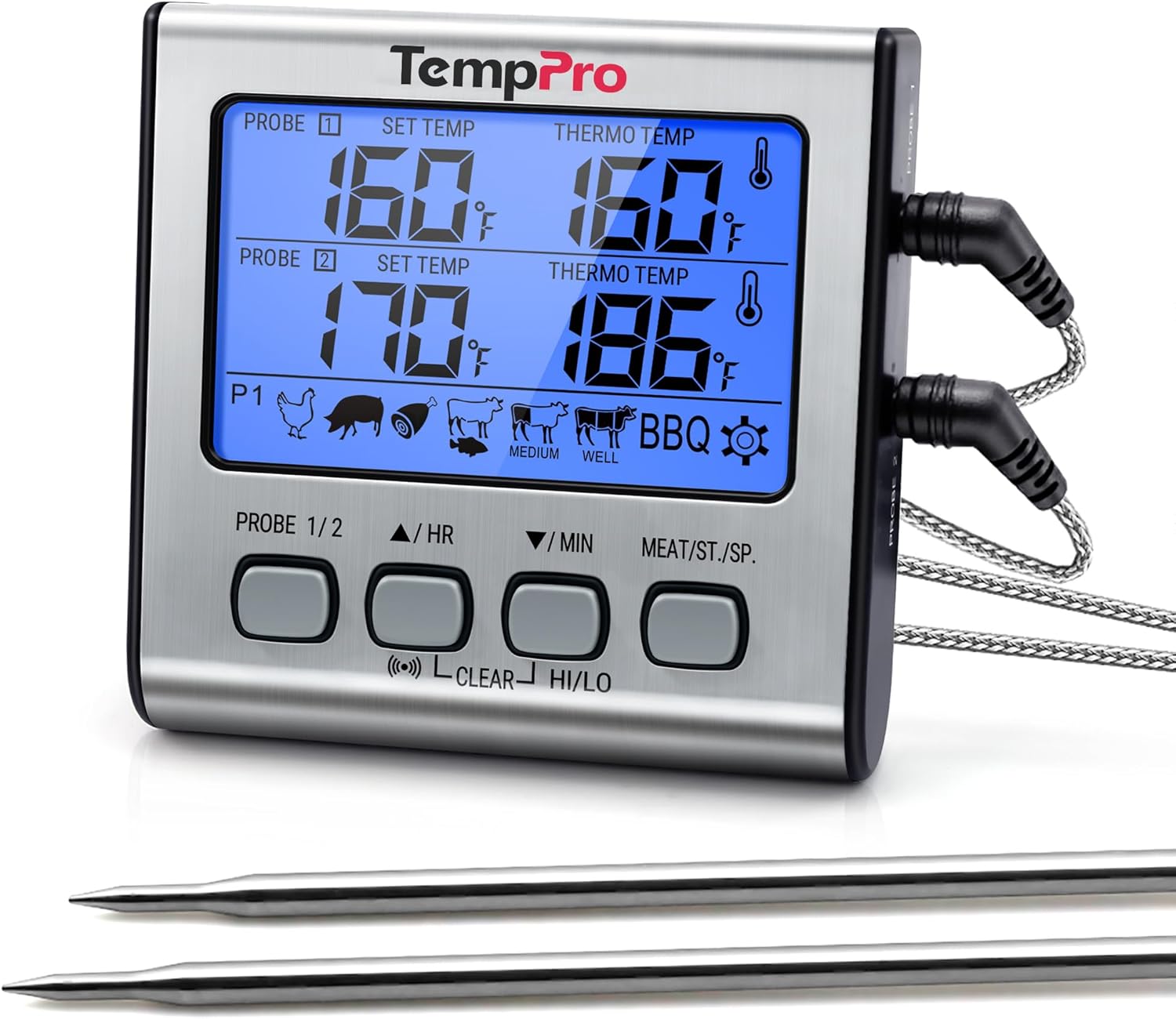 ThermoPro TP17Best wired pair on a budgetCheck price on Amazon
 Inkbird IBT-4XSBest low-cost Bluetooth four probeCheck price on Amazon
 Inkbird IBBQ-4TBest WiFi four probe for the moneyCheck price on Amazon
Prices move up and down on Amazon, so we never print a price here that could be stale by the time you read it. Use the price check button to see the current price.
The Best Meat Thermometers for Oven, Reviewed in Full
ThermoWorks DOT
The DOT is the leave-in thermometer reduced to its essentials, and for a single oven roast those essentials are complete. One probe on a 47 inch cable reads from -58°F to 572°F, the probe tip takes 572°F and the cable takes 700°F, so a domestic oven at full roast temperature stays well inside its limits. You set one target with two buttons, the round display shows the current temperature and the alarm setting together, and the unit sounds when the meat arrives, with magnets and a fold-out stand deciding where it lives while it waits. The housing is splash resistant to IP65 apart from the probe socket, the battery run is 5,000 hours on two AAA cells, and the full specification sits on the official ThermoWorks DOT product page. There is no timer, no second channel and no phone link, and that absence is the point. Buy it if you roast one centrepiece at a time and want an alarm you can set in five seconds without an app, an account or a pairing ritual. Skip it if you regularly cook two items at different temperatures, because one probe can only watch one of them.
Pros
- One probe, one target, two buttons to set it
- Cable rated to 700°F, probe range to 572°F
- 5,000 hour battery life on two AAA cells
- Magnetic back and fold-out stand for counter or oven door placement
Cons
- A single probe watches a single item
- No timer and no remote alerts away from the kitchen
- No backlight on the display
ThermoWorks Smoke
The Smoke keeps the wired probes and moves the display into your pocket. Two channels run from the base unit beside the oven: one 6 inch cooking probe for the meat and one air probe on a grate clip for the oven itself, both reading from -58°F to 572°F with accuracy of ±1.8°F through the cooking range. The base sends both readings to a separate receiver rated to 300 feet, pre-paired out of the box, so there is no phone, no app and no WiFi setup between you and the alarm. Both units are splash resistant, the displays are backlit, high and low alarms can be set per channel, and the battery run stretches to about 1,800 hours. In an oven the second channel earns its keep: the air probe tells you what your oven dial is hiding, which is often ten or twenty degrees of optimism. Buy it if you want to leave the kitchen during a long roast and still hear the alarm, without handing the job to your phone. Skip it if four items need watching at once, where the Signals below doubles the channel count.
Pros
- Two probes included: one for meat, one for oven air on a grate clip
- Dedicated receiver rated to 300 feet, no phone or app needed
- High and low alarms on both channels
- Backlit displays on the base and the receiver
Cons
- Two channels is the ceiling
- WiFi and phone graphs need a separate add-on gateway
- Probes are wired to the base, so the door seal still carries cables
ThermoWorks Signals
Signals is the wired format taken to its limit: four channels on one base, supplied with three cooking probes and an air probe with a grate clip, each reading from -58°F to 572°F. The base works on its own with a large backlit dashboard, and it also carries WiFi and Bluetooth, so the same four readings, alarms and a graph of the cook reach your phone through the ThermoWorks app and cloud. Colour rings on the probes keep a turkey breast, a thigh, a second dish and the oven air separate at a glance. The housing is rated IP66, the internal battery runs up to 16 hours and a power adapter covers longer cooks, and an optional fan controller can be added for smokers, which oven cooks can ignore. For a holiday oven carrying a bird, a ham and a tray of something else, this is the one base that watches everything. Buy it if your big cooks genuinely involve three or four temperatures at once and you want them graphed as well as alarmed. Skip it if your roasting is one joint on a Sunday, where the DOT does the same core job in a fraction of the body and the budget.
Pros
- Four channels, with three cooking probes and an air probe in the box
- WiFi and Bluetooth alongside a full standalone display
- Per channel alarms, naming and cook graphs in the app
- IP66 splash resistant housing with colour coded probe rings
Cons
- The largest and most expensive base in this guide
- Battery runs up to 16 hours, so long cooks want the adapter plugged in
- Four wired probes through one door seal takes a moment to arrange
MEATER Plus
The MEATER Plus removes the cable entirely. A single stainless probe carries two sensors: one reads the inside of the meat up to 212°F and one reads the air around it up to 527°F, and the readings travel by Bluetooth to the MEATER app, which estimates the finish time, counts in the rest, and alarms at your target. The bamboo charging block doubles as a Bluetooth repeater, which is what stretches the range to 165 feet, and a charge gives up to 24 hours of cooking. The probe is waterproof and dishwasher safe, and nothing crosses the oven door seal, which makes it the tidy answer for rotisserie cooks and for anyone whose cable has ever been trapped and frayed by a door. The limits are real and worth stating plainly: the surrounding heat ceiling of 527°F rules out the hottest searing, and one probe watches one item. Buy it if you roast at ordinary oven temperatures, cook one centrepiece at a time, and want the door seal left alone. Skip it if you sear at very high heat or cook several items together, where the Pro below or a wired multi-probe set fits better.
Pros
- Fully wire-free probe, nothing crosses the oven door seal
- Reads meat and surrounding air temperature from one probe
- Charger block doubles as a repeater for 165 feet of range
- Waterproof probe that goes in the dishwasher
Cons
- Surrounding heat ceiling of 527°F excludes the hottest searing
- One probe watches one item only
- Everything runs through the phone app, there is no display of its own
MEATER Pro
The MEATER Pro, also sold as the MEATER 2 Plus, is the wire-free idea rebuilt for hotter and more precise work. Five sensors sit along the inside of the probe with a sixth reading the surrounding air, the internal reading runs to 221°F, and the probe withstands surrounding heat up to 1,000°F, which opens the searing and open flame work the Plus cannot touch. MEATER puts the accuracy of this probe at ±0.5°F, and the Bluetooth link is the newer 5.2 standard with a longer rated range than the Plus. The probe is waterproof and dishwasher safe, the app carries the same guided cooks, finish estimates and rest timing as its sibling, and the bamboo charger keeps the same repeater role. What you do not get is a second probe or a display: it remains a one item, phone led tool, at a step up in price from the Plus. Buy it if you want wire-free monitoring that survives a ripping hot oven or a grill sear as well as a gentle roast. Skip it if your oven never passes ordinary roasting temperatures, because the Plus covers that ground and the saving is real.
Pros
- Surrounding heat resistance up to 1,000°F
- Five internal sensors plus an ambient sensor in one probe
- Bluetooth 5.2 with a longer rated range than the Plus
- Waterproof, dishwasher safe probe
Cons
- Still one probe for one item
- No display of its own, the phone is the readout
- Costs a clear step more than the MEATER Plus
ThermoPro TP20
The TP20 is the receiver format at a working kitchen price. Two stainless probes on braided cables plug into a transmitter that sits by the oven, and a separate orange receiver carries both readings up to 500 feet away by radio link, with no app, no pairing and no account. The probes read from 14°F to 572°F, the cables withstand up to 716°F, and preset temperatures for common meats and doneness levels can each be reset to your own numbers. A count up and countdown timer rides along, both units have backlit displays, and ThermoPro covers the probes with a lifetime replacement promise, which matters because probes are the part of any of these systems that eventually fails. One probe in the meat and one clipped at the rack gives an oven cook the two numbers that decide a roast. Buy it if you want the Smoke style of freedom, a carried receiver and an alarm that follows you, at the value end of the market. Skip it if you want your cooks graphed on a phone, because this system deliberately never touches one.
Pros
- Two probes with a carried receiver rated to 500 feet
- Probe cables withstand up to 716°F
- Preset meat temperatures, all resettable to your own targets
- Lifetime probe replacement promise
Cons
- No app, no graphs and no WiFi
- Two channels only
- Presets need checking against your own targets before you trust them
ThermoPro TP25
The TP25 spreads four colour coded probes across one Bluetooth base, so a whole oven load can be watched from a phone. Each probe reads from 14°F to 572°F, the base pairs over Bluetooth 5.0 with a rated range of 650 feet in open air, and the app adds per probe alarms, preset temperatures for nine meats, a cook time estimate and a graph of each probe as it climbs. The base has its own backlit display showing all four readings, which keeps the cook readable when the phone is in another room, and the internal battery is rechargeable by USB rather than a drawer of cells. Four cables through an oven door is a small traffic jam, and Bluetooth through walls and a steel door will never match the open air figure, but for a big family roast with different doneness targets at different thicknesses, this is the affordable way to watch all of it. Buy it if you cook several items at once and live comfortably inside an app. Skip it if you want monitoring with no phone in the loop, where the TP20 above keeps everything on its own receiver.
Pros
- Four colour coded probes in the box
- Bluetooth 5.0 with a 650 foot open air rating
- Base display shows all four readings without the phone
- Rechargeable battery and per probe alarms in the app
Cons
- Four cables through the door seal need arranging
- Real range through walls is far below the open air rating
- The estimate feature depends on the app staying connected
ThermoPro TP17
The TP17 is the wired pair stripped to the price a first thermometer should cost. Two probes plug into one countertop unit with a large backlit display that shows both set temperatures and both current temperatures at once, one probe for the meat and one for the oven air, or one in each of two joints. Preset temperatures cover the common meats, a barbecue mode alarms if the oven drifts above or below a band you set, and a timer counts up or down beside the temperatures. The unit stands on a flip foot or sticks to the oven front by its magnet. There is no radio of any kind, so the alarm only helps if you are in earshot of the kitchen, and the build is lighter than the ThermoWorks units above it. None of that stops it doing the central job well: two honest numbers, watched continuously, for the price of a takeaway. Buy it if this is your first leave-in thermometer or your oven usually holds two things that matter. Skip it if you need to hear the alarm from the garden or another floor, where a receiver model is the right spend.
Pros
- Two probes and both readings on one large backlit display
- Barbecue mode alarms when oven temperature leaves your set band
- Timer built in beside the temperature readings
- Magnetic back and flip stand for placement
Cons
- No remote alerts of any kind
- Lighter build than the premium wired units
- Probes are not covered by the lifetime promise the TP20 carries
Inkbird IBT-4XS
The IBT-4XS puts four probes on Bluetooth at the lowest commitment in this guide. Three meat probes and one oven probe come in the box, reading from 32°F to 572°F for short periods and to 482°F for continuous monitoring, with accuracy of ±2°F. The base pairs with a phone app over a 150 foot Bluetooth range, shows a temperature graph, and alarms on the base and the phone when a target is reached. A 1,000 mAh rechargeable battery, a magnetic back and a display that rotates to read from either side round out a unit clearly built to a price and built sensibly. The 150 foot range is the shortest in this guide and the continuous ceiling of 482°F is a real instruction to keep this one for roasting rather than searing, but within those lines it watches a full oven for very little money. Buy it if you want four probes and an app and would rather spend the difference on the meat. Skip it if your kitchen and living space stretch the Bluetooth link, where the TP25 or a WiFi model holds the connection better.
Pros
- Four probes included: three for meat, one for the oven
- Rechargeable battery and a magnetic, rotating display base
- App graphs and alarms alongside the base alarm
- The lowest cost per probe in this guide
Cons
- 150 foot Bluetooth range, the shortest here
- Continuous monitoring ceiling of 482°F
- Accuracy of ±2°F is a step behind the ThermoWorks probes
Inkbird IBBQ-4T
The IBBQ-4T answers the Bluetooth range problem with WiFi. Four colour coded probes plug into a compact base that joins your home network on the 2.4 GHz band, after which the app can reach the cook from anywhere the phone has a connection, with alarms, a temperature graph and a calibration adjustment inside the app. The base shows all four readings on its own orange backlit display, carries a magnet for the oven front, and runs on a rechargeable 2,000 mAh battery good for at least 26 hours of monitoring. Probe clips for the rack are included. WiFi setup is the one chore the Bluetooth models skip, and the base depends on your network behaving, but once it is on the network the walk-away freedom is total in a way no Bluetooth model here matches. Buy it if you want to check a long roast from the shops, the office or the far end of the garden. Skip it if your router is temperamental or you would rather not create another account and app pairing, where the receiver models keep life simpler.
Pros
- WiFi monitoring from anywhere, not a fixed radio range
- Four colour coded probes with rack clips included
- Base display shows all four readings on its own
- Rechargeable battery rated for at least 26 hours
Cons
- WiFi setup and an app account before the first cook
- Works on the 2.4 GHz band only
- Monitoring depends on your home network staying up
Wired, receiver wireless or wire-free: how oven thermometers split
One decision explains almost every difference in this guide, and it is how the reading gets out of a closed oven. A cable is honest and nearly indestructible but crosses the door seal. A radio link frees you from the kitchen but adds batteries, pairing and range limits. A wire-free probe removes the cable and puts the electronics in the heat instead. Whether a leave-in probe is even the right tool against a candy thermometer, which is built for sugar syrup rather than meat, is the subject of the full Meat Thermometer vs Candy Thermometer comparison; the table below settles the format question inside this guide. An instant-read pen belongs in this picture only as the final check at the door: it cannot stay in a closed oven, so it complements a leave-in pick rather than replacing one.
| Point of difference | Wired to a counter display | Wired probes with a remote readout | Wire-free probe |
|---|---|---|---|
| How the reading leaves the oven | A braided cable through the door seal to a unit on the counter | Cables to a base by the oven, then a radio link to a receiver or phone | No cable at all; the probe radios from inside the meat |
| Heat the system takes | Probe to 572°F and cable to 700°F or more | The same probe and cable ratings, set by the wired half | Meat reading to about 212 to 221°F; surrounding heat ceiling 527°F or 1,000°F by model |
| Alarm reaches you | Only in the kitchen | Across the house, or anywhere with WiFi models | Wherever your phone has the app open and in range |
| Probe count on offer | One or two | Two or four | One per probe, bought singly or in sets |
| Picks here | ThermoWorks DOT, ThermoPro TP17 | ThermoWorks Smoke, ThermoWorks Signals, ThermoPro TP20, ThermoPro TP25, Inkbird IBT-4XS, Inkbird IBBQ-4T | MEATER Plus, MEATER Pro |
Within the wired group, the split is channels: the DOT watches one item perfectly simply, the TP17 watches two. Within the remote group, the split is what carries the reading: a dedicated receiver never needs your phone, Bluetooth models put everything in an app within a rated range, and WiFi removes the range question and adds a network setup. Within the wire-free pair, the split is heat: the Plus is the everyday roast probe, the Pro is the one built for searing temperatures.
The check at the door
Whichever format you choose, a leave-in probe reads where you placed it, and a big joint is not one temperature throughout. An instant-read thermometer earns a supporting place here: when the leave-in alarm sounds, a quick check in two or three spots confirms the coldest part of the meat has arrived, especially on a whole bird where the thigh and the breast finish apart. That is a thirty second job at an open door, and it is the only job an instant-read model can do for an oven cook.
Also considered
- ThermoWorks ChefAlarm: the timer equipped sibling of the DOT, with a 6 inch probe, high and low alarms and adjustable volume. It missed the ten because no verifiable Amazon.com listing for it could be confirmed at the time of checking; ThermoWorks sells it directly, and third party marketplace copies carry a markup and warranty warning from the maker itself. A pillar pick has to be buyable through the link we print.
- ThermoWorks Thermapen ONE: the fastest instant-read in its class, reading in one second. It missed the ten because it cannot stay in a closed oven at all; it appears in this guide only as the check at the door complement described above, never as an oven pick.
- MEATER Block: a four probe wire-free set in a WiFi charging block. It missed the ten because the Signals and the IBBQ-4T cover four channel oven monitoring with wired probes that have no surrounding heat ceiling to manage, and four wire-free probes multiply the most expensive format in the guide.
- ThermoPro TP08S: the earlier two probe wireless ThermoPro with a 300 foot receiver. It missed the ten because the TP20 covers the same role with a longer rated range, updated presets and the lifetime probe promise.
Who this guide is for
Sunday roast cooks
You cook one joint, one bird or one tray at a time and you want it right without hovering. A wired single or dual probe is your format: the DOT for one item, the TP17 when the oven air matters too, and the routine in How to Set Up Meat Thermometer covers probe placement and door seal routing that make the numbers trustworthy.
Holiday and big cook hosts
Your oven carries a turkey, a ham and sides that all finish at different temperatures. Four channels stop being a luxury: the Signals for a wired base with WiFi, the TP25 for four probes on Bluetooth, or the IBBQ-4T when you want to check the bird from another room or another building.
Cooks who leave the kitchen
You roast while doing other things in other rooms. A carried receiver, the Smoke or the TP20, keeps the alarm on your belt with no phone involved, and a WiFi model removes the range limit altogether for long, slow cooks.
Small kitchens and dorm rooms
A leave-in thermometer is one of the smallest tools in this whole niche: a wired unit and its probe coil into a drawer, and a wire-free probe lives in its charging block on a shelf. Check your housing rules before relying on any appliance with a battery left charging, and remember the probe still needs an oven safe pan and a way to rest hot meat.
What to look for when buying a meat thermometer for oven use
The full framework sits in How to Choose a Meat Thermometer. For oven use, five things decide it.
- Leave-in design before everything. The probe and its cable, or the wire-free probe itself, must be built to stay inside a closed oven for the whole cook. An instant-read pen, however fast, is a spot check tool and never a substitute.
- Heat ratings in two places. The probe reading range and the cable or ambient ceiling are different numbers. A wired cable rated to 700°F shrugs off a hot oven; a wire-free probe with a 527°F surrounding ceiling does not belong in a searing pan.
- Probe count matched to your oven load. One probe for one centrepiece, two when the oven air or a second item matters, four for holiday loads. Extra channels you never use are extra cables through the seal on every cook.
- How the alarm reaches you. A counter unit alarms in the kitchen. A receiver alarms in your pocket. Bluetooth alarms inside a rated range that walls will shorten. WiFi alarms anywhere, at the price of setup. Choose for the house you actually cook in.
- A model you can check before you buy. A thermometer is a small electrical appliance with a battery and a heat exposed probe, exactly the kind of product worth two minutes against the CPSC recalls page before you order, and every pick in this guide was screened that way before it was ranked.
Meat thermometer sizes and capacity for oven use
Capacity on an oven thermometer is not a volume; it is how many temperatures the system can watch at once, how far the cables reach, and how far you can walk away. Probe counts here run from one on the DOT and both MEATER models to four on the Signals, TP25, IBT-4XS and IBBQ-4T.
- Cable length. The ThermoWorks wired probes run on 47 inch cables, long enough to place the base clear of oven heat with the door closed. The Inkbird probes run longer still at about 59 inches. Short cables force the base against a hot oven front, which is why length is a safety figure as well as a convenience.
- Transmitter range. Dedicated receivers here are rated at 300 feet for the Smoke and 500 feet for the TP20. Bluetooth ratings run from 150 feet on the IBT-4XS to 650 feet in open air on the TP25, and every wall and the oven door itself take a share of those numbers. WiFi models replace the question with your network coverage.
- Probe length and shape. A 6 inch class probe reaches the centre of a large bird or joint. Step down tips on the ThermoPro probes narrow near the point, which reads the centre of thinner cuts more honestly than a thick shaft does.
One sizing note travels with every pick here: the base unit never goes in the oven. Only the probe and its rated cable, or the wire-free probe, take the heat; bases, transmitters and chargers live outside, which is why cable length and radio range are the real capacity figures of this category.
How much does a good meat thermometer cost?
Prices date too quickly to print; the shape of the kit is what moves them. Format is the first driver: a wired unit is a probe, a cable and a display, while a remote system adds a radio link and a second unit, and a wire-free probe packs sensors, a battery and a radio into something that survives inside roasting meat. Probe count is the second: channels, probes and cables multiply across a four probe set, and colour coding and rack clips come with them.
Connectivity and build drive the rest. WiFi hardware, rechargeable batteries, metal housings and splash proofing all cost more to make than a simple counter unit, and probe quality is the quiet divider, because the probe is the part that takes the heat and the part that eventually gets replaced. Readers shopping at the tight end should read Best Meat Thermometer Under 20 alongside this guide, and expect the models there to be wired units with one or two probes and no radio, in the pattern of the simpler picks in this guide.
Common mistakes when buying a meat thermometer for oven use
- Buying an instant-read pen for a closed oven job. A pen reads for seconds at an open door and then comes out. The cook who relies on one opens the oven again and again, loses heat each time, and still never sees the temperature climb. Leave-in and instant-read are partners, not rivals.
- Ignoring the cable or ambient ceiling. A probe may read to 572°F while its cable is rated lower, and a wire-free probe may cap the surrounding heat at 527°F. Exceeding a ceiling does not bend the rules slightly; it kills the probe, sometimes into the food.
- Trusting the preset instead of the safe temperature. Presets are doneness suggestions. The safety floors are fixed: the FoodSafety.gov safe minimum internal temperature chart puts all poultry at 165°F, ground meats at 160°F, and whole cuts of beef, pork, veal and lamb at 145°F with a three minute rest. Set your alarm to the number your food needs, not the icon you like.
- Placing the probe against bone or in a fat seam. Bone conducts heat differently from muscle and a probe touching it reads the bone, not the dinner. Centre the tip in the thickest part of the meat, away from bone, gristle and the pan.
- Leaving the base stuck to a hot oven door. Bases and transmitters have their own temperature limits far below oven heat. A base magnetised to a hot door cooks its own electronics; keep it on the counter or a cool surface and let the cable do the travelling.
Meat thermometer pros and cons for oven use
Pros
- The door stays closed, so the oven holds its temperature and the roast cooks evenly
- An alarm replaces clock guessing, which is where dry meat and undercooked poultry both come from
- One probe in the meat and one at the rack exposes what your oven dial is hiding
- The same tool covers a weeknight chicken and a holiday turkey without new skills
Cons
- Cables cross the door seal and eventually fray, and replacement probes are a running cost
- Wire-free probes carry strict surrounding heat ceilings and small batteries to manage
- Every radio format adds a failure mode a plain cable never has: pairing, range and flat batteries
- A badly placed probe gives a confident, precise, wrong number
Who should not buy a meat thermometer
If you cook meat rarely and mostly in thin cuts on a stovetop, a leave-in oven thermometer will sit in a drawer; an instant-read pen alone covers that cooking honestly. If you will not place a probe carefully, centre of the thickest part, away from bone, no channel count or app will rescue the reading, and the tool will be blamed for placement it cannot fix. And if your oven work is baking rather than roasting, spend the money on an oven thermometer for the air and a good instant-read for everything else, because a meat probe has nothing to measure in a cake.
Meat Thermometer for Oven: Frequently Asked Questions
What should I look for first when buying a meat thermometer for oven use?
That it is a leave-in design: a probe and cable, or a wire-free probe, built to stay in a closed oven for the whole cook, with heat ratings above your hottest roast. Probe count, alarms and apps only matter once that first test is passed, and the what to look for section above works through each of them.
How many probes do I need, and how far will the signal reach?
One probe for one centrepiece, two when you want the oven air or a second item watched, and four for holiday loads. Cable runs here are 47 inches and longer, receivers are rated at 300 to 500 feet, Bluetooth at 150 to 650 feet in open air, and WiFi models work wherever your network reaches.
How much does a good meat thermometer cost?
Cost follows format and probe count rather than reading quality alone. Simple wired units sit at the entry end, receiver and Bluetooth sets in the middle, and WiFi bases and wire-free probes at the top. The cost section above walks through what each step up adds.
What is the most common mistake when buying a meat thermometer for oven use?
Buying an instant-read pen and expecting it to monitor a closed oven. It cannot stay inside, so the door opens again and again and the cook is still guessing between checks. A close second is ignoring the cable or ambient heat ceiling and killing a probe in a hot oven.
Who should not buy a meat thermometer for oven use at all?
Stovetop cooks who rarely roast, and anyone who will not place a probe carefully in the centre of the meat. Both end up with a drawer tool or a misleading number. An instant-read pen and an oven air thermometer serve those kitchens better.
Keep researching this meat thermometer
the same oven test applied at the tight end of the market, where wired one and two probe units are the pattern.
ComparisonMeat Thermometer vs Candy Thermometerthe split between a probe built for meat and one built for sugar syrup, and why the tools are not interchangeable.
How to ChooseHow to Choose a Meat Thermometerthe full framework for formats, probe counts, heat ratings and alarms, in one place.
Use & CareHow to Set Up Meat Thermometerprobe placement, door seal routing, target setting and the placement checks that make a reading trustworthy.
More in Kitchen & Cookware
Kitchen & CookwareAll Pick Hearth guides in this categoryHow we check meat thermometers like these
Read the full Pick Hearth methodology- Premise checked one model at a time: every pick here is a genuine leave-in thermometer for oven use, a wired probe, a wired probe set with a remote readout, or a wire-free probe, verified from its own listing and maker documents.
- Probe counts, cable lengths, heat ratings and radio ranges taken from manufacturer and listing documents: cables rated to 700°F and beyond, wire-free ambient ceilings of 527°F and 1,000°F, and ranges from 150 feet of Bluetooth to WiFi are the figures the rankings rest on.
- Food safety temperatures checked against the regulator, not the brands: the USDA FSIS safe temperature chart is the source for the poultry, ground meat and whole cut figures used in this guide.
- Every model screened against CPSC recalls before ranking: no pick is recalled, and the probe recalls on record, a 2014 iDevices iGrill probe line and an Australian button battery action on a different Inkbird instant-read model, were checked model by model and neither touches a current pick here.
- No brand can pay for a place, and affiliate earnings never change the order: the ranking follows format fit, heat ratings and how honestly each model serves an oven cook.
First published · Updated in place as products and specs change