Start here: decide how you cook before you count probes
Three questions, answered honestly on paper, come before any model does.
First, does your food cook behind a closed door for a long stretch, or do you stand over it? A roast, a whole bird or a brisket cooks unseen for an hour or more, and that pattern calls for a probe that stays inside and reports outward. Steaks, chops and burgers cook in minutes in front of you, and that pattern calls for a fast spot check and nothing more.
Second, how many separate pieces genuinely need a number at the same moment? One centrepiece needs one probe. A bird plus a second dish, or a joint plus the oven air itself, needs two. A holiday oven with three or four items finishing apart needs four, and buying four channels for a one joint household only adds cables to arrange on every cook.
Third, where will you be when the food arrives? In the kitchen, a counter display and a loud alarm are enough. In another room or out in the garden, the alarm has to travel, on a carried receiver, through a phone link, or over your home network. If you dislike apps and accounts on principle, that preference rules out a whole shelf at once, and ruling it out early saves real money.
The four thermometers that follow each take one of those patterns and work it through; the order is not a ranking.
 ThermoWorks DOTPattern: the single wired leave-in for one roast at a timeCheck price on Amazon
 ThermoPro TP19HPattern: the folding instant-read for fast checks at the doorCheck price on Amazon
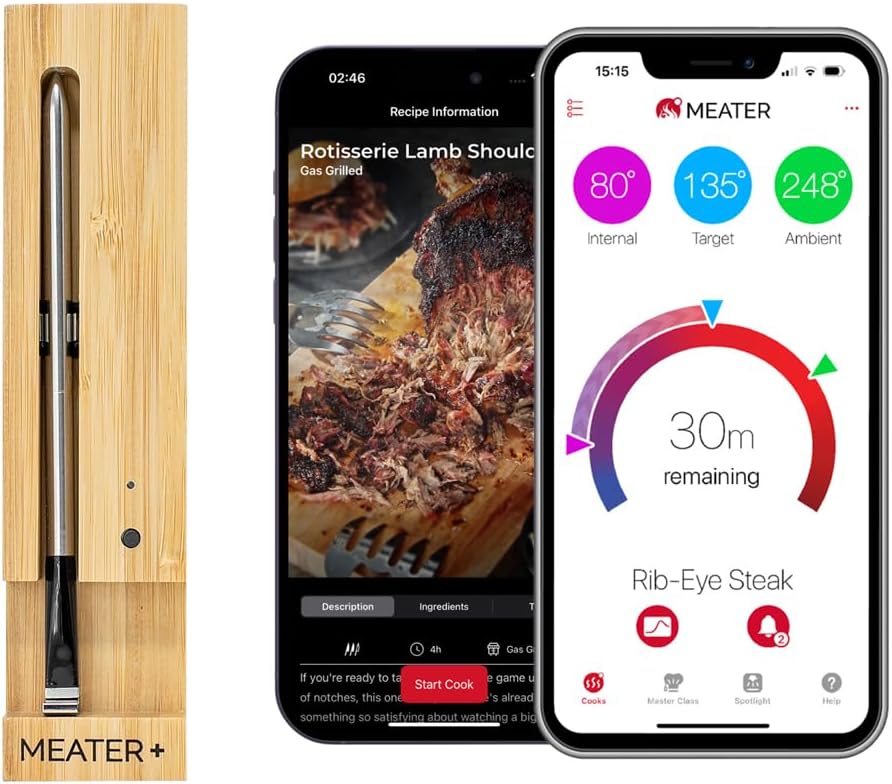 MEATER PlusPattern: the wire-free probe when no cable should cross the sealCheck price on Amazon
 ThermoPro TP25Pattern: the four-probe Bluetooth set for a loaded ovenCheck price on Amazon
Prices move on Amazon, so we never print one here. Use the price check button to see the current price.
Types of meat thermometer explained: leave-in, instant-read and dial
The wired leave-in is the workhorse pattern. A thin probe sits in the meat for the whole cook, a heat rated cable slips out past the door seal, and a small unit on the counter shows the climbing number and sounds at your target. Nothing needs pairing, nothing needs charging mid-cook, and the cable takes far more heat than any home oven produces. The costs are a cable to route with care and an alarm that only helps someone within earshot, unless a radio link carries it further.
The wire-free probe folds that whole arrangement into the meat itself. Sensors inside a single thick probe read the food and the air around it, and a phone app receives the numbers, estimates the finish and counts in resting time. Rotisserie cooking loves this pattern, because a turning joint cannot trail a cable. The trade sits in the ceilings: the part inside the food reads only to around the boiling point of water, and the air around it has a firm upper limit that rules out the fiercest heat.
The instant-read pen is a visitor, not a resident. You open the door or lift the lid, push a folding or fixed probe into the thickest part, read the number in a second or a few seconds, and take it out again. It is the quickest way to confirm a leave-in reading, to check a second spot, or to judge thin cuts that never needed monitoring at all. What it can never do is watch a closed oven for you.
The dial is the oldest pattern and the simplest object here: a metal probe and a round face that stay in the roast inside the oven, with no battery and no electronics at all. It reads slowly and in broad steps, and it offers no alarm, so you still walk over and look. Cooks who roast one large piece at a time and distrust batteries sometimes prefer exactly that bargain.
One boundary matters before any of these patterns tempts you across the aisle. A thermometer shaped for meat and a thermometer shaped for sugar syrup solve different problems, and the full head to head in Meat Thermometer vs Candy Thermometer shows where each family stops working for the other.
Meat thermometer size guide: what size do you need
Size in this category rarely means the box on the counter. It means three reach questions: how far the probe tip travels into food, how far the cable or signal travels out of the oven, and how many channels travel with it.
Probe length decides which cuts you can judge honestly, because the sensor sits near the tip and the tip belongs in the centre of the thickest part. A folding pen with a probe of about 4 inches handles breasts, chops, burgers and fish when you come in from the side. A wired probe of about 6 inches, or a long pen of about 5.3 inches, reaches the centre of a whole bird or a deep joint without your hand entering the heat. If your largest regular cook is a turkey or a thick brisket, measure that cut before you buy, not after.
Cable length decides where the base can live. Around 47 inches of cable lets a counter unit sit clear of a hot oven front with the door shut, and longer runs near 59 inches give still more slack. A short cable parks electronics against heat they were never built for, so treat length as a safety figure rather than a convenience.
Channel count is the third size. One channel suits one centrepiece. Two channels suit one piece of meat plus the oven air, which is how you learn whether your oven dial tells the truth. Four channels suit a loaded holiday oven. Buy the count your biggest routine cook needs, because unused probes still need storing, washing and routing on the days you do use the set.
Meat thermometer materials compared: steel, glass and coated bodies
Nearly every probe you will meet is stainless steel, and for good reason. Steel tolerates oven heat, does not react with food, survives being scrubbed, and keeps a thin step-down tip that slips into a cut without tearing it. When you compare probes, the useful differences are tip shape and thickness rather than the alloy itself: a narrowed tip settles in the centre of a thin fillet more honestly than a thick shaft does.
The bodies split into three camps. Hard plastic bodies keep pens and counter units light and inexpensive, and they are the reason instant-read tools must stay out of a closed oven, since the electronics and the shell cannot live in that heat. Metal bodied pens feel sturdier and wipe clean, yet they follow the same rule: only a probe and its rated cable, or an all metal dial, belong inside for a whole cook. Splash proofing and full waterproofing decide how a body gets washed, and a sealed body that rinses under the tap tends to get cleaned properly while an unsealed one gets wiped and put away damp.
Glass appears only on the dial and candy side of the wider family, as a tube carrying a liquid column. It needs no power and reads at a glance, and it breaks when dropped, which ends the tool outright. Treat glass as a deliberate simplicity choice, never as the rugged option.
Charging blocks and cases use humbler materials, bamboo on one worked example below and moulded plastic on most others, and they matter only for storage. What decides daily life is simpler: a magnet or a sheath that gives the thermometer a home you will actually use, because a probe stored loose in a cutlery drawer comes out bent.
Meat thermometer features that actually matter: alarms, range and read speed
The alarm is the feature that changes your evening. On a leave-in model you set a target once, and the tool calls you when the centre arrives, which ends the cycle of opening the door to check and watching the oven temperature fall each time. Judge an alarm by where it reaches you: on the counter, on a carried receiver, inside a phone app within its signal range, or over WiFi from anywhere your phone has a connection.
Read speed matters in the opposite situation, at an open door or a lifted grill lid, where every extra second costs heat. A pen that settles in about a second suits that rhythm. Four to six seconds costs nothing in a stockpot, where the liquid barely cools around the probe, and costs real heat over a crowded grill, where the lid stays open while you wait.
Heat range needs reading in two places at once. The number a probe can display and the heat its cable or body can survive are separate figures, and the lower one governs. A wired cable rated to 700°F or beyond shrugs off any domestic roast. A wire-free probe with a surrounding heat ceiling near 527°F belongs at ordinary roasting temperatures and nowhere near a searing pan.
Targets deserve the same scepticism as hardware. Preset doneness icons are suggestions, while the safety floors are fixed numbers: the FoodSafety.gov safe minimum internal temperature chart puts poultry at 165°F, ground meats at 160°F, and whole cuts of beef, pork, veal and lamb at 145°F with a three minute rest. Set your alarm to the figure your food needs, and treat any preset as a starting point to adjust, never as the authority.
Everything else is proportion. A timer helps when one tool runs the whole cook. A hold or lock button helps when you pull a probe out of a dark oven and want the number to stay on screen. A calibration route helps most of all over years, because a check in ice water that reads 32°F tells you the tool still tells the truth, and a model you can adjust turns drift into a two minute fix.
Meat thermometer specifications and jargon explained: accuracy, IP ratings and open-air range
Accuracy is printed as a plus and minus figure in degrees, and it tells you how far the reading may sit from the true temperature. Half a degree is the tight end of this market, just under one degree covers most good digital models, and figures near two degrees appear on some multi-probe sets. For cooking, the practical question is narrower: at the safety floors above, a degree or two decides nothing about safety when you cook to the floor and rest the meat, while it decides a great deal about a medium rare steak. Match the tolerance to the cooking you care about most.
Response time is the seconds a sensor needs to settle on a stable number. Thermocouple sensors settle fastest, commonly in about a second, while thermistor sensors trade a few seconds for a lower cost. Neither figure helps a leave-in probe, which watches a slow climb for an hour; both figures matter only for spot checks.
IP numbers describe sealing against dust and water. A rating such as IP65 covers splashes and a rinse under the tap. A stronger rating such as IP67 covers a fuller soak. No rating at all means wipe clean only, and that single fact predicts how grubby a thermometer gets by its second year.
Range figures for radios need the most careful reading of all. A Bluetooth or receiver distance is an open-air figure, measured with nothing in the way. Walls, floors and a steel oven door each take a share of it, so a generous headline number can shrink to a few rooms in a real house. WiFi sidesteps the question entirely by riding your home network, at the cost of setup and an account. When a review or a listing quotes a distance, ask what stood between the two units when it was measured.
What to measure and check before you buy
- Walk the signal path you will actually use: stand where you expect to wait during a long roast, in the living room, the garden or an upstairs room, and note every wall and floor between that spot and the oven. Count them honestly. Several walls argue for a carried receiver with a strong rating or for WiFi, while one open plan room makes a modest Bluetooth link or even a counter alarm entirely workable.
- Trace the cable route on your own oven: open the door, picture a probe in a joint on the middle rack, and follow the line a cable would take out past the seal to the counter spot where a base would sit. Measure that run with a tape. Around 47 inches reaches comfortably on most ovens; a shorter run forces the base against a hot front, and a route that crosses a burner or a sharp door edge will shorten the cable life.
- Measure your thickest regular cut: take the depth of the largest bird, joint or brisket you cook in an ordinary month, halve it, and compare that figure with probe lengths. The tip has to sit in the centre with shaft to spare. A short folding probe that judges a chicken breast beautifully can fall short in the middle of a holiday turkey.
- Decide the phone question before you shop: if you want no app, no pairing and no account anywhere near dinner, limit yourself to wired units and carried receivers from the start. If a phone is already how you run your kitchen, Bluetooth and WiFi sets open up, along with graphs and finish estimates that some cooks genuinely enjoy.
- Find the storage spot first: open the drawer, shelf or fridge door where this tool will live, and check the fit for probes, cables and a transmitter together. A wire-free probe lives in its charging block and needs a shelf; a four probe set needs a pouch or a drawer corner of its own; a pen with a magnet can live on the fridge and be found in the dark.
- Run the recall check on the exact model: read the model name off any thermometer you are close to buying, new or second hand, and search it on the CPSC recalls index before you pay. Two minutes there is the cheapest screening in this whole guide.
The framework applied: four worked examples
ThermoWorks DOT
Begin with the plainest answer to the closed door problem: a single probe, a long cable and an alarm, with nothing else asking for your attention. The probe rides in the joint on a 47 inch cable rated to 700°F, reading from well below freezing up to 572°F, so the ceiling of any home oven sits comfortably inside its span. Two buttons set the one target; the round face carries the live reading beside it, and the alarm does the watching from there. Splash resistance, a magnetic back and a fold out stand cover the counter life, and two AAA cells stretch to 5,000 hours, so battery errands stay rare. ThermoWorks publishes the complete specification on its official DOT product page. What the pattern leaves out is the point: there is no timer to set, no second channel to watch and no phone to pair, and the money sits in the probe and the alarm instead.
Pros
- One probe and one target, set with two buttons
- Cable tolerates 700°F with a 47 inch reach
- Battery run of 5,000 hours on two AAA cells
- Magnetic back and fold out stand for placement
Cons
- One channel watches one item only
- Alarm reaches only the kitchen
- Display has no backlight
Choose this pattern if you roast one centrepiece at a time, you want an alarm set in seconds with no app in the house, and you would rather own one excellent probe than four ordinary ones.
Check price on AmazonThermoPro TP19H
Turn the framework around and a different virtue leads: speed at the moment of checking. This folding pen settles in about a second, holds its reading within 0.9°F, and covers the same wide span from below freezing to 572°F, so it judges a steak, a fryer and a joint with equal ease. Its backlit display rotates to face whichever hand holds it, the body wakes on pickup and sleeps when put down, and the sealed shell takes a quick rinse after greasy work without complaint. A magnet parks it on the fridge, where it can be found without opening a drawer. Its limit is the pattern limit, stated plainly: it visits the food and leaves, so it confirms a roast at the door and checks thin cuts beautifully, and it never watches anything while you are elsewhere.
Pros
- Settles in about a second, within 0.9°F
- Backlit display turns to face the reader
- Sealed body rinses under the tap
- Wakes and sleeps on motion on one AAA cell
Cons
- Spot checks only, with no leave-in alarm
- Splash protection rather than full waterproofing
- Folding joint is the long term wear point
Choose this pattern if your cooking is steaks, chops, breasts and burgers checked at the door or the grill, you want the number fast with the lid barely open, and a leave-in system would spend its life in a drawer.
Check price on AmazonMEATER Plus
Remove the cable and the choosing questions change. A single stainless probe carries two sensors, one reading the inside of the meat to 212°F and one reading the surrounding air to 527°F, and the figures travel to a phone app that estimates the finish, allows for resting and alarms at your target. The bamboo charging block repeats the signal, which stretches the link to 165 feet, and one charge covers up to 24 hours of cooking. The probe rinses clean and goes in the dishwasher, and with nothing crossing the seal, a rotisserie joint can turn freely for hours. The ceilings govern the choice: surrounding heat beyond 527°F is out of bounds, the meat reading stops near the boiling point of water, and one probe still watches one item. Buy the pattern for tidy, ordinary temperature roasting, not for fierce searing.
Pros
- No cable crosses the door seal at all
- One probe reads both meat and surrounding air
- Charging block repeats the signal to 165 feet
- Probe is waterproof and dishwasher safe
Cons
- Surrounding heat ceiling of 527°F
- Meat reading stops at 212°F
- Phone app is the only display
Choose this pattern if cables trapped in your oven door have annoyed you for years, you roast at ordinary temperatures and often on a rotisserie, and a phone led cook with a finish estimate sounds like help rather than fuss.
Check price on AmazonThermoPro TP25
Stretch the framework to a full oven and channel count becomes the whole argument. Four colour coded probes plug into one base, each reading from 14°F to 572°F, so a breast, a thigh, a second dish and the oven air can each carry their own target and their own alarm inside a phone app that also graphs the climb and estimates the finish. The link runs on Bluetooth 5.0 with a rating of 650 feet in open air, a figure your walls will shorten considerably, and the base keeps its own backlit display showing all four readings for the moments when the phone is in another room. Power comes from a rechargeable battery topped up over USB. Four cables through one door seal take a minute to arrange without tangling, and that minute is the honest price of watching everything at once.
Pros
- Four colour coded probes in the box
- Bluetooth rating of 650 feet in open air
- Base display shows all four readings alone
- Rechargeable battery with per probe app alarms
Cons
- Real range through walls falls well short of the rating
- Four cables through the seal need arranging
- Finish estimate depends on the app staying linked
Choose this pattern if your oven regularly holds several items finishing at different temperatures, you are comfortable running a cook from an app, and one base watching the whole load beats walking back to check each piece.
Check price on AmazonMeat thermometer price ranges explained
Spending in this category follows the hardware around the sensor far more than the sensor itself. A plain pen is a probe, a small display and a battery, and it sits at the entry end. A wired leave-in adds a heat rated cable, a counter unit and an alarm. A remote set adds a radio and a second unit or a phone link. A wire-free probe squeezes its sensors, battery and radio into a steel shaft built to live inside roasting meat. A four channel base then multiplies probes, cables and clips across the set.
That order explains why two thermometers with near identical accuracy can sit far apart in cost: the dearer one is usually buying supervision, not a truer number. It also explains where money stops helping. Once a model reads quickly, holds a sensible tolerance and survives your washing routine, further spending buys channels, range and guidance, and each of those helps only when your cooking actually uses it.
Readers who set a firm ceiling first will find the tight end worked model by model in Best Meat Thermometer Under 20, where the pattern is pens and one simple leave-in unit. Readers whose ceiling is generous should still settle format before budget, because the full oven shortlist in Best Meat Thermometer for Oven shows how quickly four channels and WiFi absorb money that a one joint household never needs to spend. Size, residence and alarm reach first, at every level; polish last.
Common mistakes when choosing a meat thermometer
- Asking a pen to monitor a roast: a folding instant-read cannot stay in a closed oven, so the door opens for every check, the heat falls away each time, and the cook still never sees the climb. Match residence to the job before anything else.
- Reading only the display range and skipping the survival limit: a probe may display to 572°F while its cable or its surrounding heat ceiling sits lower. Exceeding a ceiling does not bend a rule slightly; it ends the probe, sometimes inside the food.
- Cooking to a preset icon instead of a safe figure: doneness presets are taste suggestions. The floors that keep food safe are the fixed numbers in the temperature chart linked in the features section, and your alarm belongs on those numbers.
- Trusting a headline radio distance indoors: open-air ratings assume nothing in the way. Walk your own signal path, count the walls, and choose a receiver or WiFi pattern when the path is long.
- Placing the tip against bone or in a fat seam: the sensor reports the spot it touches. Bone and fat run at their own temperatures, so a confident number from the wrong spot is worse than no number. Centre the tip in the thickest part, clear of bone and the pan.
- Storing probes loose and unwashed: a greasy probe with a bare tip in a cutlery drawer comes out bent and doubtful. Rinse or wipe it, sheath it, and give the set one home.
Meat Thermometer: Frequently Asked Questions
What questions should I ask before buying a meat thermometer?
Ask five, in this order. Does my food cook unseen behind a door, or in front of me? How many pieces need a number at the same moment? Where will I be when the food arrives, and how must the alarm reach me there? What is the thickest cut I cook regularly, read against probe length? And do I want a phone anywhere in the process? Those answers pick the format, the channel count and the link, and the model follows.
What size meat thermometer do you need?
Work from reach, not from box size. Thin cuts and side entry checks suit a folding probe of about 4 inches. Whole birds and deep joints want about 6 inches of wired probe or a long pen near 5.3 inches, so the tip sits in the centre. Then size the system around it: one channel for one centrepiece, two when the oven air matters, four for a loaded holiday oven, and enough cable, around 47 inches or more, to park the base clear of the heat.
What types of meat thermometer are there?
Four patterns cover the shelf. Wired leave-in probes stay in the meat and report to a counter unit or a carried receiver. Wire-free probes stay in the meat and report to a phone, with firm heat ceilings. Instant-read pens visit for a second or a few seconds and leave, which suits checks and thin cuts. Dial thermometers stay in the roast with no battery and no alarm, reading slowly in broad steps. Most busy kitchens end up with one resident pattern and one pen beside it.
Which meat thermometer features actually matter?
An alarm that reaches where you wait, first. A heat ceiling above your hottest cook, second, read on the cable or the surrounding air figure rather than the display range. Read speed third, for pens used at an open door. A tolerance near one degree or tighter fourth, a backlight and a hold button for dark kitchens fifth, and a calibration route for the years ahead. Timers, graphs and guided programs help only the cooks who will open them weekly.
How do you compare meat thermometer reviews without being misled?
Separate the figure from the conditions around it. A range claim means little until you know whether walls stood in the way; an accuracy claim means little until you know the span of temperatures it covers; a speed claim means little for a leave-in probe that never spot checks. Favour reviews that name the exact model, give figures in degrees, feet and seconds, and describe failures as plainly as successes. Treat any verdict with no numbers in it as advertising, whoever wrote it.
Keep researching this meat thermometer
the leave-in shortlist judged on probe count, cable heat ratings and alarms, for cooks whose roasts run behind a closed door.
Budget BuyingBest Meat Thermometer Under 20what the tight end still buys, pen by pen, for buyers who fix a firm ceiling before they shop.
ComparisonMeat Thermometer vs Candy Thermometerwhere a probe built for solid food stops suiting sugar work, and which side your cooking actually needs.
Use & CareHow to Set Up Meat Thermometerplacement in the thickest part, cable routing past the seal, and the ice water check that keeps a reading honest.
More in Kitchen & Cookware
Kitchen & CookwareAll Pick Hearth guides in this categoryHow we check buying guides like these
Read the full Pick Hearth methodology- Every threshold in this framework traces to the source named beside it: the safety floors follow the FoodSafety.gov chart linked in the features section, the centre of the cut principle follows the USDA FSIS safe temperature chart, and the recall screening route is the CPSC index linked in the checks above.
- Each worked example was matched back to its verified record in the earlier Pick Hearth meat thermometer guides: cable lengths, heat ceilings, probe counts, radio ratings and battery runs in the four cards are the figures those records hold, with the four probe set range printed only as its 650 feet open-air rating and no battery life figure printed for any model whose records disagree.
- No brand can pay for a pattern a place in this framework, and what Pick Hearth earns when a reader buys through a link never alters which patterns are taught or which thermometers illustrate them: the same four patterns would stand if entirely different brands had built the examples.
First published · Updated in place as products and specs change