That is why the two families look so different on the shelf. Meat thermometers go into the food and either stay there on a cable, stay there with no cable at all, or visit for a second and leave. Candy thermometers clip to the side of a pot and live in the liquid, with the sugar stages printed where your eyes already are. Work out which cooking you actually do, and the right side of this page chooses itself.
The short answer
Buy the meat side if solid food is the job. The three meat picks here cover the three ways a roast gets watched: a wired probe that stays in the joint and alarms from the counter, a wire-free probe that rides inside the meat with nothing crossing the oven door, and a folding instant-read that settles the question in about a second when you open the door to check. Their targets are doneness points, and their alarms exist because a closed oven hides everything.
Buy the candy side if the job is a liquid climbing through sugar stages. All three candy picks here clip to a pot and stay in the syrup, two of them print the stage names beside the numbers, and their working range runs from about 90°F or 100°F up to 400°F, with the digital pick reaching 572°F. None of them belongs inside a chicken, and none of them needs to: their whole design is a long presence in a hot pot, read at a glance while both hands stir.
One honest overlap deserves saying early: a wide-range digital probe can read a steak and a syrup on different days, and the TempPro TP510 below is exactly that shape. What it cannot do is stay inside a closed oven and call you when the roast arrives, which is the meat side's central trick.
 ThermoWorks DOTMeat side: the wired leave-in probe with an alarmCheck price on Amazon
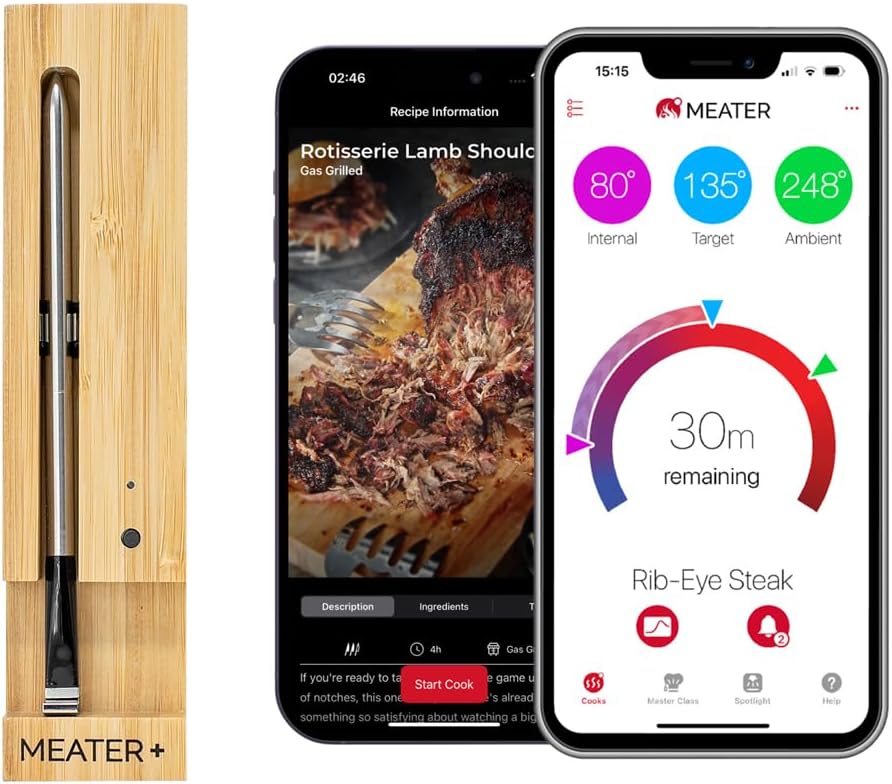 MEATER PlusMeat side: the wire-free probe for roastsCheck price on Amazon
 ThermoPro TP19HMeat side: the instant-read for the final checkCheck price on Amazon
 Polder THM-515Candy side: the long clip-on paddle with printed stagesCheck price on Amazon
 TempPro TP510Candy side: the digital probe with a candy rangeCheck price on Amazon
 OXO Good Grips Glass Candy ThermometerCandy side: the offset glass tube that reads at a glanceCheck price on Amazon
Prices move up and down on Amazon, so we never print a price here that could be stale by the time you read it. Use the price check button to see the current price.
Meat Thermometer vs Candy Thermometer: The Key Differences
Temperature range draws the first line, and it is not where most people expect. Meat targets sit low: the FoodSafety.gov safe minimum internal temperature chart puts poultry at 165°F, ground meats at 160°F, and whole cuts of beef and pork at 145°F with a rest. Sugar stages sit far above that, running from thread at about 230°F through soft ball, firm ball and hard ball, then soft crack and hard crack at about 300°F to 310°F, with caramel beyond. A candy thermometer that starts at 90°F or 100°F cannot judge a rare steak at all, and a meat dial built for roasting may top out before hard crack even begins.
What the probe touches draws the second line. A meat probe is a spike: it goes into the centre of a solid, and its reading is only honest where the tip lands. A candy probe is a resident: it hangs in a liquid from a clip on the pot wall, held off the bottom so it reads the syrup rather than the pan. Swap them and both fail in character. A folding meat pen dipped in syrup gives you a spot reading of a moving target and a hand held over steam. A glass candy tube pushed at a chicken gives you nothing at all, because there is no liquid for it to sit in.
How the reading reaches you is the third line. Meat cooking hides its subject behind an oven door, so the meat side evolved alarms, cables and radios to bring the number out. Candy cooking happens in the open, in front of your face, so the candy side evolved long scales, printed stage names and big digits you can read while stirring. The full framework behind these trade-offs sits in How to Choose a Meat Thermometer.
| Point of difference | Meat thermometer | Candy thermometer |
|---|---|---|
| Working temperatures | Doneness points, roughly 100°F to 220°F | Sugar stages, roughly 230°F to 310°F and beyond |
| Printed range | Commonly -58°F to 572°F on digital models | Commonly 90°F or 100°F to 400°F, 572°F on the digital pick here |
| What it measures | The centre of a solid, where the tip lands | A liquid, held off the pot bottom by a clip |
| How it stays put | Inside the meat, on a cable, wire-free, or held for a spot check | Clipped to the pot wall for the whole cook |
| Guidance on the tool | Doneness alarms and target settings | Sugar stage names printed beside the numbers |
| Alarm | Central to leave-in models | Rare; the cook is already standing there |
| Typical failure | A tip placed against bone or in a fat seam | A bulb resting on the pot bottom, reading the pan |
The six thermometers below put figures on that split. Read the range and stage columns together: they are the comparison in miniature.
| Product | Side | Range | Format | How it stays in place | Stage or target help | Power |
|---|---|---|---|---|---|---|
| ThermoWorks DOT | Meat | -58°F to 572°F | Wired leave-in probe | Probe in the meat, cable to a counter unit | Set target with an alarm | 2 x AAA |
| MEATER Plus | Meat | Meat to 212°F, air to 527°F | Wire-free probe | Inside the meat, no cable | App targets, finish estimate and alarm | Rechargeable probe, AAA in the charger |
| ThermoPro TP19H | Meat | -58°F to 572°F | Folding instant-read | Held in the meat for a spot check | None | 1 x AAA |
| Polder THM-515 | Candy | 90°F to 400°F | Analog paddle with a glass tube | Adjustable clip on the pot | Six printed zones, thread to hard crack plus deep fry | None |
| TempPro TP510 | Candy | -58°F to 572°F | Digital probe | Pot clip on the rim | Candy stage chart printed on the body | 1 x AAA |
| OXO Good Grips Glass Candy Thermometer | Candy | 100°F to 400°F | Glass tube on a steel frame | Extra-long clip on the pot | Candy types and stages printed beside the scale | None |
The Meat Thermometer Options, in Full
Three meat tools that show the family's range: a wired probe that watches a roast for hours, a wire-free probe that removes the cable entirely, and a fast folding pen for the check at the door.
ThermoWorks DOT
The DOT is the meat side reduced to one honest job. A single probe on a 47 inch cable reads from -58°F to 572°F, the cable itself takes 700°F, and the round counter unit shows the current temperature and your target together while it waits. You set that target with two buttons, and the alarm sounds when the centre of the roast arrives, which means the oven door stays shut and the heat stays inside for the whole cook. The housing shrugs off splashes, the battery run is 5,000 hours on two AAA cells, and the full specification sits on the official ThermoWorks DOT product page. Set against any candy pick here, its weakness is range at the top of sugar work and a probe built to spike a solid, not to hang in syrup. Buy it if you roast one centrepiece at a time and want to be called, not to keep checking. Skip it if your cooking is a pot of syrup, where a clip and a printed stage scale serve you better.
Pros
- Probe and 47 inch cable stay in the meat behind a closed door
- Cable rated to 700°F, well past any home oven
- One target, set with two buttons, with a clear alarm
- 5,000 hour battery life on two AAA cells
Cons
- One probe watches one item only
- No remote alerts away from the kitchen
- A spike probe is the wrong shape for liquids
MEATER Plus
The MEATER Plus answers the cable complaint by deleting the cable. One stainless probe carries two sensors, reading the inside of the meat up to 212°F and the air around it up to 527°F, and the numbers travel to a phone app that estimates the finish, counts in the rest and alarms at your target. The bamboo charging block doubles as a signal repeater, stretching the link to 165 feet, and the probe itself is waterproof and goes in the dishwasher. Nothing crosses the oven door seal, which suits rotisserie cooking and anyone tired of routing a cable. The ceilings are the honest cost: surrounding heat past 527°F is out of bounds, and the internal ceiling of 212°F is a meat ceiling, full stop. No setting turns this into a candy tool, because hard crack lives a hundred degrees above where its meat sensor stops. Buy it if you roast at ordinary oven temperatures and want the door seal left alone. Skip it if you sear at extreme heat or cook sugar, where it has nothing to measure.
Pros
- Fully wire-free, nothing crosses the oven door seal
- Reads meat and surrounding air from a single probe
- Charger block doubles as a repeater for 165 feet of range
- Waterproof probe that goes in the dishwasher
Cons
- Internal reading stops at 212°F, far below sugar stages
- Surrounding heat ceiling of 527°F excludes the hottest searing
- One probe watches one item, and the phone is the only display
ThermoPro TP19H
The TP19H is the meat side in its quickest form: a folding pen that reads in about a second, accurate to within 0.9°F, across a range from -58°F to 572°F. The display is backlit and turns to face you in either hand, the body wakes when you pick it up and sleeps when you put it down, and a rinse under the tap is fine thanks to sealing that keeps splashes and running water out. A magnet on the back parks it on the fridge between cooks. In this comparison its range is the interesting part, because 572°F covers every sugar stage on paper. What it lacks is residence: it reads where you hold it, for as long as you hold it, over a pot of steam, and it carries no clip and no stage scale. As a spot check beside a leave-in probe it is superb. As a candy thermometer it is a hand, a guess and a burn risk. Buy it if your meat cooking is steaks, chops and checks at the door. Skip it as your only thermometer if anything you cook needs watching for more than a few seconds.
Pros
- Reads in about a second, accurate to within 0.9°F
- Wide -58°F to 572°F range covers meat and frying alike
- Backlit display that rotates to face the reader
- Wakes and sleeps on motion, sparing its AAA battery
Cons
- Spot checks only, with no clip and no leave-in alarm
- No sugar stages printed anywhere on the tool
- Splash proof rather than fully waterproof
The Candy Thermometer Options, in Full
Three candy tools in three materials: a long printed paddle that clips on and never needs a battery, a digital probe that borrows the meat side's electronics and aims them at syrup, and a glass tube built purely for reading at a glance.
Polder THM-515
The Polder is the candy side in its oldest working shape: a glass tube carried in a long stainless paddle, with the scale printed down the front in Fahrenheit and Celsius from 90°F to 400°F. Six zones are marked where you can see them while you stir, thread, soft ball, hard ball, soft crack and hard crack, plus a deep fry zone, so the recipe's stage name and the syrup's temperature sit in the same glance. An adjustable clip fixes the paddle to the pot wall and slides to suit the depth, an insulated handle keeps your fingers off the hot end, and the whole tool goes on the top rack of the dishwasher afterwards. There is no battery, no alarm and no electronics to protect from steam, and the reading moves at the pace of a liquid column rather than a sensor. Buy it if your candy making is a tall pot, a wooden spoon and a recipe that names its stages. Skip it if you want a number in digits, or if your pots are shallow, because a long paddle needs depth to sit in.
Pros
- Six sugar zones printed on the face, in Fahrenheit and Celsius
- Adjustable clip holds it on the pot for the whole cook
- No battery and no electronics to fail in steam
- Top rack dishwasher safe for sticky clean-ups
Cons
- A liquid column settles more slowly than a digital sensor
- Long body needs a deep pot to sit honestly
- Glass tube wants careful handling and storage
TempPro TP510
The TP510 takes the digital pattern across the aisle. Its stainless probe reads from -58°F to 572°F, accurate to within 0.9°F through the range where sugar and meat both live, and a steel clip holds it on the pot rim so the reading continues while you stir. The display is backlit and pivots 90 degrees to face you, the body carries a printed chart of the candy stages from thread to hard crack, and the sealing shrugs off a rinse under the tap. One detail is worth settling before the table above is read too quickly: the probe is headlined at 10 inches in some places, while the maker's own specification gives 8.1 inches, and 8.1 inches is the figure to plan a pot around. Power is a single AAA cell, which keeps it out of the button battery world entirely. There is no alarm, so the pot still needs your eyes. Buy it if you want one digital tool that clips to a syrup pot today and checks a chicken tomorrow. Skip it if you need to be called from another room, because nothing here calls.
Pros
- Digital reading from -58°F to 572°F, past every sugar stage
- Candy stage chart printed on the body, thread to hard crack
- Pot clip and a backlit display that pivots to face you
- Runs on one AAA battery, with a rinse-clean sealed body
Cons
- No alarm, so the climb still needs watching
- Probe length is 8.1 inches on the maker's specification, not 10
- A spike probe reads meat by spot check only, never leave-in
OXO Good Grips Glass Candy Thermometer
The OXO is built around a single problem: reading a rising column through steam, at speed, without leaning over the pot. Its glass tube sits offset from the steel backing, so the markings can run large, in Fahrenheit and Celsius from 100°F to 400°F, indicating temperature within two degrees. Beside the numbers, the face names the work itself, chocolate melt, thread, firm ball, soft crack, hard crack, caramel and deep fry, printed in red where a cook's eye lands first. An extra-long clip grips the pot and adjusts as you work, a rounded foot keeps the tube off the pot bottom, and the loop at the top takes a utensil to lift the hot tool out safely. It is glass, and it behaves like glass: no drops, no drawer rummaging, and a hand wash rather than a dishwasher cycle. Buy it if you are new to candy and want the stage names large, close and impossible to miss. Skip it if your kitchen breaks glass, or if you need any reading below 100°F or above 400°F.
Pros
- Offset glass tube allows large, easy markings
- Candy types and stages printed in red beside the scale
- Extra-long clip adjusts in and out of the pot
- Indicates temperature within two degrees in both scales
Cons
- Glass construction demands careful handling and storage
- Range stops at 400°F and starts at 100°F
- Hand wash only, and no alarm of any kind
Meat Thermometer vs Candy Thermometer: Pros and Cons Side by Side
Meat thermometers
Pros
- Alarms and radios bring the number out of a closed oven to where you are
- Probes are shaped to find the centre of a solid, the only place doneness lives
- Instant-read models settle a check in about a second, with the door barely open
- Digital ranges start far below freezing, so frozen and chilled food reads too
Cons
- A spike in a liquid reads one spot in a moving syrup, with your hand over steam
- Leave-in cables fray over years of door closings, and probes are wear parts
- Wire-free models cap the meat reading near the boiling point of water
- Nothing on this side prints the sugar stages a candy recipe speaks in
Candy thermometers
Pros
- Clips hold the sensor in the syrup for the whole climb, hands free to stir
- Stage names printed on the tool turn a recipe instruction into a glance
- Analog models need no battery and carry no electronics into the steam
- Long bodies keep hands clear of bubbling sugar and hot oil
Cons
- Scales that start at 90°F or 100°F cannot judge meat below that floor
- Glass tubes break, and a broken tube ends the tool completely
- No alarm on the analog side, so a wandering cook misses the stage
- A flat paddle or tube cannot be pushed into a solid to find its centre
Which Should You Choose
Choose a meat thermometer if a roast, a bird or a joint is the main event
Choose the meat side if the temperature that matters is hiding inside solid food, behind a door, for an hour or more. That job is about residence and alarms: a probe that stays, a number that travels, a call when the centre arrives. The full oven line-up, with multi-probe and WiFi models for bigger cooks, is compared in Best Meat Thermometer for Oven.
Choose a candy thermometer if the holidays mean fudge, brittle and caramel
Choose the candy side if your big cooking season is confectionery: trays of fudge at soft ball, caramels at firm ball, brittle taken to hard crack while the house fills with people. Those recipes name stages, climb fast at the end, and need a sensor that lives in the pot with the stages printed beside it. The Polder and the OXO both answer in exactly those terms, one on a long paddle, one on an offset tube.
Choose a meat thermometer if steaks and chops are checked, not monitored
Choose the instant-read end of the meat side if your cooking is a grill or a pan and the pattern is lid up, probe in, number, lid down. A one second read with a backlit screen, the TP19H pattern, serves that rhythm perfectly, and the same pen spot-checks frying oil or a syrup in a pinch, as long as a hand over the pot for a few seconds is acceptable.
Choose a candy thermometer if you want no battery and no screen
Choose an analog candy pick if the tool you trust is the one that cannot be flat, fogged by a dead display or killed by a splash. The Polder and the OXO both read the moment they are clipped on, store without a thought about charge, and ask only for careful handling in return. For a drawer that is opened twice a year for jam and toffee, that simplicity is the feature.
Choose the digital candy probe if one tool must cover both worlds
Choose the TempPro TP510 if your cooking genuinely splits between the pot and the roast and one purchase has to stretch. Its range covers frozen meat at one end and hard crack at the other, its clip serves the syrup, and its spike serves the spot check. What it will not do is watch a closed oven and call you, so cooks whose roasts run long should treat it as the second tool, not the only one.
What Each Option Costs to Own
Neither family asks for much after the purchase, and the honest differences are about batteries, breakage and one wear part on the meat side. The tier question behind this comparison, whether the simpler or the fancier end of thermometers costs less to run, lands simply: on both sides the running costs stay tiny, and the format, not the price band, decides what little spending there is.
On the meat side, the wired and folding models run on AAA cells that last months to years; the DOT stretches a set to a rated 5,000 hours, so its battery drawer visits are rare. The wire-free pattern swaps loose cells for a charging habit in its block, with one AAA in the charger itself. The real meat side expense is the probe: cables that cross an oven door eventually fray, and a replacement probe is the cost of staying in the leave-in pattern for years. Readers working to a firm ceiling for that pattern should read Best Meat Thermometer Under 20 for what the tight end still buys.
On the candy side, the analog picks cost nothing to run at all, forever, until the day one is dropped, because glass breakage is this family's whole replacement story. Store the tube in its sleeve, wash it by hand where the design asks for that, and it serves for years; knock it off the counter and the replacement is the whole tool. The digital candy pick runs on one AAA cell and asks for a rinse rather than a soak. Across both sides, careful storage is the lifespan lever, and the routines in the setup and care guides for each family are worth the two minutes they take.
Also Considered
- CDN DTC450: a digital candy thermometer with seven preset sugar stages, an 8.25 inch stem and alerts as each stage approaches. It missed the six on the battery screen: its two LR44 button cells sit behind a cover that slides and clicks shut rather than a screw-secured compartment, and the digital place here went to a model running on a single AAA cell instead.
- Taylor 5983N: a 12 inch stainless paddle with a glass insert, an adjustable clip and stage markings from thread to hard crack, reading 100°F to 400°F. It missed the six because the Polder covers the long paddle place with top rack dishwasher care, and the OXO covers the glass place with larger, offset markings.
- MEATER Pro: the wire-free meat probe built for far hotter work, with an internal reading to 221°F and surrounding heat resistance to 1,000°F. It missed the six because the MEATER Plus already carries the wire-free meat place in this comparison, and the Pro's extra heat serves searing rather than the oven and syrup split argued here.
- Escali AHC3: a glass candy thermometer reading 100°F to 392°F, with a protective sheath carrying a sugar stage guide and certification for food service use. It missed the six because its exact Amazon listing could not be verified at the time of checking, and this guide only prints a buy link it can stand behind.
When You Need Both, or Neither
Both is the honest answer for the cook whose year holds a holiday table at both ends: a bird or a ham that needs a leave-in probe and an alarm in the afternoon, and brittle, fudge or caramel that needs a clipped sensor and a stage scale in the evening. The two tools fail in opposite directions, one blind in liquids, the other mute behind a door, so owning both is not duplication. It is coverage. The habits that keep the pair honest are small ones: probe placement learned from How to Set Up Meat Thermometer, and a boiling water check on the candy side before the season starts.
Neither dedicated tool is the answer in one common case: the occasional cook who roasts twice a year and makes candy once. A single wide-range digital probe, the TP510 pattern, covers both jobs at spot-check level, clips to the syrup pot, and asks for no second drawer slot. And if your cooking involves neither roasts nor sugar work, if dinner is pasta, stir-fries and tray bakes judged by eye, then no thermometer on this page earns its place, and the honest purchase is none of them.
Meat Thermometer vs Candy Thermometer: Frequently Asked Questions
What are the key differences between a meat thermometer and a candy thermometer?
Range, residence and guidance. A meat thermometer judges the centre of a solid at doneness points between roughly 100°F and 220°F, and its leave-in models carry alarms because the food hides behind an oven door. A candy thermometer lives clipped in a liquid through sugar stages from about 230°F to 310°F, with the stage names printed beside the numbers and no need for an alarm, because the cook is standing there stirring.
Which costs less to own, a meat thermometer or a candy thermometer?
The candy side, by a small margin, and only on the analog models, which run on nothing at all. Meat thermometers cost a set of AAA cells every year or few years, plus an eventual replacement probe on wired leave-in models. Digital candy models cost the same AAA pattern as the meat side. On both sides the bigger ownership risk is breakage and storage, glass on one side and frayed cables on the other, not consumables.
For holiday candy making alongside the roast, which fits your needs?
Both, doing different shifts. The roast wants a leave-in meat probe with an alarm, because it cooks for hours behind a door while you do everything else. The candy wants a clipped thermometer with the stages in view, because it cooks in minutes in front of you and punishes a turned back. One tool forced into both jobs does one of them badly, and the holiday cook is the reader who feels that compromise first.
Can a candy thermometer replace a meat thermometer, or the other way round?
Halfway, in one direction only. A wide-range digital candy probe can spot-check meat honestly, because its spike and its range both fit the job, though it cannot stay in a closed oven and alarm. A candy paddle or glass tube cannot check meat at all, since there is no liquid for it to sit in, and most meat tools cannot follow syrup properly either, lacking a clip, a stage scale, or in the wire-free case the range itself.
Which lasts longer, a meat thermometer or a candy thermometer?
The one that is stored like an instrument. An analog candy thermometer has nothing electronic to fail and can serve for decades, right up to the drop that breaks its tube. A simple meat pen or wired unit lasts years when its probe is sheathed and its cable is not slammed in doors, while a wire-free probe adds a battery that ages with every charge. On both sides, the drawer decides more than the design does.
Keep Researching This Meat Thermometer
the leave-in probe systems built to live in the oven, with wireless monitoring and multi-probe sets.
Budget BuyingBest Meat Thermometer Under 20the meat shortlist at the tight end of the market, where instant-read pens and one leave-in model sit under the ceiling.
How to ChooseHow to Choose a Meat Thermometerthe full framework for formats, probe counts, heat ratings and alarms before you spend.
Use & CareHow to Set Up Meat Thermometerprobe placement, door seal routing and the checks that make a reading trustworthy.
More in Kitchen & Cookware
Kitchen & CookwareAll Pick Hearth guides in this categoryHow We Check Comparisons Like These
Read the full Pick Hearth methodology- Every figure on both sides was checked against the manufacturer's own specifications: ranges, cable and ambient heat ceilings, probe and stem lengths, clips and battery types were each traced to a maker or listing document recorded for this guide, including the probe length where two published figures disagreed.
- The verdicts rest on the verified split between the families, range, residence and guidance, not on brand or price: a tool that borrows one trait from the other side, as a wide-range instant-read does, is described as a spot check and never stretched into a leave-in or a candy resident.
- No brand can pay for a place, and affiliate earnings never change a verdict: every pick was screened model by model against the CPSC recalls index before ranking, the binding iGrill and Inkbird positions from the sibling guides were carried exactly, and one digital candy model was set aside over its button battery compartment rather than ranked.
First published · Updated in place as products and specs change