Start here: settle the cooking rhythm first, then size the pot to it
Write down your answers to three things before you browse any models at all.
First, when do you decide dinner? If the answer is usually late in the day and you want beans, grains or a tough cut turned around the same evening, you are shopping for pressure speed and you will be present at the start and the finish. If your meals are planned in the morning and cooked while you are out, hold that thought, because the head to head in Pressure Cooker vs Slow Cooker tests whether a slow cooker, or a pressure cooker with a slow cook mode, serves that rhythm better than pressure alone.
Second, how many portions leave the pot on an ordinary night? Write down the usual number, not the holiday number. That figure, run through the fill rules in the size section below, points to one size class and rules out the rest. Most choosing errors in this category are size errors wearing a features costume.
Third, who minds the pot? An electric cooker minds itself: it builds pressure, times the cook and drops to a warm hold without you. A stovetop pot minds nothing: you set the burner, you watch for pressure, you decide when it comes off the heat. Neither answer is wrong, but they lead to different shelves, and swapping later costs more than choosing honestly now.
Four cookers carry the rest of the guide, each standing for one pattern rather than one rung on a ladder.
 Instant Pot DuoPattern: the stainless electric that covers a family week without fussCheck price on Amazon
 Instant Pot Duo MiniPattern: the compact electric sized for one or two peopleCheck price on Amazon
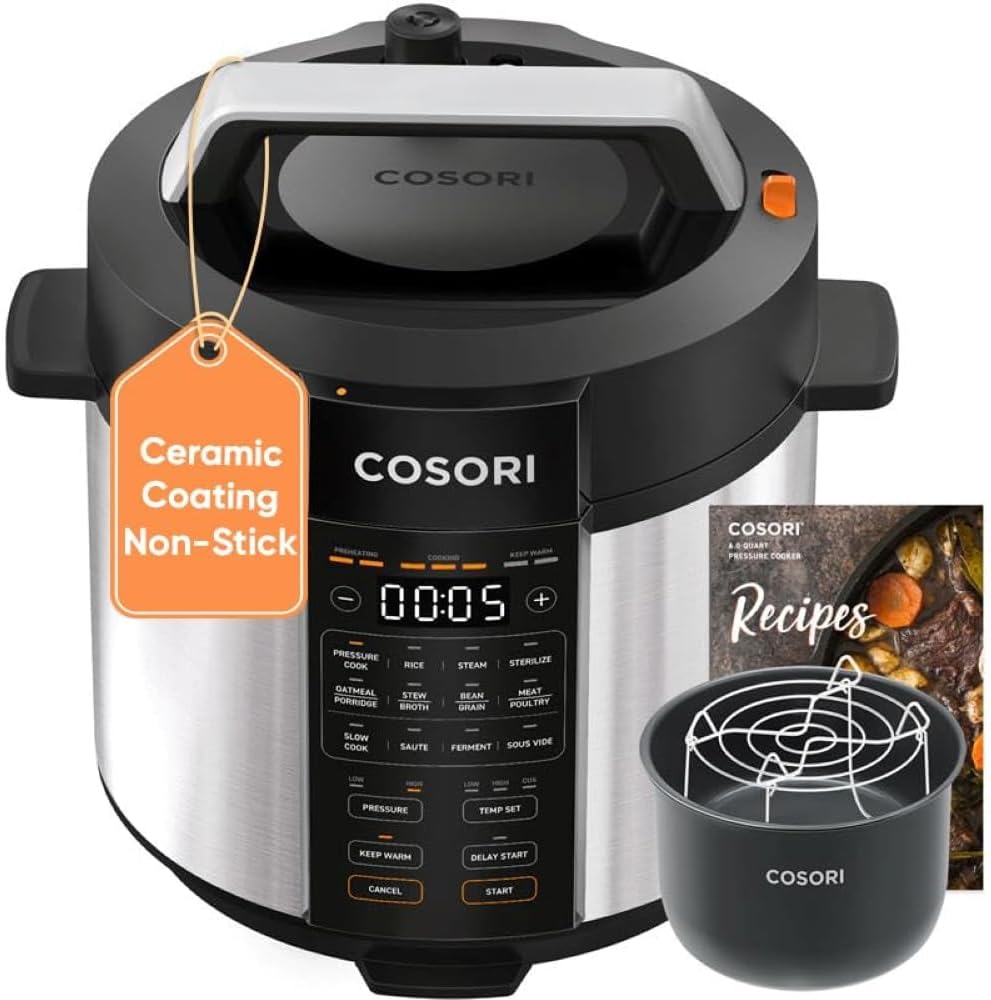 COSORI Pressure CookerPattern: the ceramic pot electric for cooks tired of soakingCheck price on Amazon
 Presto Stainless Steel Pressure CookerPattern: the stovetop pot that trades electronics for longevityCheck price on Amazon
Prices move on Amazon, so we never print one here. Use the price check button to see the current price.
Types of pressure cooker explained: electric, stovetop and multi-function lids
The countertop electric is the default pattern for most homes now. A heating element, a sealed body and a control panel do the whole job: the cooker raises pressure on its own, holds it for the time you set or the program you picked, and then keeps the food warm. Programs for rice, beans, stew and similar staples take the guesswork out of a first year with the format, and a delay timer on some models lets a pot be loaded ahead. The costs of the convenience are footprint, a lid and valve assembly with more parts to wash, and a working life tied to electronics.
The stovetop pot is the older pattern and the simpler object: a heavy pot, a locking lid, a regulator that vents excess pressure, and your burner as the power source. There is nothing to program and nothing electronic to fail, the pot doubles as ordinary cookware in the hands of a confident cook, and a good one can serve for decades with only gaskets and small parts renewed. What you give up is automation. There is no warm hold, no timer, and no program: pressure, timing and release are yours to manage on every cook.
A third group sits on top of the electric pattern rather than beside it: multi-function lids that add a second cooking method, most often crisping, under the same lid that pressure cooks. That extra hardware earns its counter space only when the second method is part of your weekly cooking, finishing chicken skin or gratins in the pot they cooked in. If your pressure cooking ends at stews, beans and grains, the added lid is weight, cost and cleaning you will carry for a feature you rarely open.
Whichever type you lean toward, one safety habit belongs to the choosing stage, not the ownership stage: check any model, and especially any used or renewed one, against the recall record before it enters your kitchen. The CPSC recall of the SharkNinja Foodi OP300 series, recall 25-247, covers the OP300, OP301, OP301A, OP302, OP302BRN, OP302HCN, OP302HAQ, OP302HW, OP302HB, OP305, OP305CO and OP350CO models, whose pressure lids could be opened during use. No cooker from that series belongs on a shortlist, whatever the discount.
Pressure cooker size guide: what size do you need
Quarts on the box describe a pot filled to the brim, and a pressure cooker never works at the brim. Ordinary foods fill to two thirds at most, and grains, beans and anything that foams or swells stop at half full, because the contents need room to move without pushing starch and liquid toward the valve. Your working capacity is therefore smaller than the headline figure, and it is the working figure that has to match your household.
Run your usual dinner through that arithmetic. A 3 quart pot works to about a quart and a half for grains and beans, which suits one or two cups of dry rice and small stews for one or two people. A 6 quart pot, the family standard, works to about 3 quarts for foaming foods and 4 quarts for the rest: a whole chicken with vegetables, a generous stew for four to six, or three to four cups of dry rice with room for the foam to settle. Pots of 8 quarts and above serve batch cooking and stock making, and they punish small dinners: a shallow layer spread across a wide base sits under the liquid level the pot needs to come to pressure, and cooks unevenly for it.
Grains deserve their own line in the calculation, because rice is where size mistakes show up first. Readers whose cooking centres on rice will find the grain by grain version of this maths in Best Pressure Cooker for Rice. Put briefly, choose a size where your usual dry amount sits comfortably below the half mark, and count any extra volume beyond your biggest routine cook as storage space used up rather than useful room.
Pressure cooker materials compared: stainless, ceramic coated and aluminium
The inner pot is the surface your food touches, the part you wash after every cook, and the one component whose material changes your daily routine. Three families cover nearly everything on sale.
Bare stainless steel is the permanence choice. It tolerates metal utensils, goes in the dishwasher, browns well when you sauté before the lid goes on, and has no surface to wear through, so the pot that arrives is effectively the pot you keep. Its honest drawback is grip: rice, oatmeal and starchy sauces hold on to it, and a soak before washing becomes a normal part of the evening rather than an occasional rescue.
A ceramic coated pot answers that grip directly. Cooked grains and beans lift away with a paddle or a cloth, washing is quick, and sticky foods are less likely to catch and scorch at the base. The trade is care and lifespan. You need to stick to wood, silicone or plastic tools with it, avoid abrasive scouring, and accept that once the surface wears out you will need to buy a new pot rather than keep it indefinitely. Choose it when easy release is the thing that will decide whether the cooker gets used weekly.
Aluminium belongs mainly to the stovetop shelf. It is light, heats quickly and evenly, and keeps the classic hob pots inexpensive, and in hard anodised form it resists staining and reaction with acidic foods. Plain aluminium does not work on induction burners, it can dull in a dishwasher, and it will never have the shrug it off durability of steel. On a gas or electric hob, for a cook who hand washes, those are mild prices for a pot that costs little and lasts.
Lid and body materials matter less. Stainless bodies wipe clean and shrug off knocks; the parts that decide sealing life are the silicone ring and the valve assembly, and both are consumables on every design in this guide.
Pressure cooker features that actually matter: release, keep warm and pressure bands
Steam release is the feature you will feel in your hand, so judge it before the program list. The simplest design is a valve you turn yourself, which works well and asks for a hand kept clear of the jet. A switch set away from the vent, a diffusing cover, or a vent angled backward all put distance between your fingers and the steam, and that distance matters most after foamy foods, when the release carries starch with it. Fully automatic release, where the cooker vents on its own at the end of a program, removes the moment entirely and belongs to the guided end of the market.
Keep warm decides whether the cooker fits evenings that do not run to a timetable. On electric models it switches on by itself when cooking ends and holds the pot ready for serving. Treat it as a bridge to the table, not a cupboard: food waiting to be served belongs at 140 degrees Fahrenheit or above, and leftovers belong in the fridge within 2 hours, the limits set out in the FoodSafety.gov guidance on serving and storing cooked food. Stovetop pots offer no hold at all, so their owners serve when the food rests, which suits households that eat together and frustrates households that drift in.
Pressure choice is the third feature with real consequences. A lot of electric models provide two pressure ranges, a softer low range for eggs, vegetables and fragile grains and a stronger high range for beans and dense cuts. Finer control, a spread of selectable levels, helps cooks who move between fragile and stubborn foods in the same week. A single well chosen band covers a household whose pressure cooking is mostly stews and beans, and extra levels add panel complexity without adding dinners.
Everything beyond those three is proportion. A delay timer earns its place if loading ahead is a genuine routine. Sauté inside the pot earns its place if you brown before you seal, which most stew cooks do. Yogurt, cake and sous vide programs earn theirs only in kitchens that will actually run them. Count the programs you would use in a month, and let that count, not the total on the box, guide you.
Pressure cooker specifications and jargon explained: psi, fill lines and natural release
Psi is pounds per square inch, the unit pressure is measured in, and it explains why pressure cooking is fast: raised pressure lifts the boiling point of the liquid inside, so food cooks hotter than an open pot can manage. Electric cookers commonly work in a band rather than at a single figure. The COSORI in the worked examples, for instance, works between 5.1 and 8 psi on its low setting and between 9.4 and 12.3 psi on high. Stovetop regulators hold their own set pressure on the burner. For choosing, the band matters more than the peak: a cooker with a genuinely gentle low end handles delicate foods better than one whose only talent is maximum pressure.
Fill lines are the markings inside the pot, and they are working limits rather than suggestions. Two thirds is the ceiling for most foods, half is the ceiling for grains, beans and foaming dishes, and the minimum liquid line matters too, because a pressure cooker needs enough water to make steam. A pot cooked below its minimum will struggle to seal and may scorch at the base.
Release language confuses first time buyers more than any other term. Quick release means venting the steam at once when cooking ends, which suits vegetables and delicate foods that overcook in minutes. Natural release means leaving the pot alone while pressure falls slowly on its own, which suits beans, grains and foamy dishes, because a sudden vent pulls starch toward the valve. Many cooks use a middle path for rice and beans: a short natural rest, then venting whatever pressure remains.
Wattage on an electric cooker, roughly 700 watts on a compact pot and 1000 to 1200 watts on a family size one, mainly decides how quickly the pot reaches pressure. It does not change what the food tastes like once pressure is reached. Sealing ring, float valve and anti block shield are the small parts named in manuals: the ring makes the seal, the float shows whether pressure is inside, and the shield keeps food particles away from the vent. All three need a rinse and a check as part of ordinary care.
What to measure and check before you buy
- Measure the counter depth and the space above it: note the depth of the counter where the cooker will live and the height to the underside of the wall cabinets above that spot. You need clearance above for the lid to open, and an unobstructed path for steam that does not blast a cabinet front, so a cooker stored under a low cabinet must be moved forward each time you vent it. If that shuffle would annoy you weekly, plan the spot before you plan the model.
- Match quart size to a real portion, on paper: write down your ordinary dinner in portions and your ordinary dry rice or bean measure, then apply the fill rules: two thirds for ordinary foods, half for grains and foaming dishes. Four portions most nights points to the 6 quart class; dinner for one or two points to 3 or 4 quarts; a pot bought for a crowd will cook your Tuesday dinner badly.
- Walk the washing route: carry a full size saucepan from the counter to your sink and back, and picture the inner pot on that route after a stew. Check whether the pot you are considering is dishwasher safe or hand wash, whether the lid has parts that come apart for rinsing, and whether your sink fits the pot flat. A pot that is awkward to wash gets washed reluctantly, and seals suffer for it.
- Check the burner if a stovetop pattern tempts you: measure your most used burner and compare it with the base of the pot. A base that overhangs a small burner heats unevenly, and an aluminium pot will not work at all on an induction hob, so confirm hob compatibility by material before a stovetop cooker makes your shortlist.
- Price the wear parts before the cooker: look up a spare sealing ring and, for a coated design, a replacement inner pot for any model you are close to buying. Expect to buy a replacement ring every year or two with regular use, at modest cost; if no spares are sold for a model, a worn ring can force you to replace the whole cooker.
- Run the used buying check: if a second hand or renewed cooker is in play, read its model number off the label and check it against the CPSC recalls and product safety warnings index before you pay anything. In this category the two checks that matter most are the OP300 series and the Sensio made Bella, Bella Pro, Crux and Cooks lines named in the CPSC notice for the Sensio pressure cookers, and a recalled model stays recalled no matter who owns it now.
The framework applied: four worked examples
Instant Pot Duo
Start the framework at its most travelled point. This is a 6 quart electric cooker with a bare stainless inner pot, seven functions that include pressure cooking, rice, slow cooking, sautéing, steaming and yogurt, and thirteen customisable programs behind the panel. At 1000 watts it reaches pressure at the pace a family dinner expects, and a warm hold starts on its own when a cycle ends, which covers the half hour when the rest of the meal is still catching up. For the choosing framework, its lesson is allocation: the money sits in the pot and the element rather than in guidance, so you judge your own times for anything beyond the named programs. Brown rice, for example, runs on the single rice program with the time adjusted by hand. You open the steam release by turning a valve by hand, the single step in each cook that calls for close attention.
Pros
- Stainless inner pot with no coating to protect or replace
- Rice function and an automatic warm hold in a 6 quart body
- Seven functions cover the ordinary family week
- Inner pot and lid components are dishwasher safe
Cons
- Only one rice setting, so brown rice requires a manually adjusted time
- Manual valve asks for a careful hand at the release
- 6 quarts is more pot than a one cup rice cook needs
Choose this pattern if your household cooks for four to six most nights, you want one electric cooker that handles the week without an app or a learning project, and a pot that never needs replacing matters more than extra programs.
Check price on AmazonInstant Pot Duo Mini
Shrink the same framework and a different virtue appears: depth. Spread one or two cups of dry rice across a 6 quart base and the layer runs thin and catches at the edges, while in this 3 quart pot the same amount sits at a depth where the water line is easy to judge and the grains cook evenly. The design carries the same seven functions, a dedicated rice program among them, and eleven smart programs, scaled to a 700 watt element matched to the smaller pot. Portions suit as many as three people, the stainless inner pot uses a tri-ply base for even sautéing before you seal it, and weighing 8.65 lb at about 10 inches tall it fits into cupboards too small for a family sized body. For a beginner cook working alone, that combination of a small pot and a named rice program removes the two errors that spoil first attempts: too much pot and a guessed time.
Pros
- 3 quart pot gives small portions the depth they need
- Rice program and warm hold in a body about 10 inches tall
- Stainless pot with a tri-ply base for even sautéing
- Light enough at 8.65 lb to move and store easily
Cons
- Cooks for three people at most
- 700 watts reaches pressure more slowly than family models
- Fills quickly once grains stop at the half line
Choose this pattern if you mostly make meals for one or two, cupboard space is short, and your normal servings would be dwarfed by a family sized pot, or you would like a smaller second cooker for rice and sides alongside a larger one.
Check price on AmazonCOSORI Pressure Cooker
This pattern spends its design effort on the two moments stainless owners grumble about: the soak after dinner and the jet of steam at the end. Inside, the 6 quart pot has a ceramic coating, so rice, beans and oatmeal come away cleanly without a long soak beforehand. The release vent is set at a backward angle of 30 degrees, pointing away from the hand operating it, and the seal control is placed apart from the valve itself, a layout described alongside the lid lock on the official COSORI pressure cooker page. Low pressure covers 5.1 to 8 psi and high pressure covers 9.4 to 12.3 psi, which lets a fragile grain cook at a softer setting than a batch of beans. Its program list is broad, with rice, steam, oatmeal and porridge, bean and grain, slow cook, sauté, ferment and sous vide among its programs, it draws 1100 watts, and it carries a 2 year limited warranty. No count of safety features is printed here, because the honest choosing facts are the concrete ones: the lock, the angled vent and the warranty term.
Pros
- Ceramic coated pot releases grains and beans without soaking
- Release vent angled away from the hand that works it
- Two pressure bands, gentle and firm, in one cooker
- 2 year limited warranty
Cons
- Use only wood, silicone or plastic utensils with the coating
- A replacement pot is a future cost stainless never charges
- Wide program list takes a few cooks to learn
Choose this pattern if scrubbing stuck pots is the chore that puts you off pressure cooking, you cook sticky grains and beans often, and you are content to trade a permanent pot for an easy washing up.
Check price on AmazonPresto Stainless Steel Pressure Cooker
Remove the element, the panel and the programs, and what remains is the oldest pattern in the guide: a 6 quart stainless pot that builds pressure on your burner, holds it with an automatic regulator, and leaves timing and release entirely to you. In exchange for that attention it offers things no electric here can match. Its tri-clad base suits gas, electric and induction burners, an indicator for the cover lock lets you see the lid state quickly, the included cooking rack lets a small dish sit above a stew, the pot is dishwasher safe, and it carries a 12 year limited warranty. At 6.6 lb it stores like the saucepan it resembles and needs no counter at all. Its limits are the pattern's limits, stated plainly: there is no rice program, no timer and no warm hold, so rice is cooked by your own timing and served when it has rested.
Pros
- Tri-clad stainless base is compatible with gas, electric and induction
- 12 year limited warranty, the longest warranty term in this guide
- Cooking rack included for a dish cooked above the main pot
- At 6.6 lb it is saucepan weight and lives in a cupboard
Cons
- No warm hold, timer or rice program of any kind
- Burner control and timing are entirely your job
- First attempts can catch at the base while you learn your hob
Choose this pattern if you enjoy cooking by feel, you want a pot that outlasts trends and works on any burner including induction, and your household serves food when it is ready rather than holding it warm.
Check price on AmazonPressure cooker price ranges explained
Spending here tends to fall across four areas in much the same sequence each time: format, pot material, guidance and extras. Format comes first because a stovetop pot is steel, a regulator and a gasket, while an electric adds an element, a sealed body and a control panel, so electrics sit higher as a group before any feature is counted. Pot material comes second: a stainless pot costs more to make and nothing to replace, while a coated pot costs less at the till and carries a replacement date.
Guidance is where the middle and upper bands separate. A named rice or bean program is inexpensive to provide. Saved settings, selectable pressure levels, automatic release and, at the top, a built in scale with guided recipes each add hardware and software, and each is worth paying for only when it solves a failure you actually have: scorched layers, soupy grains, or timings you can never repeat. Extras come last. Adding another way of cooking under one lid costs about as much as the separate appliance it stands in for, which is essentially its role.
Readers who fix the ceiling before they shop will find the band worked model by model in Best Pressure Cooker Under 100. The order of spending this guide recommends does not change with the budget: size and type first, because a cooker that fits your portions and your rhythm is the right cooker at any price, then the release design and the pot material, and only then guidance and extras. If money has to come out, take it from the end of that list.
Common mistakes when choosing a pressure cooker
- Reading the quart figure as the cooking capacity: the brim is not the working line. Ordinary foods stop at two thirds and grains and beans at half, so a household that needs a large finished stew needs a larger pot than the box number first suggests.
- Buying a family pot for a small household: a single cup of rice in a large, mostly empty pot forms too thin a layer, calls for more liquid than the grain needs, and burns around the rim. Match the pot to the portions you cook most weeks.
- Skipping the model check on a bargain: a renewed cooker from a recalled line is a false saving, however cheap the listing. Check the model number against the CPSC notices, the OP300 series above all, before any second hand cooker comes home with you.
- Choosing a coated pot for a metal utensil kitchen: steel spoons will gradually damage a coated surface. If your cooking stirs with metal, buy a bare stainless pot and accept the soak after starchy foods.
- Venting a foamy pot the moment it beeps: beans, grains and porridge carry starch toward the valve on a sudden release. A short natural rest first is the routine these foods expect, and it keeps the lid and the counter clean.
- Counting programs instead of evenings: fourteen functions do not cook a stew better than seven. The type, the size, the pot material and the release decide your results; the yogurt program decides nothing.
Pressure Cooker: Frequently Asked Questions
What questions should I ask before buying a pressure cooker?
Ask six, in the order this guide uses them. Do I want the cooker to mind itself, or am I content to run a pot on the burner? What portions do I cook most weeks, read against the half and two thirds fill lines? Which pot material matches how I stir and wash? How does the steam release work, and where will that steam go in my kitchen? Do I need a warm hold for the way my evenings run? And is the exact model clear of any recall notice?
What size pressure cooker do you need?
Work from portions and fill lines, not from the brim. One or two people, cooking a cup or two of dry rice and small stews, fit the 3 to 4 quart class. For households of four to six, the 6 to 6.5 quart class is the usual fit, holding three to four cups of dry rice within the half fill limit. Pots of 8 quarts and above suit deliberate batch cooking and stock, and they cook small dinners poorly.
What types of pressure cooker are there?
Two main types, plus a variation. Stovetop models reach pressure over a burner, leaving timing, heat adjustment and venting to the cook. Electric cookers build and hold pressure themselves, run named programs, and drop to a warm hold when cooking ends. The variation is the multi-function electric whose single lid adds a second method such as crisping on top of pressure cooking, worth its cost only when that second method is part of your weekly cooking.
Which pressure cooker features actually matter?
Start with how steam is released, since your hand is there at the finish of every cook: a valve positioned clear of the steam, a diffusing cover or automatic venting all avoid having to lean over an open jet. Next, whether the warm hold suits how your evenings run. A gentle low pressure band third, if you cook delicate foods alongside beans and tough cuts. After those, a delay timer and an in pot sauté function help households that genuinely use them, and the rest of the program list is decoration.
How do pressure cooker pot materials compare?
Bare stainless tolerates any utensil, browns well and never needs replacing, and in exchange starchy foods stick and a soak becomes routine. A ceramic coating releases grains and beans cleanly and washes quickly, and in exchange it asks for gentle utensils and carries a replacement cost when it wears. Aluminium, mostly on stovetop pots, is light, quick to heat and inexpensive, and it does not work on induction in its plain form and prefers hand washing.
What do pressure cooker price ranges buy you?
The lower band buys the core job done properly: a stovetop pot with a regulator and a long warranty, or a plain electric with named programs, a warm hold and a stainless or basic coated pot. The middle band buys refinement: selectable pressure bands, a switch release set away from the steam, saved settings and better pots. The upper band buys guidance and second methods: automatic release, sensors, a built in scale, or crisping under the same lid. No band buys a different answer to the size question, so settle that first at every level.
What do pressure cooker specifications and jargon mean?
Psi measures the pressure inside the pot, and a higher figure means a higher cooking temperature. Fill lines mark the working ceilings, two thirds for most foods and half for grains, beans and foaming dishes. Quick release vents steam at once for delicate foods; natural release lets pressure fall slowly, which suits beans and grains. Wattage on an electric model mainly sets how fast the pot reaches pressure. A sealing ring makes the lid seal, and a float valve shows whether pressure is still inside.
Keep researching this pressure cooker
the shortlist judged on grain texture, rice programs and pot materials, for households where rice is the main event.
Budget BuyingBest Pressure Cooker Under 100what you can still get under a firm ceiling, worked through model by model, for buyers who fix their spending limit first.
ComparisonPressure Cooker vs Slow Cookersealed speed against all day patience, for readers deciding which rhythm their dinners actually follow.
Use & CareHow to Maintain a Pressure Cookerkeeping the seal sound: washing rings and lids, clearing the release valves and spotting a gasket that is giving up.
More in Kitchen & Cookware
Kitchen & CookwareAll Pick Hearth guides in this categoryHow we check buying guides like these
Read the full Pick Hearth methodology- Every limit in this framework is tied to the source named next to it: the fill ceilings and release habits come from how pressure pots are built to work, the holding and leftover limits follow the FoodSafety.gov guidance linked in the features section, and the recall model lists were read in full on the CPSC notices linked above.
- Each worked example was matched back to its verified record in the earlier Pick Hearth pressure cooker guides: capacities, pressure bands, pot materials, wattages and warranty terms in the four cards are the figures those records hold, with no safety feature count printed for the ceramic pot example where the maker's own materials disagree.
- No maker can buy a pattern a place in this framework, and what Pick Hearth earns when a reader buys through a link never alters which patterns are taught or which cookers illustrate them: the same four patterns would stand if entirely different brands had built the examples.
First published · Updated in place as products and specs change